It was a Tuesday night and Maria was brewing up a cup of coffee beside her laptop as, she opened her first Fidelity account. She had finally saved enough funds to seriously invest and she wanted to take the safest and the boring thing, which is to invest in an Index Fund. An index fund isn’t really about picking winners as it’s about being a basket of stocks that tracks a market index such as the S&P 500.
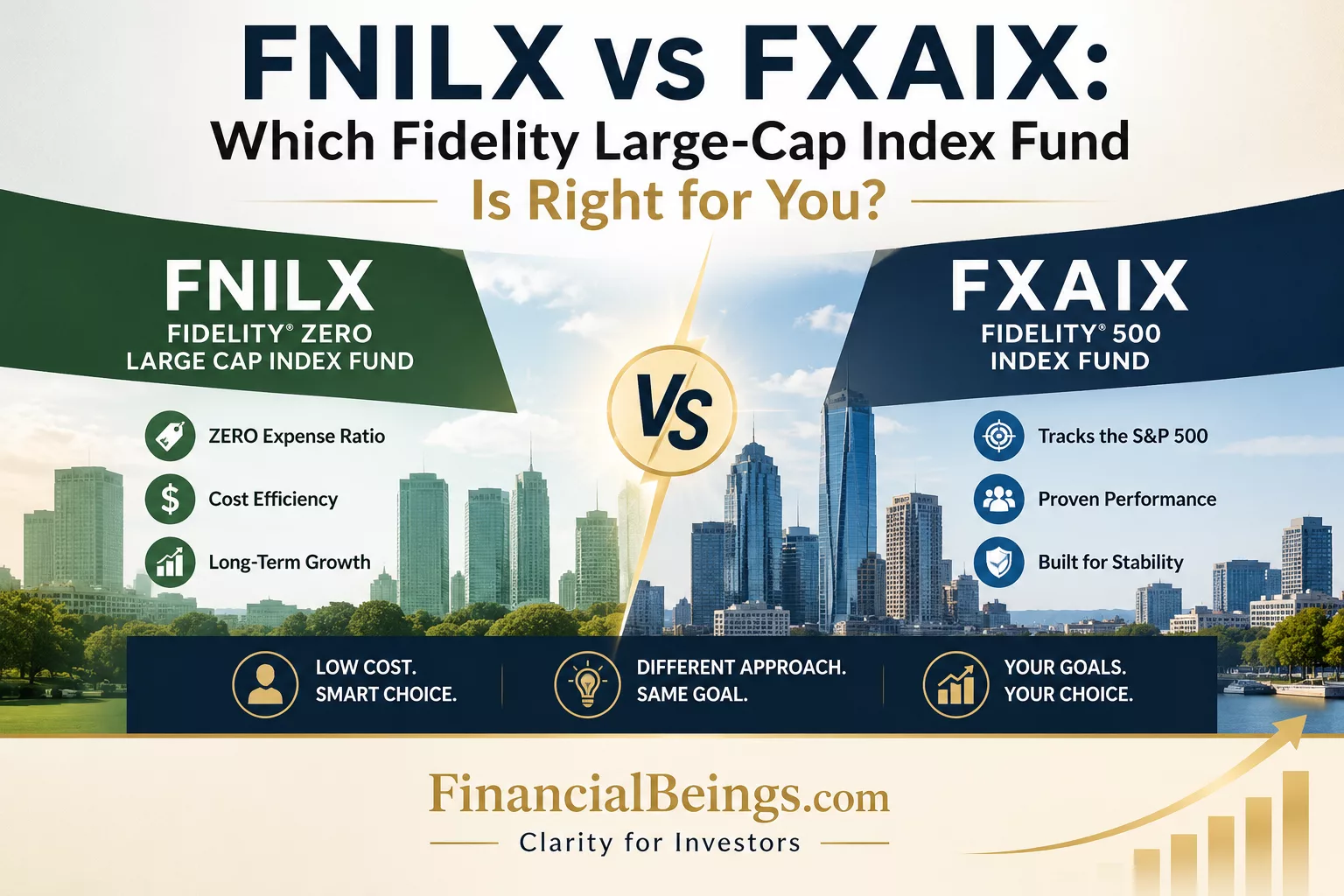
Simple enough. Until she entered “S&P 500 index fund” into the search bar at the Fidelity website, and received two search results: FNILX and FXAIX.
Same company and Same idea, this is nearly the same price. She looked at the screen and her mind went into that peculiar modern way of thinking – the one where a choice looks small but you’re not totally sure it is, and you don’t want to find out you guessed wrong five years from now.
The good news is that, it’s not exactly a guess. You should only have to make this decision, knowing what the difference is between FNILX vs FXAIX in the first place. Though it’s not the point of focus for the majority of comparison articles
The Short Answer, Before We Get Into It
Here’s the short version if you are wondering what the difference is between FNILX and FXAIX. In a retirement account, a Roth IRA, traditional IRA or 401(k), has a slight advantage as there is no fee at all. If it’s a regular taxable brokerage account, or if you might want to switch brokers at any point, FXAIX is the better option. This is because FXAIX can “walk with you” and FNILX can’t.
What You’re Actually Buying: Nearly the Same Portfolio
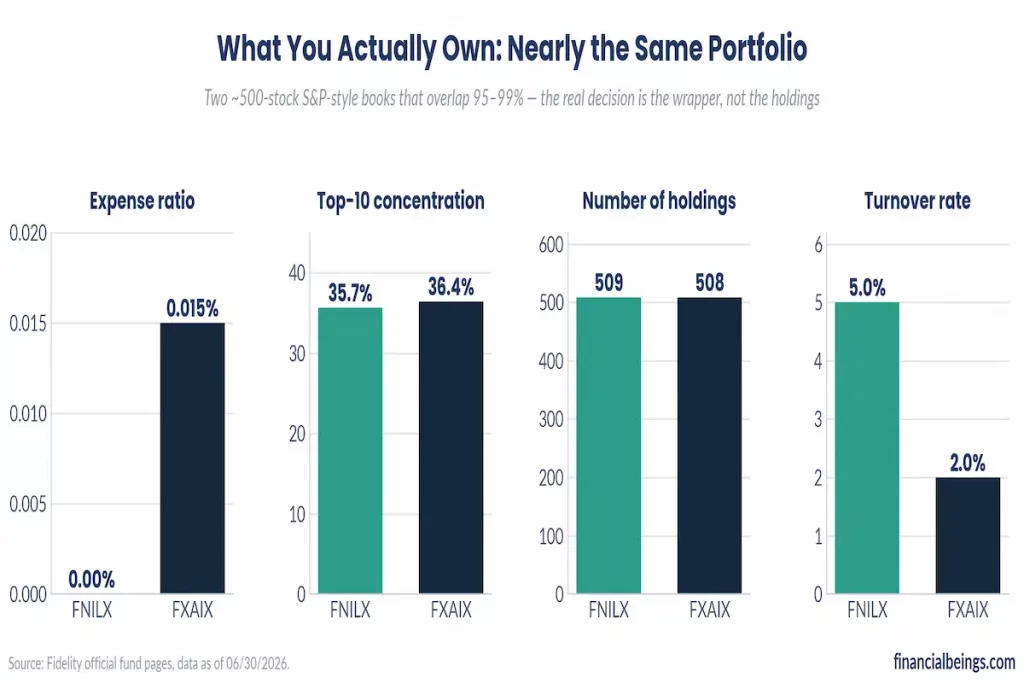
What most people don’t know is that these two funds own almost the same stocks.
They have about 500 of the largest companies in the U.S. At the top are familiar names, Nvidia, Apple, Microsoft, Amazon, Alphabet. The top ten holdings in both funds account for approximately 36% of the holdings. At almost 38% of the total, technology is the biggest sector in both. Independent estimation of the overlap between the two portfolios has been in the range of 95-99%.
When people ask ‘FNILX vs FXAIX, which one will perform better’, they are asking the wrong question. Two containers have nearly the same contents The real differences are in the fine print, the rules each fund follows, and what happens if you ever want to move your money somewhere else.
Two Funds, Two Different Rulebooks
The S&P 500 is the benchmark managed by S&P Dow Jones Indices, and is tracked by FXAIX. A company must meet a profitability test to be allowed to join the S&P 500; that is, it must have made a profit in the previous four quarters, plus a few other things.
The Fidelity U.S. Large Cap Index, which Fidelity created and operates, is what FNILX tracks. It also targets about the 500 largest U.S. companies, without the need to also meet a profitability criterion.
In reality, that translates to a large, noisy, but still unprofitable business getting one bit closer to getting into the stocks, on average, than the S&P 500. It’s a minor adjustment, and if the portfolios are so similar, it doesn’t make a huge difference.
Why FNILX Is Free (Yes, Really Free)
A 0% fee always gives people the creeps and that’s a good thing since if it’s free you are the product. How does Fidelity do it?
Two ways. It avoids paying a licensing fee, which is pretty much standard with all other S&P 500 funds, by using its own index instead of the S&P 500’s name. Second, FNILX has lent out some of its stock holdings to other investors and banks, which it retains the income generated from, as is common with index funds. And that’s clearly stated in the fund’s prospectus.
The fund’s expenses are met by those two streams of revenue. And the proof is in the numbers: since it launched, FNILX has actually landed about 1 basis point (0.01%) ahead of its own benchmark, on average, per year. But those “zero fee” tags are not bait and switch either.
One Detail Almost Nobody Mentions: Who’s Actually Picking the Stocks
Maria delved into: there isn’t some group of Fidelity stock-pickers running each of the two funds. Both FNILX and FXAIX have an identical day-to-day management team, run on identical system, Geode Capital Management. Since it was launched in 2003, Geode has organised FXAIX and since 2018 FNILX. Don’t think the “free” fund is some “cheap cousin”. It’s handcrafted by the same artisans. 0
Performance: Does the Difference Actually Matter?
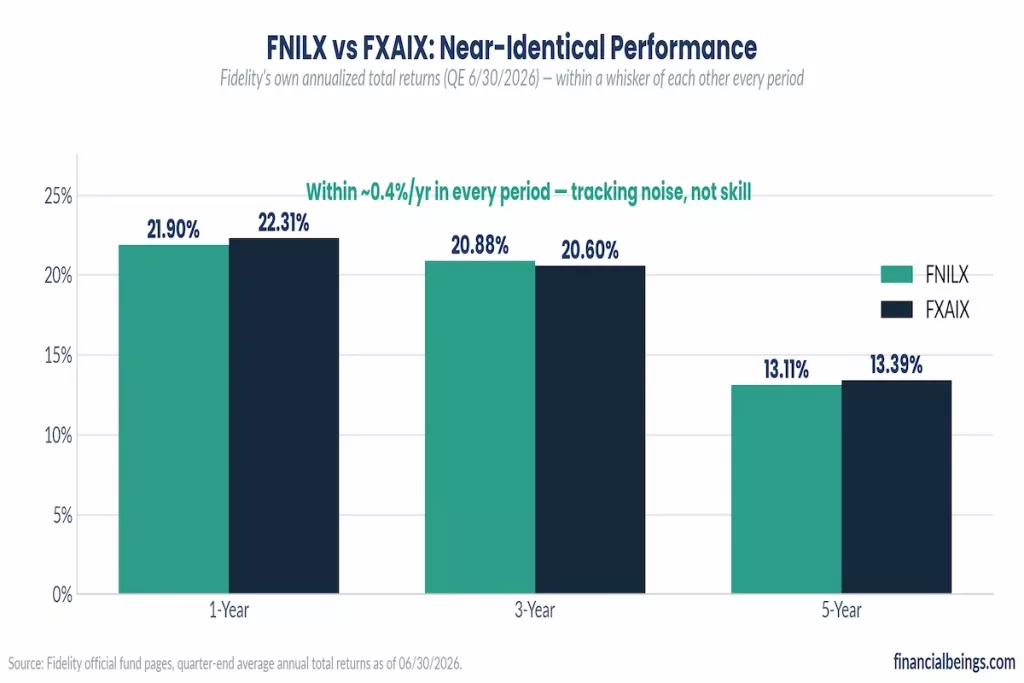
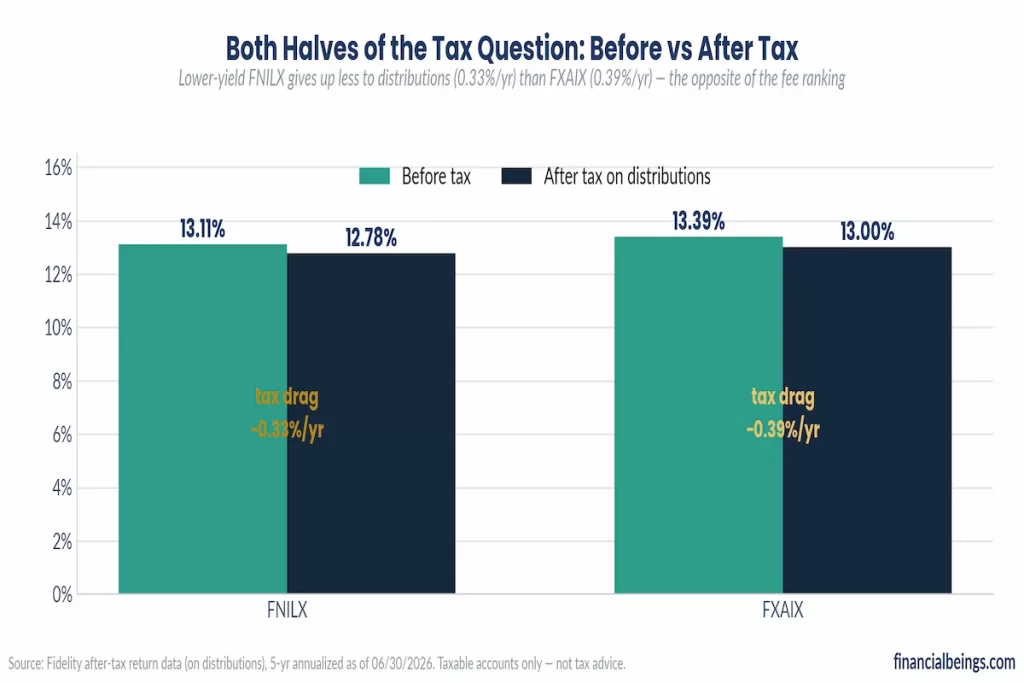
Over the past year, the FXAIX returned +22.31%, over three years it was +20.60% annualized and over five years it was +13.39% annualized. FNILX returned 21.90%, 20.88%, and 13.11% over those same stretches.
Pay attention to this: FXAIX does not win during every period. Actually, FNILX jumped ahead more than three years. There is no year in which the difference between them is more than about 4-tenth of one percent. That’s not a smarter fund, it’s two very similar funds that are just a little bit apart because of minimal differences in their rules, and the normal minute-by-minute tracking noise, the slight wobble between a fund’s return and the benchmark’s return.
One disclaimer: Since 1988, FXAIX has existed. It has survived the dot com bubble, financial crisis 2008, and pandemic crash 2020. FNILX is a relatively new index that wasn’t put into practice until 2018 and has never experienced an actual extended bear market. It’s not a negative for FNILX (returns are quite good so far) but it is just that FXAIX has more history behind it.
The Fee Gap That Barely Matters
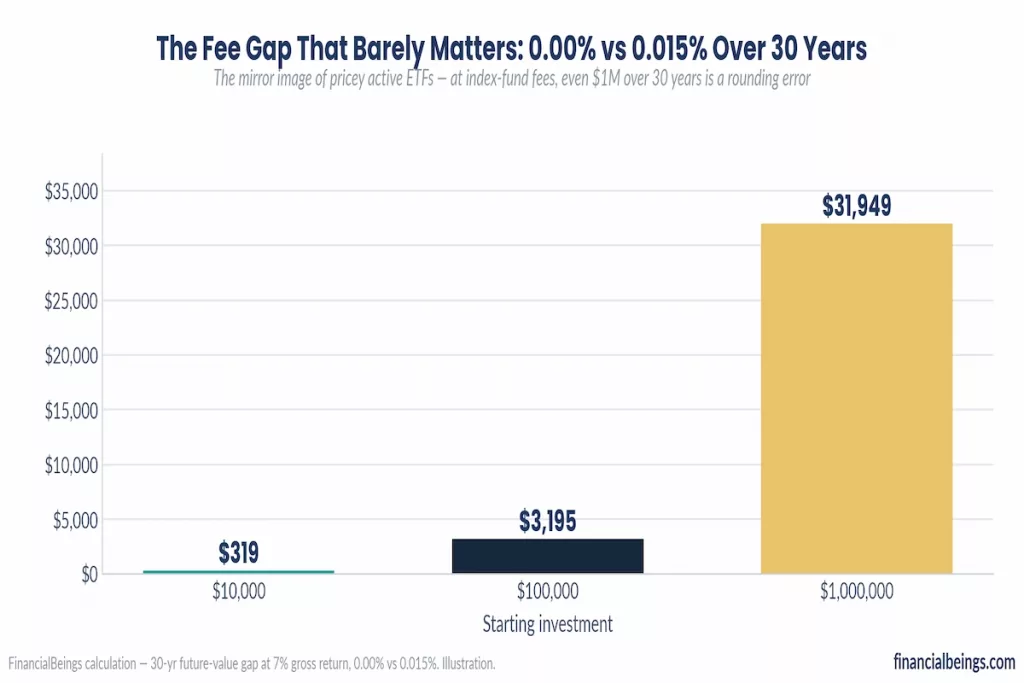
The obvious thing to say is that no one wants to pay 0.00% or 0.015%, etc. for either of them. Technically true. Practically? It’s near futile.
Do the math: 0.015% on a $10,000 investment is $1.50 a year. That’s it.
On a $10,000 investment, this difference between the two funds is only about $319 over 30 years of compounding at a typical market return, and about $3,195 over 30 years of compounding at a typical market return on a $100,000 investment, and about $31,949 over 30 years of compounding at a typical market return on a $1 million investment. That last number seems high when you consider it’s over three decades of years and a seven-figure account.
The point isn’t that fees are never important they are certainly a sucker punch to your returns over the long haul of investing. The reason this particular fee difference is a rounding error, is that both of these funds are almost fee-free. People who select an option based on the 0.015% are looking at the wrong number.
The Decision That Actually Matters: What Kind of Account You’re Using
It’s at this point, and not the performance or fees, that FXAIX vs FNILX comes down to where the money is.
Inside a Roth IRA or 401(k): Slight Edge to FNILX
Within a retirement account, distributions do not occur year-by-year, and you cannot even access FNILX to another brokerage, since the two negatives don’t exist here. Which means that the only difference is the expense ratio, and FNILX is the winner. It is small, just a dollar and a half per $10,000, but it’s free money, take it.
Inside a Taxable Account: Edge to FXAIX (With a Caveat)
In a regular, taxable brokerage account, it’s a different story at least in part thanks to something called portability. The turnover at FXAIX is lower as well and they have a lot more assets who can back them up.
The truth is, however, that if you’re looking after pure tax efficiency, you can in fact outperform both of these mutual funds with an S&P 500 ETF such as Vanguard’s VOO or iShares’ IVV. Unlike neither FNILX nor FXAIX, ETFs can redeem their built-up gains in what is known as an “in-kind redemption”. When it comes to reducing your taxable distributions, you might just as well say neither one or two pick an ETF instead. Not sure why that matters? Here’s a full breakdown of stocks vs ETFs and how each structure behaves differently.
The Portability “Lock-In Tax” – the Part That Really Should Be the Headline
That’s the nitty-gritty that most comparison articles only include in a footnote, but is the most important.
No one can leave Fidelity, not even FNILX. It’s based on Fidelity’s proprietary index, so no other brokerage will offer it. You cannot move in kind (that is, move over without any changes) it to Schwab, Vanguard or anywhere else.
This same portability question comes up with Vanguard funds too — see our VTSAX vs VOO comparison for how that trade-off plays out there. Selling FNILX will be the first step when you decide to change brokers. In a taxable account, selling equates to a gain being realized and tax being due on the gain.
Let’s make this real; in another tab, Maria opened a calculator. If you have $100,000 in a taxable account with only $40,000 being profit, what happens to the rest? If you have $100,000 in a taxable account and $40,000 of that is profit, what happens to the other $60,000? If you wanted to change brokers, you would need to sell and incur long-term capital gains tax on the $40,000. At a 15% rate, that’s about $6,000. At 20%, it’s $8,000. Add the net investment income tax of 3.8% for some higher income earners, and it’s about $9,520.
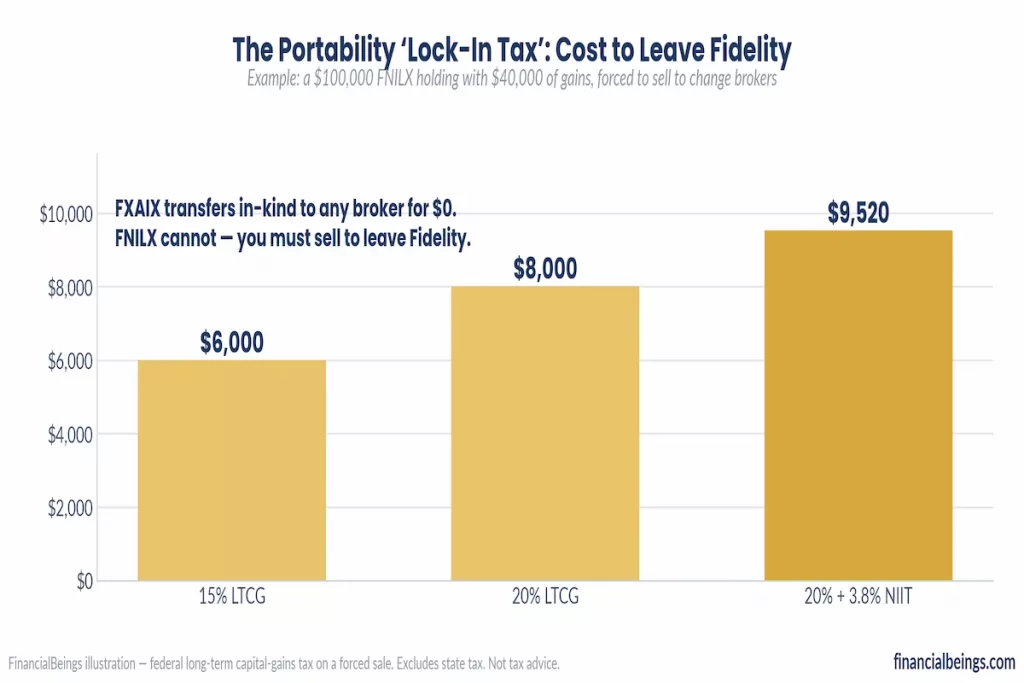
Changing platforms is a real bill with thousands of dollars just to change. However, FXAIX enters into transfer in kind with nearly all brokers, and offers no forced sale or any tax implications. If you have any hope of using that flexibility someday it is worth much more than FNILX’s $50 savings per $10,000.
Dividends and Taxes, in Plain Terms
There are two funds that pay dividends at different times. FXAIX is paid quarterly (at the end of April, July, October and December). The annual payout, which is paid once a year in December, is lower with FNILX at just a bit less than 1%, or 0.9% compared to FXAIX’s 1.0%.
For those who are reinvesting dividends to grow, FXAIX does this a bit more frequently on a quarterly basis. When you are retired and are relying on dividend income, it’s easier to get monthly payments instead of a lump sum payment once a year. If dividend income is your main goal rather than index tracking, you might also want to look at our list of best dividend stocks to buy directly.
There are two things to know about taxes. First, FNILX’s after-tax return on its distributions over a five-year period is slightly lower than that of FXAIX, according to Fidelity’s data (0.33% versus 0.39% per year, respectively, over the past five years), and that is primarily because it distributes a bit less.
Secondly, both funds have not been dishing out significant capital-gains payments to their taxable investors. The only dividend FNILX has ever paid is an $0.011 per share dividend in 2018. It’s been a while since FXAIX was released, since 2019. They’re both extremely clean in terms of taxes for a mutual fund – even more so than a cleaner ETF.
Should You Switch or Even Hold Both?
But, do you need to change your position from one to another? Within an IRA, sure, if you wish to cut that final sliver from the fee; there is no tax consequence for moving to an IRA. Typically it is not advantageous in a taxable account. You would be making a return today, and paying taxes on that return now, rather than saving about a dollar-fifty per $10,000 of additional income a year. Maths doesn’t always work out.
Can you hold both? Yes and, since they track slightly different indexes, some investors use FNILX and FXAIX together for tax-loss harvesting: selling one less to get a tax loss and then promptly buying the other to remain invested in the same market. With two S&P-style funds, however, be careful with the IRS’ wash-sale rule, and be aware that it is actually a very murky area for determining what is and is not “substantially identical” for tax purposes. Be sure to consult a tax professional before relying on this approach.
How They Stack Up Against VOO, VFIAX, FSKAX, and FZROX
The two ETFs, VOO and IVV, are both S&P 500-based, both cost about 0.03% and they are both portable and more tax-efficient than the mutual funds in a taxable account. VFIAX is the Vanguard version of an S&P 500 mutual fund, and is roughly 0.04%. FSKAX and FZROX are Fidelity’s total-market variants; both include mid- and small-cap stocks for greater coverage, and FZROX is charged at 0.00% (the same fee as FNILX), subject to the same limitation as FNILX – the stocks are all held by Fidelity only. VOO or IVV is the closest to the S&P 500 for those who wish to use a more flexible wrapper. For a complete list of all U.S. listings, consider FSKAX or FZROX.
Conclusion
Ultimately chose to invest in FXAIX in her taxable brokerage account, and FNILX in her Roth IRA, which she opened a few months after. It’s not the smarter of the two funds they’re almost the same portfolio, just with different names. She chose to invest based on the location of the money, NOT the name of the fund.
The only answer to FNILX vs FXAIX is that’s it Put your money in an FNILX within an tax-advantaged account, and claim the free fee. Select FXAIX in a taxable account, or in any place where you don’t have to worry about a big tax bill if you want to move your broker. All other things the difference in fees, the difference in returns that are small are noise.