That’s one number you shouldn’t ignore: 79% of all the large-cap fund managers who work in the industry missed the mark in 2025 on beating the S&P 500. That is, nearly 4 out of 5 professional stock pickers, who work full-time studying companies, were beaten by an index fund. But millions of beginners continue to open brokerage accounts in the hope that they will find the next Apple or Nvidia. Then, which one is the better idea?
Evidence-based investing is how we believe at FinancialBeings. We dissect the Stock Picking vs Index Funds dilemma with actual data, expert advice and a step-by-step process, so you can make the correct decision about your money for 2026.
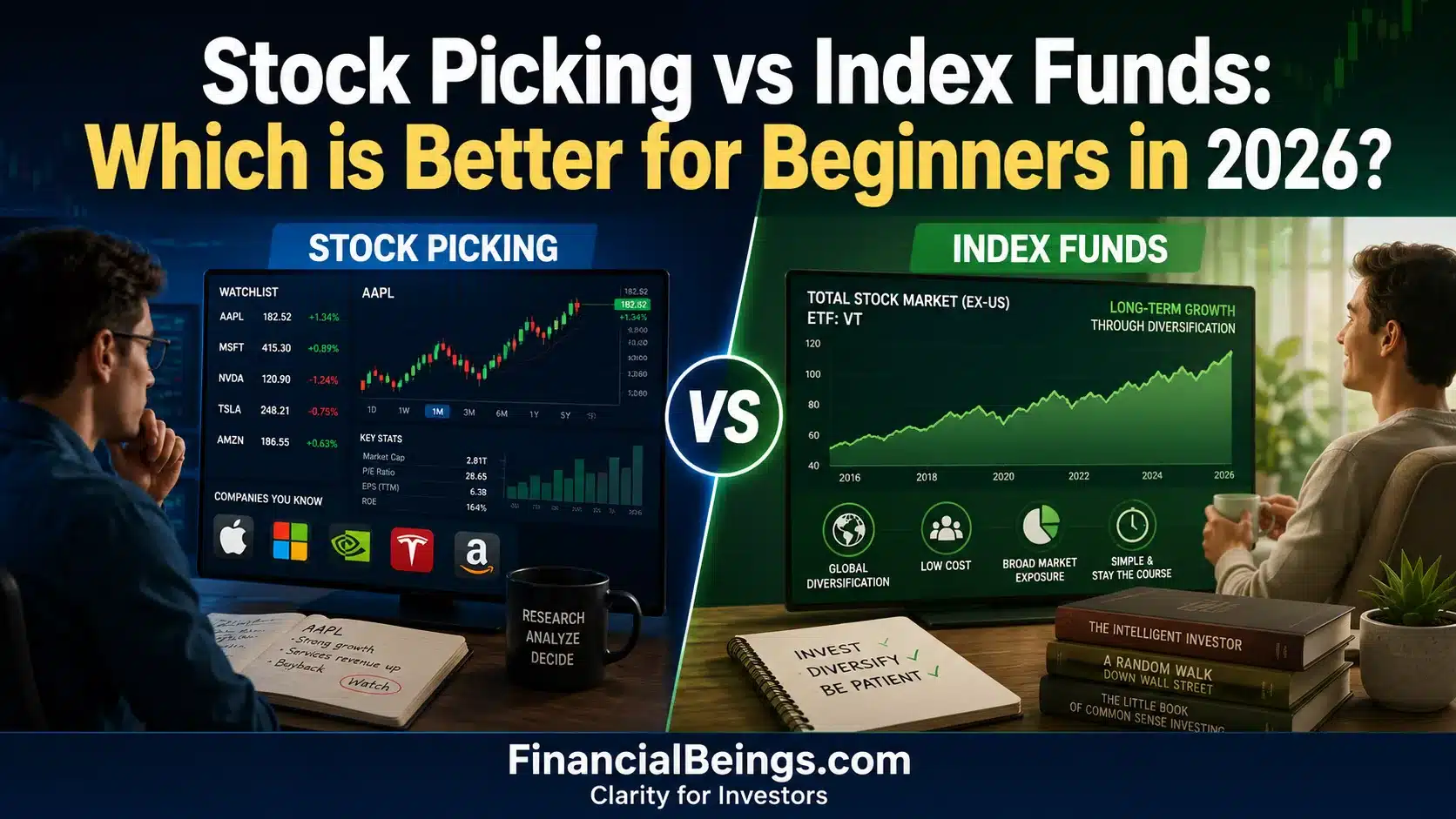
Stock Picking vs Index Funds Overview
Stock Picking (Active Investing)
Stock picking is choosing individual stocks you think are going to do better than the market. You do your research on money, news and decide between buying or selling. It’s like looking for hidden gems before it’s too late, before everyone has jumped on them, just like you bought Amazon in 2001. It’s active investing because you are making decisions on a regular basis.
Index Funds (Passive Investing)
An index fund is a portfolio of securities that replicates a market index, typically the S&P 500, which indexes America’s 500 largest companies. If you purchase one share of an S&P 500 index fund, such as Vanguard’s VOO or Fidelity’s FZROX, you automatically own a piece of Amazon, Apple & Microsoft, and other firms. This is a passive approach to investing, rather than trying to outsmart the market.
Key difference: Active investing takes a gamble on individual companies. Passive investing is a bet against the overall market, and that is a bet that can be historically made with confidence.
For high-conviction individual stock ideas focused on long-term growth across multiple sectors (not just tech), check our latest research: Best stocks to buy for long term growth before 2025 ends.
The Performance Data: Who Actually Wins?
This is the very most important part of the index funds vs stock picking argument, and the statistics don’t lie. The data speaks for itself, and it is consistent: According to the SPIVA (S&P Indices Versus Active) Scorecards, which have monitored active fund performance for more than 24 years, the evidence is the same.
| Time Horizon | Active Funds Underperforming S&P 500 |
| 1 Year (2024) | 65% |
| 1 Year (2025) | 79% |
| 5 Years | >90% |
| 15 Years | >90% |
| S&P 500 Mean Return (1982–2022) | 12.85% per year |
An actively managed fund will usually have an annual fee of 0.50%–1.50%, while index ETFs have fees as low as 0.03%. If a fund has a 1% higher fee than an index fund, it will only beat the index by 1% annually on average to break even, and, in fact, it cannot do that for more than 15 years or so.
The mean annual return of the S&P 500 for the 20 years since 1982 has been 12.85%, while the median return has been 15.79% (with a large standard deviation of 16.73%). The market delivered 37.58% in 1995 and lost 37% in 2008. Those who didn’t pay attention to the highs and lows of index investing were compensated in the long run.
Index Funds vs Stock Picking: Side-by-Side Comparison
| Factor | Index Funds | Stock Picking |
| Average Annual Return | ~10–12% (S&P 500 avg) | Varies widely; most trail index |
| Expense Ratio | 0.03%–0.20% | 0.50%–1.50%+ (active funds) |
| Time Required | Minimal — set and forget | High — ongoing research |
| Diversification | Instant (500+ stocks) | Limited unless a large portfolio |
| Risk Level | Market risk only | Market + individual stock risk |
| Tax Efficiency | High (low turnover) | Lower (frequent trading) |
| Skill Required | Beginner-friendly | Intermediate to Advanced |
| Best For | Most investors, beginners | Experienced, high-conviction |
Pros and Cons of Stock Picking
Advantages
- The opportunity to make a lot of money: Profitable stock companies can give you life-changing returns if you recognize them early enough.
- Completely in control of their ownership: They determine what they own and when to sell.
- Engagement: A lot of investors enjoy the research process.
- No tracking error: No rules imposed on you by the index to force you into buying overvalued stocks.
Disadvantages
- Poor average outcomes: Even professional managers perform worse than the market in 80% of 5-year time periods.
- Time-consuming: Hours of research are needed per week to make serious stock picking.
- Emotional risk: Most individual investors make the mistakes of buying high and selling low due to fear and greed.
- The concentration risk is that if there are fewer stocks, there is the risk that it will destroy the returns on a portfolio if it is a bad stock.
- Increased tax drag: Frequent trading leads to short-term capital gains tax.
Pros and Cons of Index Funds
Advantages
- Long-term performance: Outperformed most active managers over 10+ year time periods.
- Low cost: Many have costs as low as 0.03% per annum.
- Instant diversification: Ability to get exposure to hundreds of companies in one fund.
- Beginner-friendly: No stock analysis required – consistent contributions.
- Tax efficiency: With fewer turns, there are fewer taxable events during the year.
Disadvantages
- No beaters: Returns are at the market level only, and you will never exceed the indexes.
- No downside protection: In times of market crashes, such as the -37% in 2008 or the -18% in 2022, the index drops along with the market.
- Owns too-expensive stocks: Index requirements keep buying too-expensive companies.
Warren Buffett & Expert Opinions
The world’s best investor, Warren Buffett, has publicly and repeatedly said that most investors should invest in index funds. In his famous 2007 bet, Buffett bet “passive portfolio,” comprising the S&P 500 index, would outperform a hand-picked collection of hedge funds over 10 years. The index fund was up about 126%, and the hedge funds averaged about 36%.
In his 2013 shareholder letter, Buffett was clear: If you’re an ordinary investor, invest 90 per cent of your money in a very low-cost S&P 500 index fund. He believes that most people, even professionals, cannot beat the simple, overall passive approach after fees.
Other points of view to be aware of:
- Jack Bogle (Vanguard founder) is well known for his quote: The stock market is a magnificent forum for the distraction of the business of investing.
- A rare counter voice: Peter Lynch’s Magellan fund had huge returns, but admits most investors should not aim to do what he does.
- John Bogle’s principle: When you invest, you receive what you don’t pay for. Over the decades, costs count a lot!
When Should You Pick Individual Stocks?
There’s nothing wrong with stock picking, as long as the conditions are right. The following three conditions must be true to consider an individual stock in FinancialBeings:
- You have a strong financial base: An emergency fund of 3-6 months of expenses, no high-interest debt, and retirement accounts have been funded.
- You know how to read financial statements, that you understand valuation measures such as the P/E ratio, and that you know where to look to learn about industry trends without hot tips.
- You have time: You need to spend at least 5–10 hours of research into stocks each week, every week, to make meaningful stock picking.
Some individual opportunities worth researching include healthcare innovators like Dexcom (DXCM).
The Core + Satellite Strategy
The Core + Satellite approach is the best investment strategy if investors want both worlds. Invest 80-90% of your portfolio in low-cost index funds (the “core”) and the remaining of your portfolio in individual stocks or thematic ETFs (the “satellite”). You get reliable returns on the market while you still have the chance of showing your investment beliefs and not taking the risk of losing long-term wealth on speculation. For strong AI-themed stock ideas with detailed fundamental analysis for 2026, read our latest guide: Best AI stocks to buy in 2026
Practical Guide: How to Start in 2026
Starting with Index Funds (Recommended for Beginners)
- Sign up for a low-cost brokerage account like Fidelity, Vanguard or Schwab.
- Invest in a broad market index fund such as VOO (Vanguard S&P 500 ETF), FZROX (Fidelity Zero Total Market Fund, with a zero fee) or SWPPX (Schwab S&P 500 Index Fund).
- Create Dollar Cost Averaging (DCA). Invest a fixed dollar amount each month, irrespective of the market. This eliminates emotion and decreases your overall cost on average.
- Automatically reinvest dividends, and don’t let daily portfolio checks keep you from focusing on your investment strategy.
- Most importantly, boost your contributions as your income rises and hold on to your stocks during market dips.
If You Want to Try Stock Picking
- Begin with companies that you really know and respect, those in your industry, those that offer products you use, or those in your field of employment.
- Understand basic concepts: revenue growth, profit margins, debt and competitive advantages.
- Do research using tools such as Morningstar, Simply Wall St, or Seeking Alpha.
- Initially, keep individual stocks to 10-20% of your total portfolio.
- Honestly monitor your performance and make sure to increase your allocation when and if you beat the S&P 500 index by 3+ years.
Common Myths and 2026 Market Outlook
Myth 1: “I can simply follow the professionals’ stock tips. The majority of tips are hindsight or luck. Even with full-time teams with huge research budgets, there is a consistent gap.
Myth 2: “Index funds are guaranteed not to lose value. An index fund is a fund that tracks the market. The S&P 500 lost 37% in 2008 and 18% in 2022. They do not have vehicles, no haven today. They are not haven, they are long-term vehicles.
Myth 3: “Stock picking is for only the rich. Prices of stocks can be as low as $1 with fractional shares. It is not capital, it is skill and time.
Myth 4: ‘AI will make stock picking easy now’. While AI can aid in research, it cannot actually solve the core issue that markets are very efficient and difficult to beat consistently after fees.
Buying and selling to anticipate market changes will be even more difficult in 2026 and in years to come, due to increasing interest rates, the rise of artificial intelligence and the current global economic uncertainty. The benefits of dollar cost averaging low-cost index funds remain even stronger than ever. History has shown that investors who are disciplined through the volatility have been rewarded.
Conclusion: Our Recommendation
For any but the most experienced investor, and particularly for any inexperienced investor, the evidence overwhelmingly favours index funds over stock picking: index funds win. Data from more than 20 years of SPIVA Scorecards has been consistent. In 2025, 79% of active large-cap U.S. equity funds trailed the S&P 500, and more than 90% of all active managers have underperformed the index over 15 years. The benefits are magnified when you consider reduced cost, tax efficiency and no time commitment.
But that doesn’t imply that there’s no room for stock picking in your portfolio. With the Core + Satellite approach, you can be confident that you’re in on a market growth without having to risk a lot of money on single plays.
Our recommendation at FinancialBeings: Invest in index funds. Build your foundation. Once you get some real skill and some money to invest outside, go for individual stocks, and if you have high risk tolerance, you can also explore crypto. To learn the key differences between Crypto and Stock Market, click here: Crypto vs Stock Market.
Frequently Asked Questions
Q1. Is stock picking or index funds better for beginners?
In terms of value, beginner’s index funds are a lot better than stock picking. They offer immediate diversification across hundreds or thousands of stocks, which means that the risk of a total loss is much less, and historically, they’ve done better than most individual investors and professional fund managers over the long term.
Q2. Can I beat the market by picking stocks?
It can happen, although the odds are extremely slim. 79% of the big-cap funds managed by professionals underperformed the S&P 500 in 2025. Without teams of analysts and institutional resources, it is even more difficult for individual investors.
Q3. What is the average return of the S&P 500?
The mean annual total return (including dividends) for the S&P 500 index from 1982 to 2022 was about 12.85%, and the median annual total return was 15.79%. But volatility in returns is high; in 1995, the index had a gain of 37.58% while in 2008, it had a loss of 37%.
Q4. What are the best index funds for beginners in 2026?
The best options are Vanguard’s VOO (0.03% fee, S&P 500), Fidelity’s FZROX (0% fee, total market fund), and Schwab’s SWPPX (0.02% fee). These are a good way to diversify at a low cost. Before investing, always check with a financial advisor.
Q5. How much money do I need to start investing in index funds?
You can now open an account with as little as $1 for many brokerages and open an account by buying fractional shares. There is no minimum investment with Fidelity’s FZROX. The consistency is more important than the amount invested; it doesn’t matter if you invest $50 per month regularly, but you do matter.
Q6. What is Dollar Cost Averaging and why does it matter?
Investing fixed dollars into the market over time, whether it’s rising or falling, is known as Dollar Cost Averaging (DCA). It eliminates emotion in investing, it reduces the average price that you are paying when you go against the crowd, and it is one of the easiest and most effective long-term strategies that you can implement as a retail investor.
Q7. What did Warren Buffett say about index funds vs stock picking?
Buffett has always advised the majority of investors to invest in inexpensive index funds that track the S&P 500. He has told the trustee of his estate to invest 90% of the cash in an S&P 500 index fund in his 2013 letter. He also beat hedge funds in 2017 with a simple index fund in a famous 10-year $1 million bet.
Q8. What is the Core + Satellite investment strategy?
Core + Satellite means investing in low-cost index funds (the core) and individual stocks or thematic ETFs (the satellite) within your portfolio. It provides you with a stable, market-matching return to build and protect, and lets you be selective about the stock exposure without compromising the overall return.
Q9. Are index funds risky?
The advantage of index funds is that they are less risky than buying individual stocks since they provide instant diversification, but are not completely risk-free. They are subject to market, concentration and economic risks and trade at varying market values.
📚 Sources & References
- Ganti, A. (2026). U.S. Persistence Scorecard Year-End 2025. S&P Dow Jones Indices. Link
- S&P Dow Jones Indices. (2025). SPIVA U.S. Year-End Scorecard 2025. S&P Global. Link
- S&P Dow Jones Indices. (2025). SPIVA U.S. Year-End Scorecard 2024. S&P Global. Link
- Brower, M. (2025, September 13). Wrapping up the 2024 SPIVA Institutional Scorecard. Seeking Alpha. Link
- Buffett, W. E. (2014). 2013 annual letter to Berkshire Hathaway shareholders. Berkshire Hathaway Inc. Link
- Damodaran, A. (2023). S&P 500 Index and associated metrics at December 31 each calendar year, 1982–2022. Stern School of Business, New York University.
© 2026 FinancialBeings.com
This article is for informational purposes only and does not constitute personalized financial advice.