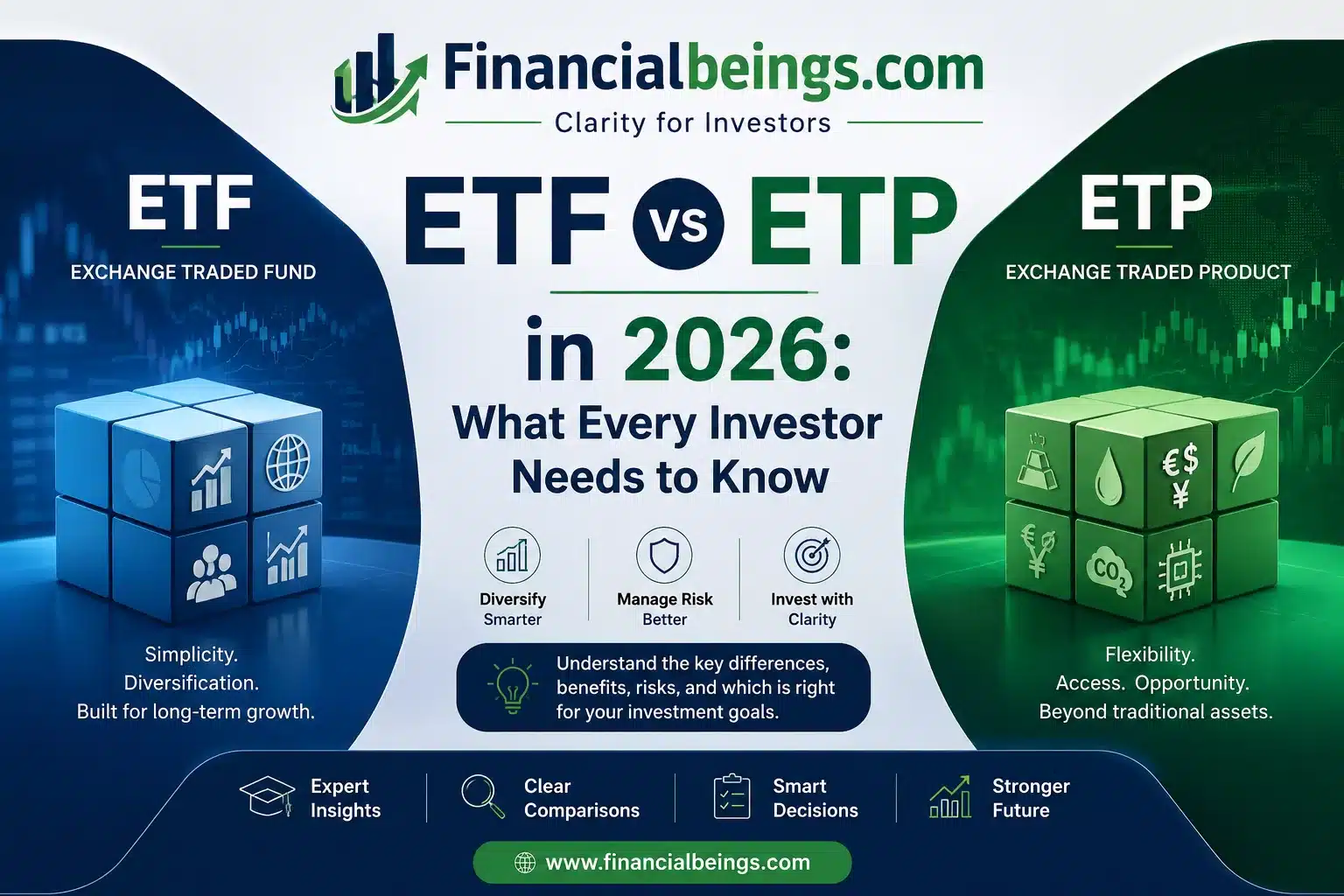
You finally decide to start investing. You open a brokerage account. You are looking for something easy and low-cost. Two terms appear immediately – ETF and ETP. They sound similar. But they are not alike. And choosing the wrong one without understanding the difference could expose you to risks you never signed up for.
This is a guide that breaks through the confusion. At the end, you will be in no doubt about what each of them is, the difference between them, or which one should be in your portfolio.
What is ETF?
An ETF (Exchange-Traded Fund) is exactly what the name says. A fund. That trades on an exchange, like a stock.
Here is a simple way to think about it. Imagine you want to own a piece of every major US companies – Apple, Microsoft, Amazon & 497 others. Buying each one individually would cost thousands of dollars and hours of research. An ETF bundles them all together. You buy one ticket. You own a slice of all of them instantly.
ETFs hold real underlying assets. If you buy an S&P 500 ETF, the fund actually owns the shares of those 500 companies. Your investment is backed by something tangible. Something real.
They trade throughout the day on stock exchanges – just like shares of Nvidia or Tesla. Prices move in real time. You can buy at 10 am and sell at 2 pm if you choose.
The most well-known examples are SPY, which tracks the S&P 500, and QQQ, which tracks the Nasdaq-100. Both are simple, transparent, and owned by millions of investors worldwide.
ETFs are regulated investment funds. They come with legal protections. Your money sits in a segregated fund – separate from the company that manages it. If the fund manager goes bankrupt, your assets are protected.
If you’re still deciding between buying individual company shares or investing in a diversified fund, understanding the differences between ETFs and individual stocks can save you both time and risk – here’s a detailed comparison.
That last point matters more than most beginners realize. And it is exactly where ETFs and some other ETPs start to diverge.
What is ETP?
Here is where most investors get confused. And honestly, it is not their fault.
ETP stands for Exchange-Traded Product. It is not one specific thing. It is an umbrella term. Think of it like the word “vehicle.” A car is a vehicle. So is the truck. So is a motorcycle. They all move you from A to B – but they work differently and carry very different risks.
ETFs sit under the ETP umbrella. But so do two other products that most beginners never hear about until something goes wrong.
ETFs – Exchange-Traded Funds
A fund holding real assets – stocks, bonds, or securities. Regulated. Transparent. Asset-backed. The safest structure within the ETP family.
ETNs – Exchange-Traded Notes
Not a fund. A debt instrument. A promise. You are lending money to a bank. That bank promises to pay you a return linked to an index. If that bank collapses, your money goes with it. When Lehman Brothers failed in 2008, investors holding Lehman ETNs lost everything – even though the indices those ETNs tracked kept functioning perfectly.
ETCs – Exchange-Traded Commodities
These give you exposure to gold, oil, silver, or wheat. Some hold the physical asset. Others use derivatives. Physically backed ETCs are safer. Derivative-based ones carry hidden counterparty risks that most retail investors overlook entirely.
Every ETF is an ETP. But not every ETP is an ETF. That one distinction is where real money gets lost.
Key Differences Between ETFs and ETPs
Two products. Same exchange. Completely different DNA underneath.
Most investors treat ETFs and ETPs as interchangeable terms. That mistake does not show up immediately. It shows up when markets get stressed – when a bank struggles, when liquidity dries up. By then, it is too late to ask questions you should have asked at the start.
Here is where they differ:
Structure:
ETF is a registered investment fund. It holds real assets on your behalf. An ETN is a bank-issued debt note. It is a contractual promise. One gives you ownership. The other gives you an IOU.
Risk:
ETFs carry market risk – if the assets fall in value, your investment falls too. ETNs carry an additional layer – credit risk. If the bank issuing fails, your investment disappears regardless of what the underlying index does. That is a fundamentally different kind of risk.
Transparency:
ETFs disclose their holdings daily. You always know exactly what you own. Many ETNs provide no such transparency. You own a promise & promises do not come with daily disclosure.
Legal Protection:
ETF assets are legally segregated from the fund manager. If the manager goes bankrupt, your assets are protected. ETN investors have no such protection. They join the queue of unsecured creditors.
| Feature | ETF | ETN | ETC |
| Asset-backed | Yes | No | Varies |
| Credit risk | No | Yes | Partial |
| Daily transparency | Yes | Often no | Varies |
| Legal protection | Yes | No | Varies |
How ETFs and ETPs Are Traded
Trading an ETF feels exactly like buying stock. That simplicity is the point. But beneath that simplicity, a precise and important mechanism is at work, and understanding it protects you from costly mistakes.
The Exchange Mechanics
ETFs and ETPs trade on stock exchanges throughout the day. You place an order through your broker. The trade executes at the current market price. You can buy at 9:45 am and sell at 3:15 pm if you choose. That real-time flexibility is what separates them from traditional mutual funds, which only price once per day after markets close.
Liquidity – The Hidden Risk Nobody Talks About
Liquidity means how easily you can buy or sell without moving the price. Large ETFs like SPY trade billions of dollars daily. You can enter and exit instantly with no impact. Smaller or niche ETPs are different. Low trading volume means fewer buyers and sellers. Getting out quickly – especially during a market panic – can be difficult, slow, and expensive.
Bid-Ask Spreads – The Cost You Never See on a Fee Sheet
Every time, each ETF and ETP corresponds to two prices. The offer is the price the buyers are willing to pay. They enquire – what sellers desire. The separation between them is growing. On SPY, it is cent by cent. It can be 0.5% or above on a thinly traded ETP. Each time you trade, you pay that cost. It does not appear in any fee disclosure. But it is real.
Costs and Fees Comparison
Nobody loses money all at once to fees. They lose it slowly. Quietly. A fraction of a percent every year until one day they compare what they should have and what they actually have. That gap is where fees lived all along.
Expense Ratios – The Annual Silent Charge
Every ETF and ETP charges an expense ratio. This is the annual fee for managing the fund. It gets deducted automatically from the fund’s value. You never write a check. You never see an invoice. It just quietly reduces your returns every single year.
Vanguard’s S&P 500 ETF (VOO) charges 0.03% annually. That means on a $10,000 investment, you pay $3 per year. Some actively managed ETPs charge 0.75% or more; that same $10,000 costs you $75 annually. Over 20 years, compounded, that difference runs into thousands of dollars.
Trading Costs – What Fee Sheets Never Show You
Every time you buy or sell an ETF or ETP, you pay the bid-ask spread. On liquid ETFs, this is negligible. On niche ETPs, this can be 0.5% per trade, both ways. Active traders pay this cost repeatedly. It compounds silently, just like the expense ratio does.
ETNs – Lower Fees, Higher Hidden Risk
ETNs often advertise lower expense ratios than comparable ETFs. That lower fee comes with a trade-off: credit risk. You are paying less to own a promise instead of real assets. For some investors, that trade-off is acceptable. For most, it is not worth it.
| Cost Type | ETF | ETN | ETC |
| Expense Ratio | 0.03%–0.75% | 0.15%–0.89% | 0.15%–0.50% |
| Trading Spread | Very low (liquid) | Low to moderate | Moderate |
| Hidden Costs | Minimal | Credit risk premium | Rollover costs |
The cheapest option on paper is not always the cheapest option in reality.
Risks Associated with ETFs and ETPs
Every investment carries risk. The investors who get hurt are not always the ones who take the most risk. They are often the ones who did not know what risk they were carrying in the first place.
Market Risk – The Universal One
Every ETF and ETP faces market risk. If the underlying assets fall in value, your investment falls too. This applies to everyone – no exceptions. A broad S&P 500 ETF dropped over 30% in March 2020 in a matter of weeks. That is market risk doing exactly what it does. It is unavoidable. It is manageable, but only if you know it was coming.
Credit Risk – The ETN Trap
This one catches investors completely off guard. When you hold an ETN, you keep a promise from a bank. If that bank fails, the promise dies with it. In 2008, Lehman Brothers collapsed overnight. Investors holding Lehman-issued ETNs woke up to investments worth nothing, not because markets crashed, but because the issuer vanished. The index kept running. Their money did not.
Liquidity Risk – The Exit That Is Not There
Selling sounds simple until nobody wants to buy. Niche and thinly traded ETPs can become impossible to exit quickly during market stress. Spreads widen. Prices gap. You end up selling at a significantly worse price than expected or waiting longer than you can afford.
Tax Considerations
Nobody budgets for the tax they never saw coming. But it arrives anyway – quietly, consistently, year after year, until one day you realize a significant portion of your returns never actually belonged to you.
The product you choose determines how much of your money is yours.
How ETFs Are Taxed
ETFs are built with tax efficiency in mind. The way they operate, swapping securities between large institutions rather than selling them, means capital gains rarely get triggered inside the fund itself. You sit quietly. The clock barely moves. You only face a tax bill when you personally decide to sell.
Vanguard’s VOO has distributed zero capital gains to investors for over a decade. That is not a coincidence. That is the structure protecting you silently, every single year you hold it.
How ETNs Are Taxed
ETNs tell a harder story. Because they are debt instruments, tax authorities treat them differently. Some gains are taxed as ordinary income, not at the lower capital gains rate. That gap alone can silently erase several percentage points of annual return.
Then there is phantom income. Certain commodities and currency ETNs require you to pay tax on gains you have not received yet. You owe money on profits still sitting on paper. That bill arrives whether you are ready for it or not.
The Simple Rule
ETFs keep more of their money working longer. ETNs can quietly hand a larger share of your returns to the tax authority. Always check the structure before you buy it, especially in a taxable account.
Benefits of Investing in ETFs and ETPs
Twenty years ago, the stock market felt like a private club. You needed a broker who returned your calls. You needed enough capital to deal with the matter. You needed connections that most ordinary people simply did not have. Ordinary investors stood outside looking in.
That wall is gone now. And ETFs and ETPs are what knocked it down.
Diversification – Instant and Affordable
Imagine buying one ticket that gets you into 500 companies at once. Apple and Microsoft. Johnson and Johnson. All of them. One purchase. One price. If one company stumbles, the other 499 absorbs the impact. That kind of protection used to demand serious wealth. Today it costs less than a dinner out.
Low Costs – The Compounding Advantage
Here is a number worth sitting with. Vanguard’s VOO charges 0.03% per year. Many traditional funds charge 1% or more. On $50,000 held for 30 years, that difference does not just add up – it multiplies. The gap runs into tens of thousands of dollars. Money that stays in your account instead of disappearing into a fee that no one ever clearly explained to you.
Transparency – You Always Know What You Own
Most ETFs publish their full holdings every single day. No guessing. No surprises hidden in a quarterly report. Your money is always visible and accountable.
Access to Specialized Markets
Gold in a Swiss vault. Carbon credits. Lithium miners. Emerging market bonds. ETPs make genuinely specialized markets accessible to any investor with a phone and a brokerage account. That access used to belong to institutions. Now it belongs to everyone.
Which Should You Choose: ETF or ETP?
You are standing at a crossroads. Both paths lead to the same destination, market exposure. But they take you there differently. One is a paved highway with clear signs. The other has shortcuts that look attractive until you hit an unexpected turn.
The right choice depends entirely on who you are as an investor.
Choose an ETF if:
- You are a beginner or long-term investor who values simplicity and safety
- You want legal protection over your assets regardless of what happens to the fund manager
- You want full daily transparency into exactly what you own
Choose an ETP beyond ETFs if:
- You specifically need commodity exposure – gold, oil, silver – and a physically backed ETC fit that need
- You fully understand credit risk and accept it in exchange for a specific index exposure that an ETN provides
- You are an experienced investor using ETPs as part of a deliberate, informed strategy – not a default choice
Honest Practical Advice
For most investors, beginners, retirement savers, and long-term wealth builders, a straightforward ETF is the right answer. It is transparent, protected, and tax-efficient. It costs almost nothing to hold.
ETNs and complex ETPs are tools for specific jobs. Do not use a specialist tool when a simple one does the job better.
The best investment product is always the one you fully understand before you buy it. If you have questions about ETFs, ETPs, or need personalized guidance on your investments, don’t hesitate to get in touch with us.
What ETFs are expected to do well in 2026?
In 2026, ETFs focused on technology and AI, clean energy and ESG, and healthcare/biotech are expected to do well, driven by innovation, renewable energy adoption, and medical advancements. Dividend and low-volatility ETFs may also perform steadily if markets stay uncertain.
Is it safe to invest in ETPs?
ETPs can be safe, but it depends on the type. ETFs are generally low-risk, asset-backed, and regulated. ETNs and some ETCs carry higher credit or liquidity risks, so only invest in them if you fully understand the risks.
Which one is better ETFs or ETPs?
For most investors, ETFs are better because they are regulated, hold real assets, offer daily transparency, and provide legal protection. Other ETPs like ETNs or derivative-based ETCs carry higher credit or liquidity risks and are suitable only for experienced investors.
How to invest in ETPs and ETFs?
You can invest in ETFs or ETPs through a brokerage account—just like buying stocks. Pick the product that fits your goals, place a buy order during market hours, and monitor your investment over time. For beginners, starting with broad-market ETFs is usually safest.
Sources & References
- SEC — Exchange-Traded Funds: Official Guide
- SEC — Investor Bulletin: Before You Invest in ETFs: SEC.gov
- SEC — Investor Alert: Risks of ETNs: SEC.gov
- FINRA — ETF vs ETN: Choosing the Right Product: FINRA.org
- Investopedia — Exchange-Traded Note (ETN): Investopedia
- BlackRock — ETF Benefits & Risks: BlackRock
- Vanguard — ETF Expense Ratios & Tax Efficiency: Vanguard Investor
- Morningstar — ETF Investor Guide: Morningstar
- IRS — Tax Treatment of Exchange-Traded Funds: IRS Publication 550
Author Usama Ali