Since her daughter’s birth, Maria has held an investment in Costco stock. It’s not checked very frequently. The question every long-term investor will ask at some point is what will this be worth in a few years? But last week, as she was scrolling through her portfolio at midnight, that question arose in her mind.
She looked for a Costco stock forecast 2030 and found most online answers were just a number with no explanation of where it came from. It’s a problem that is hardly uncommon in most Costco stock forecasts for 2030, and it’s a quiet one.
Most forecasts never state out loud what they assume: by 2030, investors will have to pay more at Costco than they do now. This one doesn’t. It makes the assumption that investors will pay the same price-to-earnings multiple (more on that below) and allows the business to do all the work.
As of the 14 August 2026 close, Costco traded at $961.10 a share. Here are the things this price is keeping secret.
What Is Costco Stock Forecast 2030?
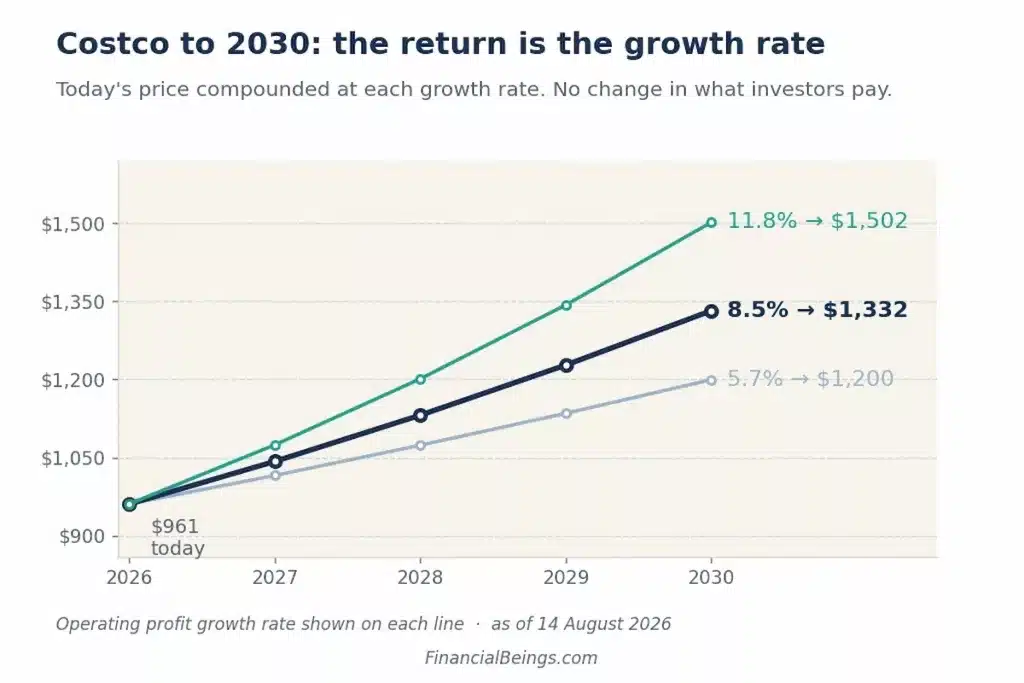
Our central Costco stock forecast for 2030 suggests that the Costco stock price will be $1,332 a share, rising 8.5% annually, and about 10.0% annually after factoring in the cash that the company pays out. The range is dependent on the performance of the business and will be from $1,200 at the lower end to $1,502 at the higher end.
It’s simple, and it’s the simplicity of the method that is important. We take the current price and compound it (add on to it each year) at the same rate we believe the underlying profit of Costco will grow from year to year. We don’t have to speculate as to what investors will be willing to pay for the stock in 2030. We’re assuming that they pay the same as they do now and allowing the company’s growth to do the work.
How Is a 2030 Stock Forecast Actually Built?
The vast majority of published forecasts are not valuations. They’re trend lines. No one says how much the company’s earnings need to be or what they need to be valued at by investors. It’s like analysis, but it’s not. It is a statement based on a guess.
There are two elements to a real forecast: the amount of profit that is growing, and the price an investor will pay for that dollar of profit (the multiple). Any change in one will result in a change in the price target. Most forecasts assume both of these tend to rise, and this boosts the forecast. If you’re not familiar with how a company’s growth rate is actually calculated, our guide on growth stocks and growth rates breaks down the mechanics before we apply them to Costco.
One of those two levers is held in place in ours. We keep the multiple close to today’s and allow only the growth rate to move. That is a much harder test to pass, and this is why this forecast is so dependent on one number.
What Multiple Does Our 2030 Forecast Assume?
The one number that really counts: our forecast suggests a multiple of 48.6x in 2030 compared with the current level of 48.27x. Essentially the same as today’s, and it sits inside the five-year band of 34.9x to 61.1x, which Costco’s stock price has been in for the past five years.
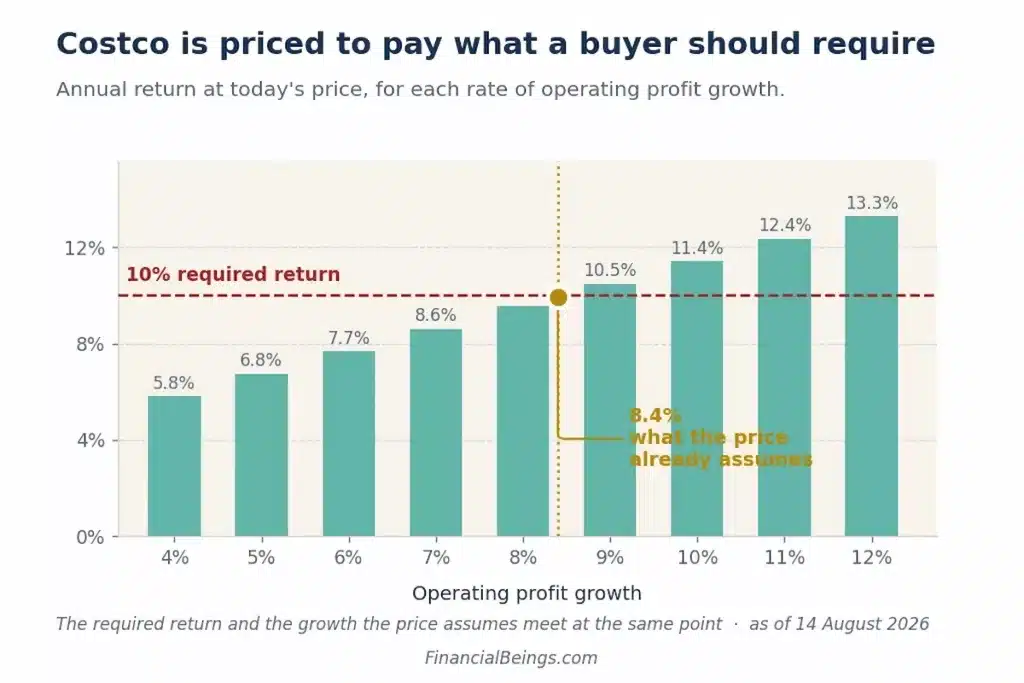
All prices represent a multiple, for good or bad, either explicitly or implicitly. We do the math out in the open; if Costco’s profits are increasing by 8.4% each year, an investor who purchases today will earn an annual return of 10% — the return we think a company of this sort should provide. Growth of more than 8.4% would be better. Grow slower, and you will miss out, about one point of return for each point of growth missed.
This 8.4% is not a wild guess that was entered into a spreadsheet. But this is what the current price assumes, whether Costco management has stated it or not. The question one must ask here is can Costco actually provide it?
What Growth Does Costco’s Price Already Assume?
This section is used to alter the way that the stock price is read. Today’s price already incorporates about 8.4% growth per year based on the profit made above the cost of the capital employed by the company. Costco has actually delivered around 8.7% over the past three years – the company has performed a lot like the market expects it to perform and not much more.
Where does that confidence come from? Costco makes approximately 35 cents per dollar of capital in the business — everything from warehouses, inventory, systems and more. It’s approximately three cents of profit on each dollar of sales, turned more than 12 times per year, in the business. Low margin, extraordinary speed. That’s what powers Costco. That efficiency edge shows up clearly when you compare Costco’s capital returns against Walmart’s — the two retailers run on very different economics despite selling similar products.
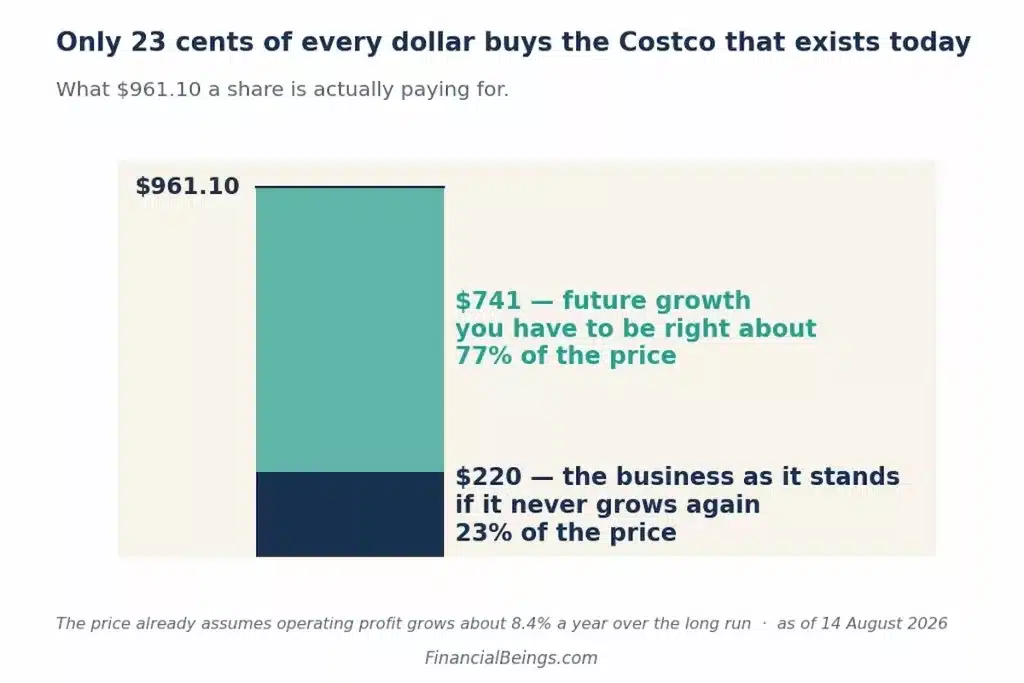
Now divide the $961.10 share price into two parts. The $220, about 23% of that, is what it is worth today without a single additional dollar. The final $741, or 77%, is all future projection. Nearly four-fifths of the price of Costco stock is an investment in tomorrow and not in what the company has today. But that’s no criticism. Once opened, it’s just what any Costco stock forecast for 2030 is really comprised of.
What Has to Go Right for Costco by 2030?
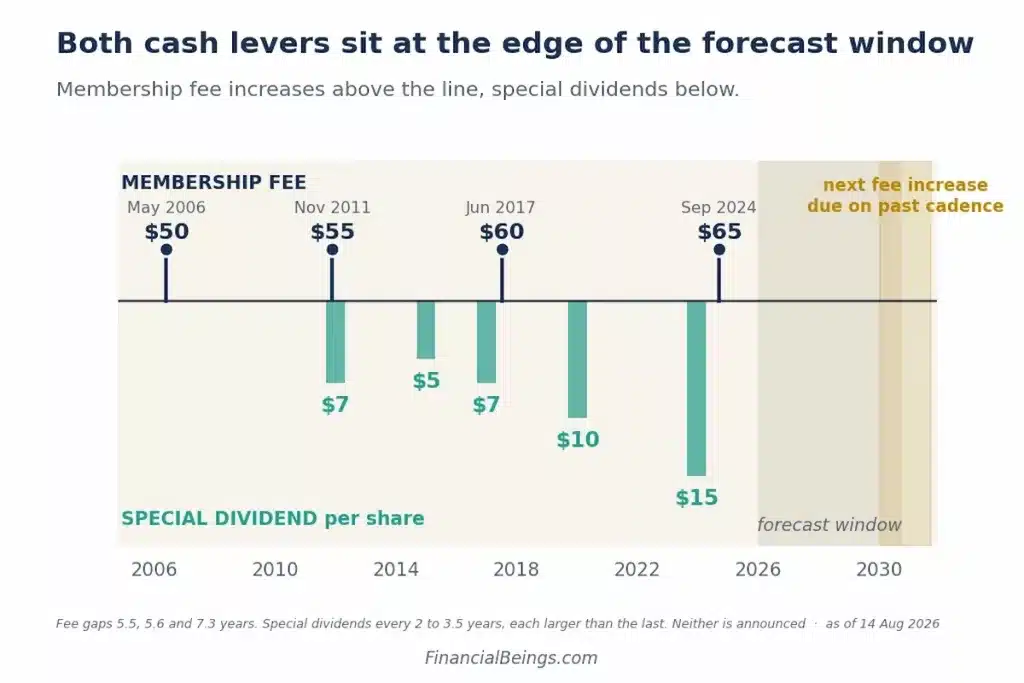
There are two levers that are not as loud, which can be overlooked when just observing the price behind the headline number. The first one is Costco’s membership fee — the annual dues that members have to pay just to shop there. Costco has raised it three times since 2006: from $50 to $55, then $60, then $65 in September 2024.
The length of the intervals between increases has been 5.5, 5.6 and 7.3 years. On this trend, the next uptick will likely occur sometime between early 2030 and late 2031, which is on the cusp of this forecast period, if not beyond. Costco has announced nothing. This is not presumed to be true, but rather open to question.
The second lever that is not considered by most forecasts at all: special dividends, one-off cash payments in addition to the regular dividend payment. Costco has issued five since 2012 — $7, $5, $7, $10, and most recently $15 a share in December 2023.
There is no schedule and they come in succession, each bigger than the previous, every two to three and a half years or so. For income-focused options with steadier payouts, see our list of the best dividend stocks.
It has now been more than two and a half years since the previous one. Based on historical data, one or two more could arrive before 2030. If Maria pays attention only to the price, she would only see half of the picture.
What Are the Three Paths to 2030?
We constructed three scenarios, not probabilities with attached outcomes, but three reasonable pictures of what the different growth rates will look like.
Conservative: Profit increases by 5.7% per year, the stock goes close to $1,200, for a 7.4% total annual return. Central case: Balanced-Growth: profit is increasing by 8.5% per year, the stock price is $1,332 and the total return is 10.0%. Upper: profit growth of 11.8% per year would push the stock to $1,502, for a 13.1% return, but that would be the best ever for Costco’s margins.
See how each path is driven by the rate of growth. Not investor sentiment. Not a much-anticipated re-rating. Just the nitty-gritty of business, compounding. That same break-even line is running through the middle of all three: 8.4% growth will result in just the 10% return you would like.
Below that, it’s low pay for the risk. If you are at or above it, you’re fairly compensated. This same scenario-based approach — holding the multiple steady and letting growth do the work — applies just as well to other mega-caps. See how it plays out in our Apple stock forecast for 2030.
My Honest Take
Not a single one of these gives you or Maria an answer to the question of buy, hold or sell. What the Costco stock forecast for 2030 shows is what you must believe for the price the stock is at now to be correct. If you’re still weighing whether picking individual names like Costco is worth the extra effort versus just owning the market, our comparison of stock picking vs index funds walks through that trade-off.
These are all our assumptions, and the required 10% return is not a law of nature: if you require only an 8% return, you would reach a different answer. This is not investment advice, this is an illustration of the assumptions, not a guarantee of what will come to be. We apply this same growth-and-multiple framework across other large-cap names — you can see how the assumptions shift for a very different business model in our Meta stock prediction for 2030.
Frequently Asked Questions
How much will Costco stock be worth in 2030?
What today’s price compounds to is $1,332, which is approximately 8.5% higher per year than the price is now, based on our model. Our range runs from $1,200 to $1,502.
Will Costco stock reach $2,000 by 2030?
Not until operating profit grows at a 20.1% rate per year, which is faster than Costco’s best eight-year stretch of 19.2%, will this be true. That would also be a multiple of 73.0x, which is more than the 61.1x peak recorded over the past five years.
Is Costco stock overvalued right now?
It trades at 48.27x trailing earnings compared to the five-year median of 47.5x, which is about average for its own trading range. The business already has an 8.4% growth rate built into the price, however, and only 23% of the price you are paying is for the business today.
What return can I expect from Costco by 2030?
Our required return from owning a business like this is 10.0% per year on our central path. The price is designed in such a way that if Costco continues growing as expected, you’re getting what you deserve. It remains to be seen whether it will deliver.
Will Costco raise its membership fee again before 2030?
No announcement has been made yet. The last three gaps have been 5.5, 5.6 and 7.3 years, and the last increase was in September 2024, so the next increase is likely to be between early 2030 and late 2031 just on the edge of this forecast window.
Does Costco still pay special dividends?
Yes — beyond its regular quarterly payout, the Costco dividend history includes five special dividends since 2012, worth $7, $5, $7, $10, and $15 a share, most recently in December 2023.