
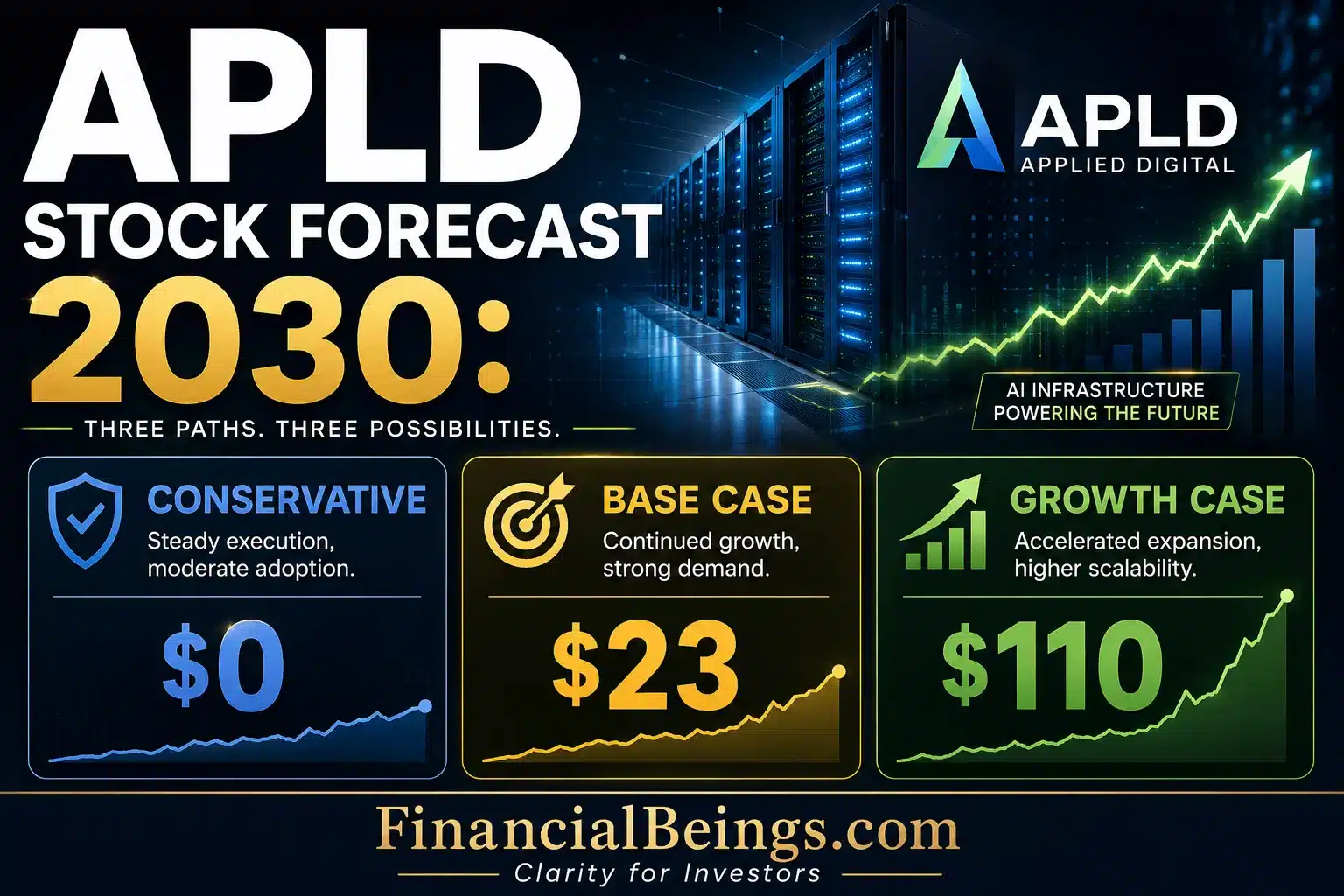
If you’ve fallen down the rabbit hole of contradictory APLD price predictions, this article is for you. We’re going to build our APLD stock forecast 2030 not by reading tea leaves on a price chart, but by asking what the company has to do — or fail to do — for any of the following numbers to make sense.
The Short Answer
No one knows what Applied Digital (APLD) will be worth in 2030. Anyone claiming otherwise is speculating with confidence, not knowledge.
What we can do is give you a range built on real business drivers, and spell out what has to happen for each “what if”. The current situation is represented in the table below; from here, there are very different possible outcomes in 2030: a conservative, a middle, and an optimistic path. These aren’t guarantees; they’re conditional paths — three different roads, each with its own tolls and potholes.
This is the backbone of a defensible long-range view: not a chart extrapolation, but a statement of what has to go right — and what must not go wrong.
| Snapshot (as of ~Aug 2026) | Value |
|---|---|
| Share price | $25.34 (Aug 30, 2026) |
| Shares outstanding | ~280M |
| FY2026 revenue | $0.61B |
| Net debt position | ~$3.51B (net debt) |
| Anchor tenant | CoreWeave (~400MW leased) |
| 12-month analyst target | ~$74 (range $37.50–109) |
Calculation (Net Debt)
Detailed Net Debt (component breakdown)
Interest-Bearing Debt:
- Long-term notes payable: $4,959.5M
- Current notes payable: $16.4M
- Finance leases (current + noncurrent): $47.6M + $10.7M
- Operating leases (current + noncurrent): $18.5M + $47.2M
- Preferred stock: $0.0M
- Total Interest-Bearing Debt = $5,099.9M
Liquidity:
- Cash & equivalents: $1,592.0M
- Short-term investments: $0.0M
- Total Liquidity = $1,592.0M
Net Debt = Interest-Bearing Debt − Liquidity = $5,099.9M − $1,592.0M = +$3,507.9M = +$3.51B (net debtor)
Why the Predictions Disagree So Wildly
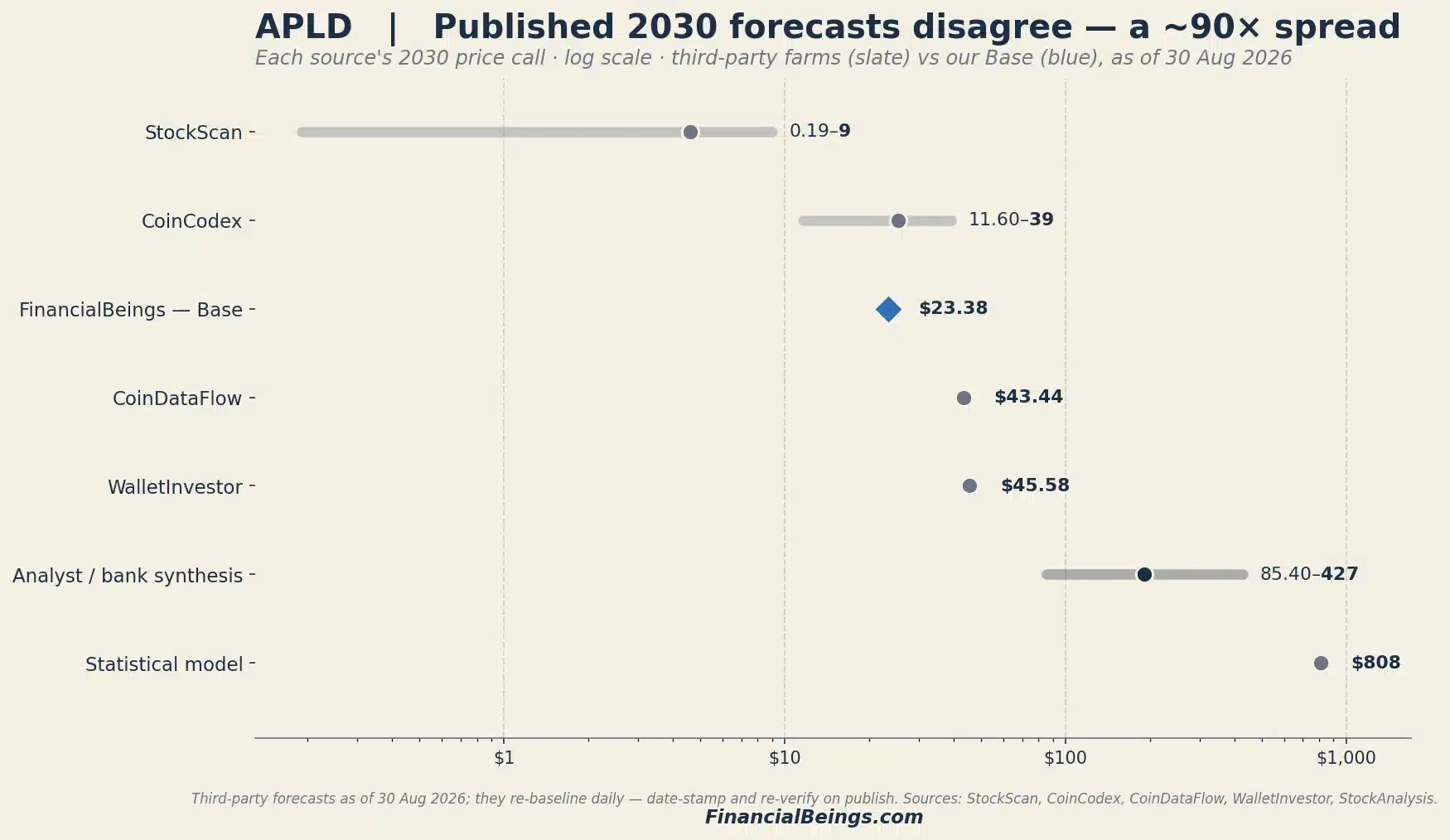
This is where it gets almost comical — if it weren’t so misleading. Search for Applied Digital’s 2030 price and the published calls run from roughly $4.59 to $427: more than 90 times apart on the same company. Two mechanics examining the same engine: one predicting it’s going to the junkyard, the other that it is going to victory at Le Mans.
Here is that spread, source by source, against today’s price of ~$25.34 (third-party numbers re-checked 31 Aug 2026):
| Source | Type | 2030 price call | vs. today |
| StockScan | Algorithm | ~$4.59 (range $0.19–$9) | ~85–90% decline |
| CoinCodex | Algorithm | $28.66–$49.20 | +13% to +94% |
| WalletInvestor | Algorithm | Withdrawn — now caps its forecasts at one year | — |
| CoinDataFlow | Algorithm | $19.73–$26.11 | −22% to +3% |
| Analyst/bank synthesis | Aggregated | $85.40–$427 | 3x–14x |
| Statistical model (outlier) | Algorithm | ~$808 | ~26x |
How are numbers that far apart all correct answers? The majority of these “forecasts” aren’t actually forecasts, so much as an educated guess. They’re algorithms. They come up with a number based on the price changes that have taken place in the past few days, and periodically update it, often daily. While we were finishing this article, two of the five re-baselined and a third withdrew its long-range forecast entirely — the point demonstrates itself.
None of them read the lease contracts. None of them ask whether the business can actually deliver. It’s pattern-matching as prophecy; it’s even filtering into the AI-generated search summaries that run contrary to the same paragraph.
What Applied Digital Actually Is Today
First of all, let’s get the facts straight. Contrary to some articles that have been published in the past, Applied Digital is not a bitcoin mining firm. Years ago, it was part of that world, but it’s not the business these days.
Today, Applied Digital builds large-scale data centers — vast, power-hungry server facilities it leases to companies running AI workloads. Rather than crypto miners, think ‘landlord for AI factories’.
That matters, because a landlord’s fortunes depend on how much space gets built, whether tenants move in and pay, and whether those tenants are creditworthy. If you’re curious how APLD stacks up against other leading AI data center stocks, the comparison is worth a look before deciding where it fits in your portfolio. Remember: that is the picture that everything comes from.
What Actually Drives the Stock
Three numbers drive this stock. Lease backlog — space already signed, a promise of future revenue. Energized capacity, in megawatts — because a signed lease means nothing until the building is finished and switched on.
Most important are the tenants — above all CoreWeave, the Nvidia-backed AI-computing firm leasing a large share of Applied Digital’s capacity.. Since CoreWeave’s fortunes are so tightly tied to Nvidia’s GPU demand, it’s worth checking whether Nvidia is a good stock to buy now — a slowdown there would ripple straight through to APLD’s biggest tenant.
And how the buildout will be financed. The data centers are costly, and construction has been financed by a mix of issuing new shares — dilution — and, increasingly, borrowing: roughly $5.1B of interest-bearing debt now sits against $1.6B of cash, the ~$3.51B net-debt position broken down above. The share count has grown from roughly 90 million to roughly 280 million in about three years.
Any honest long-range estimate has to carry that cost — otherwise it prices the growth without pricing what the growth costs. Traditional shortcuts such as the price-to-earnings ratio don’t apply at this stage. This is not harvest time; it’s still a building business.
How to Value a Company That Isn’t Profitable Yet
This is the most important aspect that you don’t see in most forecast websites, and this is what you should see.
Consider the price of the stock on three levels. The bottom is the reproduction cost floor, which is the approximate cost of reproducing the company’s physical assets, per share. We are re-deriving the exact figure after the net-debt correction — with ~$5.1B of debt now in the claims stack, it lands well below the current share price.
The middle layer is earning power: how much the business is currently earning, and in Applied Digital’s case, that’s pretty much zero; the company is still running a loss. The biggest part is by far the growth premium: the markets’ bets on the company’s potential. If you’re new to this concept, it helps to first understand what growth stocks are and how their growth rate is measured before applying that framework here. With the floor modest and earning power near zero — the company still runs a loss — nearly the entire share price is growth premium: the market’s bet on what gets built.
In other words: Almost none of the price today is supported by current profits. Almost all of it is a wager on the likelihood that the build-out will occur in the future. If you’re looking at something big that you’re trying to predict, multiply it by the reasonable share count that you know the company has (this number is constantly increasing), and then ask yourself if the company’s building pace and lease backlog are worth that type of company.
This growth-over-earnings pricing pattern isn’t unique to APLD though — it raises the broader question of whether AI stocks are a good investment right now, given how much of their value across the board rests on future bets rather than current profits. Otherwise, you’ve looked deeper than the algorithms!
The Conservative, Base, and Growth Cases
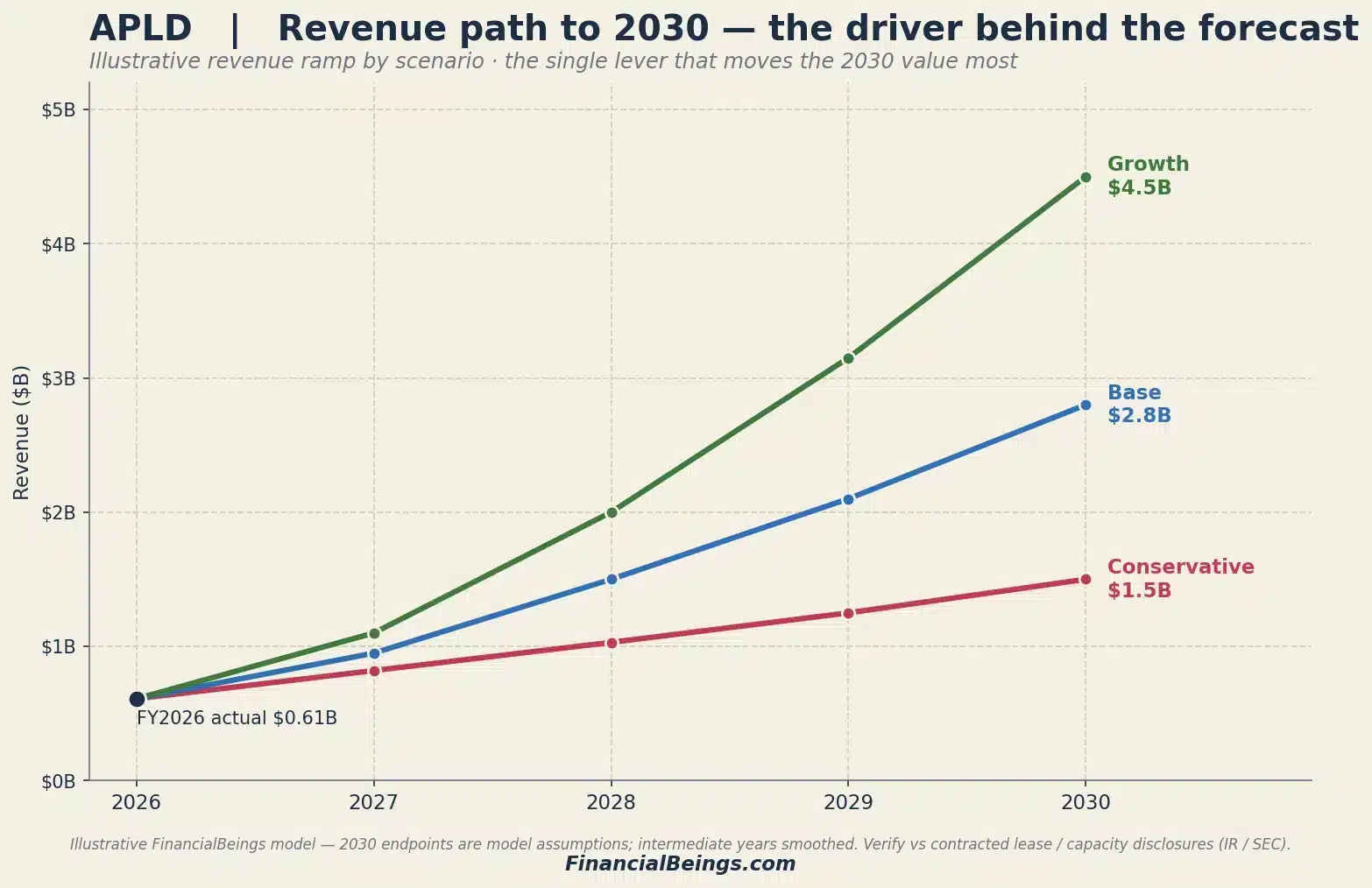
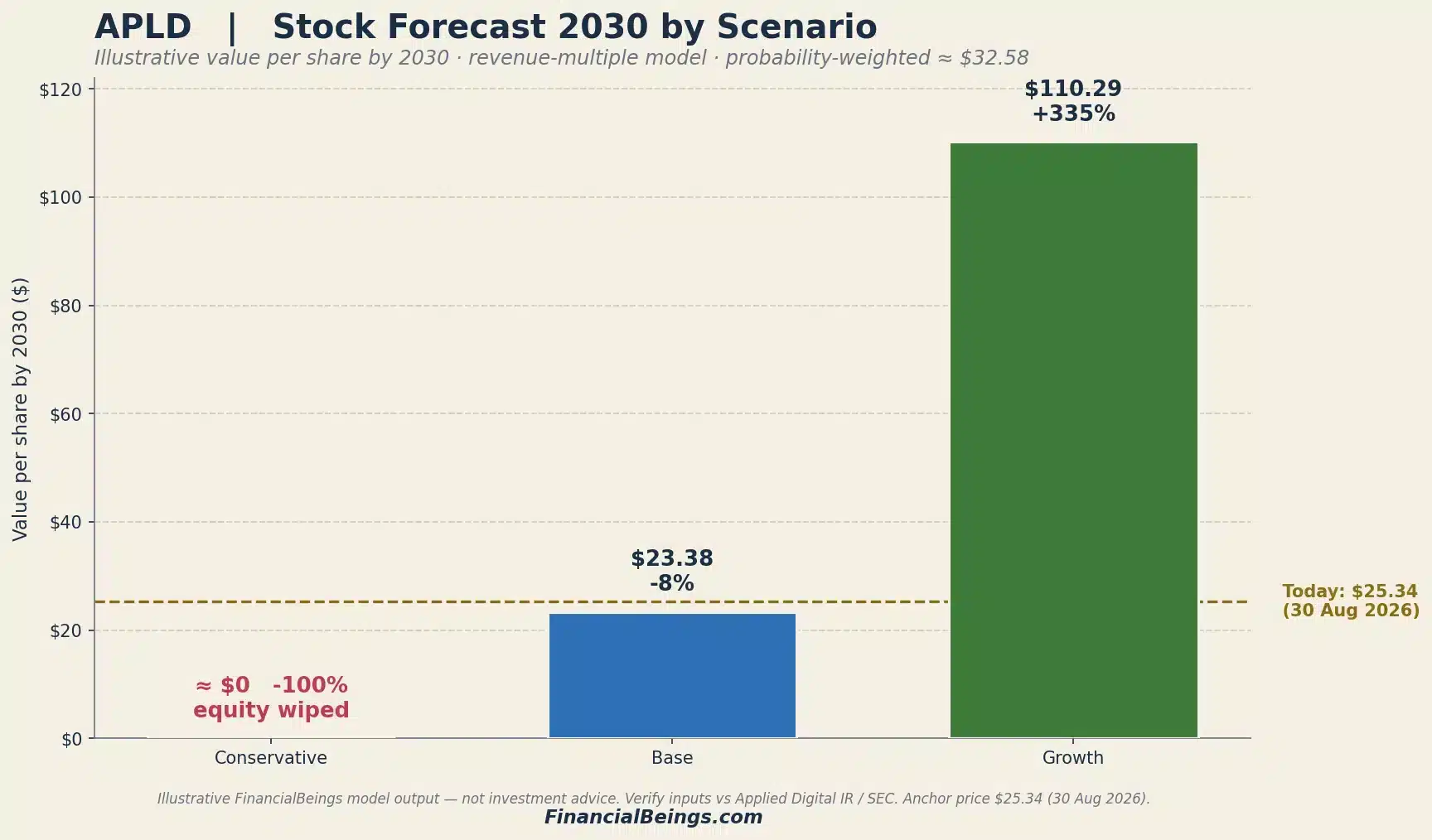
Here’s how the three paths break down, in plain numbers, based on our own driver-based model; treat these as our estimates, not market fact:
| Scenario | 2030 revenue | Value multiple used | Value per share | vs. today | Rough odds |
| Conservative | $1.5B | 3.0x sales | ≈$0 (equity wiped) | −100% | 35% |
| Base | $2.8B | 5.0x sales | ~$23.38 | −8% | 45% |
| Growth | $4.5B | 9.0x sales | ~$110.29 | +335% | 20% |
These outputs lean on the balance sheet as much as on revenue: the model assumes 2030 net debt of roughly $7B, $5B and $3B and diluted share counts of about 460M, 385M and 340M across the conservative, base and growth paths — the growth case carries less dilution because financing arrives on better terms. Weighted by our rough odds, the three paths average to a probability-weighted value near $32.58 against $25.34 today — and all of that upside is carried by the growth tail: our base case lands slightly below the current price.
Two more disclosures, because they matter. The exit multiples — 3.0x sales if growth disappoints, 5.0x for a steady infrastructure operator, 9.0x only if the market grants a premium platform rating — bracket where listed data-center and digital-infrastructure names have traded, and the 35/45/20 odds are our judgment, not market-derived probabilities: flex either lever and the weighted value moves with it. And a revenue-multiple lens is deliberately the friendlier of our two: our primary valuation model, which capitalizes current economic profit, reads a loss-making builder more conservatively. Showing you the optimistic arithmetic without saying so would be exactly the kind of forecast this article criticizes.
The growth case, around $110 a share, is heavily dependent on construction staying on schedule, signed leases converting into billed and energized capacity, CoreWeave and other tenants remaining financially stable, and the company finding additional tenants and financing projects without overcrowding the market with new shares. If all of that lands, the market can begin treating Applied Digital as a stable, income-producing operator — and that re-rating does as much for the stock as the revenue itself.
The conservative case is harsher than a chart makes it look: with roughly $7B of net debt by 2030, the enterprise would be worth less than what it owes — the equity gets wiped to zero, and lenders take losses before shareholders see anything. It’s what happens when construction falls behind; when the company continues to issue more shares to finance ongoing construction; when a big tenant goes under; or when the AI infrastructure boom fizzles out sooner than the company’s forecasts.
None of these are exotic risks — they are the ordinary hazards of a leveraged, capital-hungry buildout. When sentiment changes, a stock that is valued almost solely on future growth gets less generous, and that goes both ways: good news can cause it to shoot up just as quickly as bad news can plunge it.
A fair long-range view keeps both stories alive at once — the market will price whichever one execution confirms.
Milestones to Watch
Don’t focus on a set goal; watch the events. Is new capacity being added, or is construction lagging in each of the quarters? Are signed leases actually being monetized, or are they press-release fodder? Is the company raising capital on sensible terms, or on terms that signal distress? And watch the debt schedule as closely as the equity raises: refinancing terms and interest coverage on the ~$5.1B stack now decide the conservative case.
And the one that settles the argument: the year profit turns durably positive — when the business starts making money rather than just getting bigger. The next scheduled checkpoint is the fiscal first-quarter report, expected in early October on the company’s usual cadence. Follow that timeline and it will tell you more about the stock’s direction than any price target ever did.
The Verdict
Applied Digital is not a scam; it isn’t a sure thing. It’s a true company that is constructing real infrastructure for a real trend: in-demand artificial intelligence computing power. It could be anywhere from a wiped-out equity to a ~$110 stock by 2030, with a base case near $23 — slightly below today’s price — and the difference is execution, building over time, tenants paying on time, and funding the growth without drowning existing shareholders in new stock.
This is a stock for someone comfortable with volatility, who understands they are underwriting a buildout rather than buying steady, predictable gains — and who can watch an account swing hard in a single week without flinching.
And whatever long-range number you settle on, remember that the widely quoted $74 is an analyst target for one year, not a 2030 projection — confusing the two is how most of the contradictory search results got that way.
If the number of shares in the company continues to increase, then any prediction that doesn’t take this into account is not really a prediction. None of this is investment advice; it’s a method — better questions than the algorithms ask. If you’re weighing APLD alongside other top AI stocks to buy, it helps to see how its risk profile compares to more established AI plays before allocating capital.
Frequently Asked Questions
Is Applied Digital a bitcoin miner or an AI company?
It is now an AI infrastructure company that constructs and leases data centers to AI computing tenants. It used to be associated with crypto mining, but this is no longer the case.
What is APLD’s price target, and is that the same as a 2030 forecast?
No. The price target is a one-year forecast and is currently at $74 from analysts. A 2030 forecast is a much longer time frame and is based on very different, and far less predictable, factors, such as construction speed and financing.
How high can APLD stock realistically go by 2030?
Don’t fix on one number — think in ranges tied to conditions. A stalled, debt-burdened buildout points toward a wiped-out equity; steady execution lands in the $20s; a strong, well-financed buildout supports a triple-digit outcome.
Sources
- Applied Digital IR — View source
- Applied Digital IR, SEC filings — View source
- SEC EDGAR (APLD, CIK 0001144879) — View source
- StockScan — View source
- CoinCodex (still lists the old name “Applied Blockchain”) — View source
- CoinDataFlow — View source
- WalletInvestor — View source
- StockAnalysis — View source
- Motley Fool (“Could APLD triple by 2030?”) — View source