The Netflix stock dividend yield is 0%. Netflix (Nasdaq: NFLX) pays no cash dividend on its common shares and returns excess cash to shareholders through buybacks.
Netflix says it has never declared or paid a cash dividend and does not expect to pay one in the foreseeable future. Its share count fell 2.7% through September 2026. At the November 20 closing price, a hypothetical 1% dividend would cost Netflix about $2.33 billion a year. Netflix 2025 Form 10-K · Q3 2026 shareholder letter
What Netflix buybacks did to the share count
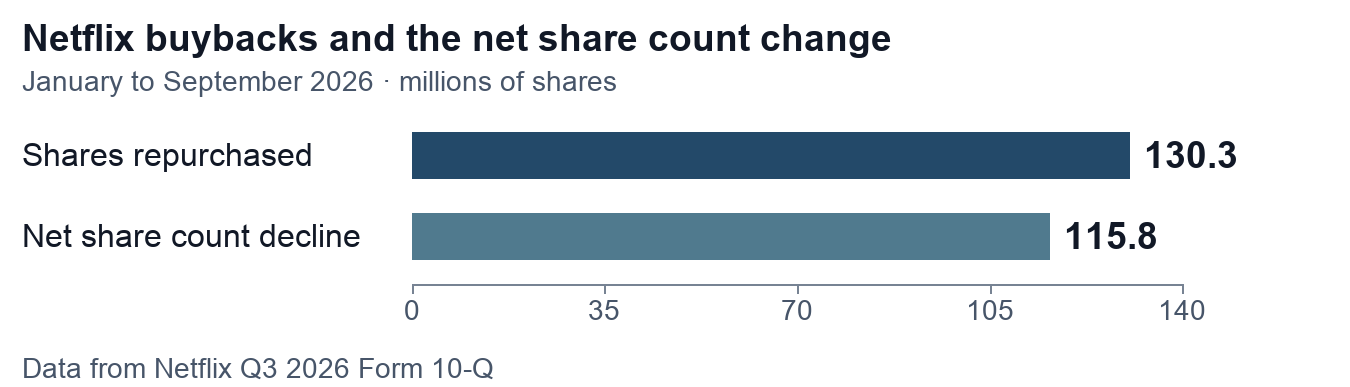
From January through September 2026, Netflix bought back 130.3 million shares for $10.7 billion, excluding excise tax. The third quarter accounted for 63.9 million shares and $4.8 billion, the biggest repurchase quarter Netflix had reported. For comparison, the company spent $9.1 billion on repurchases in all of 2025, also excluding excise tax. Q3 2026 Form 10-Q · 2025 Form 10-K
The number of shares outstanding fell from 4.222 billion at year-end 2025 to 4.106 billion at September 30, 2026. That was a net reduction of 115.8 million shares, or 2.7%. Share issuance, including shares issued through employee stock options, offset part of the repurchases. Q3 2026 Form 10-Q
If you kept the same number of NFLX shares, your ownership stake was about 2.8% larger relative to where it started. Fewer shares can raise earnings per share if total profit holds steady. The cash spent on the buyback also matters. If Netflix overpays for shares, the buyback can reduce the value of each remaining share. Our September Netflix intrinsic value analysis shows how growth assumptions affect the estimated value of the shares.
In a buyback, cash goes to the investors who sell their shares. A cash dividend would pay all eligible shareholders in proportion to the number of shares they own.
Why Netflix favors buybacks
Netflix says it invests in the business first, keeps enough cash on hand, and then uses excess cash for repurchases. Content is one reason flexibility matters. At September 30, 2026, Netflix had $25.2 billion in commitments to produce, license and acquire content, with $11.8 billion due within a year. Q3 2026 shareholder letter · Q3 2026 Form 10-Q
When cash is needed elsewhere, management can pause buybacks. Netflix announced a pause in January 2026 to build cash for its proposed Warner Bros. acquisition. Starting a regular dividend would create an expectation that Netflix would keep paying it through weaker quarters. Q4 2025 shareholder letter
Netflix stock dividend yield and payout scenarios
At the model’s $56.73 reference price, the November 20, 2026 close, a 1% cash yield would pay about $0.57 per share each year. For 100 shares, that’s about $57 before taxes. Across 4.106 billion shares, the cost to Netflix would be $2.33 billion annually. NFLX historical prices · Q3 2026 Form 10-Q
| Hypothetical yield | Annual cash per share | Annual cost to Netflix |
|---|---|---|
| 0.5% | $0.28 | $1.16 billion |
| 1.0% | $0.57 | $2.33 billion |
| 2.0% | $1.13 | $4.66 billion |
The Netflix stock dividend yield would move with the share price. A fixed $0.57 annual dividend would yield about 0.8% at $70 per share or 1.3% at $45. A shareholder would receive the same cash payment per share in either case.
The 1% scenario would use about 25% of Netflix’s $9.46 billion in 2025 free cash flow, which deducts all spending on property and equipment from operating cash flow. It would use about 24% of the Financial Beings model’s $9.69 billion estimate of 2025 owner earnings, which deducts only the estimated maintenance portion of that spending. Q4 2025 shareholder letter
What could make room for a Netflix dividend
Adding the hypothetical dividend to Netflix’s $9.1 billion of 2025 buybacks would take the combined payout to about $11.4 billion, roughly $2 billion above that year’s free cash flow. With cash flow at that level, Netflix would need to scale back buybacks or fund the difference from another source. 2025 Form 10-K
Our Oracle and Microsoft dividend coverage analysis compares each company’s payout with the cash it had left after capital spending.
A lasting dividend would depend on steady cash flow after investment and a change in board policy. Netflix forecast about $12 billion of free cash flow for 2026. Operating cash flow through September included a one-time $2.8 billion Warner Bros. Discovery termination fee, which makes 2025 a better baseline for this illustration. Q3 2026 shareholder letter · Q3 2026 Form 10-Q
Frequently asked questions
Why do some sites show a yield for Netflix bonds?
A Netflix bond yield measures the return on the company’s debt at a given bond price. The Netflix stock dividend yield measures annual cash dividends per share against the share price. NFLX pays $0 in annual cash dividends per share. 2025 Form 10-K
Will Netflix pay a dividend in 2027?
Netflix has announced no cash dividend for 2027 as of November 23, 2026. The current Netflix stock dividend yield is 0% under a policy that favors reinvestment, liquidity and buybacks. 2025 Form 10-K · Q3 2026 shareholder letter
Did the stock split create a dividend?
The 10-for-1 split in November 2025 gave shareholders nine additional shares for each share they held. Netflix used a stock dividend to carry out its 7-for-1 split in 2015. Both splits distributed shares and generated $0 in cash for shareholders. 2025 split announcement · 2015 split announcement