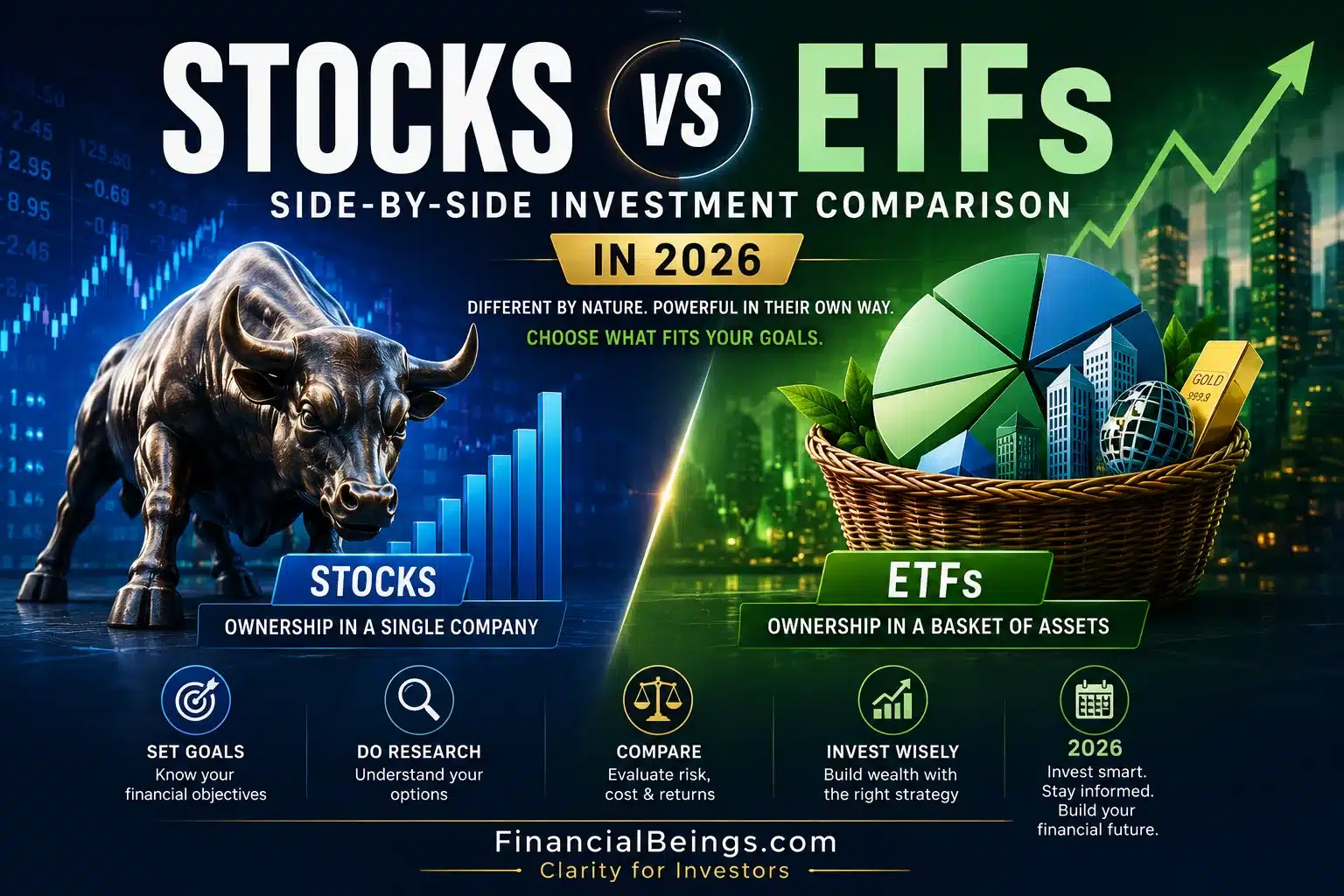
One of the most fundamental choices any investor must make is whether to invest in stocks or ETFs. They both trade on the same exchanges, pay dividends & can be purchased through a regular brokerage account but they can be used for different investment goals and are ideal candidates for different types of investors.
By the end of 2025, total net assets of the ETFs listed on the US exchanges amounted to $13.4 trillion, accounting for 30% of all assets managed by such investment companies in the US, while net share issuance in 2025 reached a record $1.5 trillion, from $1.1 trillion in 2024, according to the Investment Company Institute.
On the other hand, investors are still interested in individual stocks with company-specific returns. We’ll explore all the essentials that will help you make the best decision for your portfolio in 2026.
What Is a Stock?
A stock is a security that is fractional ownership in a particular company. When you purchase shares, you are a partial owner of the business (also known as a shareholder).
As a shareholder, you will have some rights:
- Voting rights on important matters, such as electing board members,
- When the company pays out some of its profits as dividends.
- Capital Appreciation: Your shares can have a higher valuation over time
- To be exposed to the company’s performance, both good and bad.
Stock prices are subject to volatility driven by a company’s performance, market conditions, and investor sentiment.
What Is an ETF?
An exchange-traded fund is a fund made up of individual securities, such as stocks, bonds, commodities, currencies, or other assets that are packaged together and traded in a single unit on an exchange market. When you purchase shares of an ETF, you are purchasing a portion of the entire pool of investments, but you can trade in or out of the ETF with daily flexibility similar to a mutual fund. The net asset value is the value after liabilities of the total value of the assets in the fund divided by the number of shares held.
Since 2008, the ETF industry has expanded by a cumulative annualized return of 20.1%, to total assets under management by the end of 2024 of $13.8 trillion. The U.S. currently has 288 ETF sponsors offering 4,495 funds. The global ETF industry saw a record $330.7 billion in inflows in 2024, accounting for 22.24% of all ETF inflows in the world, which underscores the continued strength of investor demand for the asset class.
Differences Between ETFs and Stocks
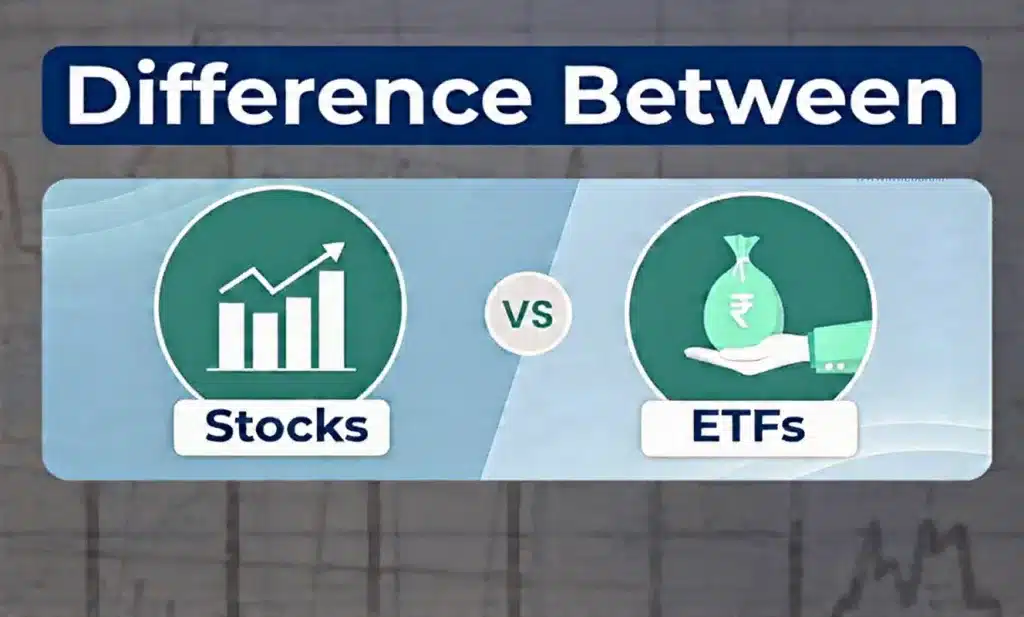
There’s a significant structural difference between ETFs and stocks, and it has ramifications for performance, cost and how they’re incorporated in a broader portfolio strategy.
| Feature | ETFs | Individual Stocks |
| Diversification | High – holds many securities | Low – single company only |
| Risk Level | Lower; spread across assets | Higher; concentrated in one firm |
| Management | Professionally managed | Investor manages independently |
| Expense Ratio | Yes (annual management fee) | No management fee |
| Dividends | Passed through from holdings | Paid directly by the company |
| Liquidity | High; traded throughout the day | High; traded throughout the day |
| Research Required | Minimal – fund manager handles it | Significant ongoing research needed |
| Upside Potential | Moderate – averaged across holdings | High- single company can surge |
Diversification
This is the most essential difference. ETFs contain hundreds (or thousands) of securities in a single trade, eliminating single-stock risk. Instead, you are at risk of the performance of just one company with individual stocks.
Research and Management
The ETF is supported by a team of professional fund managers who conduct their own research and manage the portfolio for you. In each stock transaction, the investor is solely responsible for any research or trades.
Expense Ratio
ETFs have annual fees (Expense Ratio) that cover the management and operating expenses. There are no management fees for individual stocks, but both types could incur brokerage fees. For investors considering individual stocks, analyzing leading companies within the same industry can provide valuable insights. For example, our JPM vs BAC Comparison explores the strengths, risks, and growth potential of two major banking stocks.
Different Types of ETFs
There is an ETF for just about every investment goal and risk profile in the ETF universe.
- Index ETFs: Suitable for long-term buy-and-hold investors, Index ETFs track broad benchmarks such as the S&P 500, are passively managed and have minimal fees.
- Sector ETFs: Focus on a particular industry or sector to gain exposure without stock picking, such as technology, healthcare, or energy.
- Dividend ETFs: Put your money into companies that have a stable dividend payouts record, which is great for any individual who desires regular income.
- Bond ETFs: invest in a variety of fixed-income securities with returns that are more likely to remain steady in a diversified portfolio.
- ESG ETFs: Filter your investments for environmental, social and governance considerations to allow investors who are seeking to invest in values for their values to do so.
- Active ETFs: Professionally run discretionary decision-making ETFs and now represent a larger proportion of ETF flows worldwide.
- Core ETFs: are broad-based low-cost portfolio anchors for fundamental, long-term exposure to multiple asset classes.
ETFs vs Stocks: Pros and Cons
ETF Pros
- With built-in diversification you can minimize your risk in any one stock.
- Reduced expenses than managed mutual funds
- A professional management would be required, with no need to select specific securities.
- The tax efficiency of the in-kind redemption processes.
- Easy to access for those who have not much capital
ETF Cons
- The higher the expenses, the lower the long-term returns.
- Less upside potential, gains are spread out among lots of holdings
- Low trading volume of some ETFs means that they are less liquid
- Is unable to influence specific holdings within the fund
Stock Pros
- A good performing stock can perform far better than the index, creating a higher return potential.
- No management fees or expense ratios.
- Shareholder rights including Voting rights, Direct dividends.
- 100% possession of property
Stock Cons
- The more focused businesses are based in one company, the greater the risk.
- Needs extensive studies and continuous monitoring
- For portfolio diversification, significant amounts of capital are required.
- The increased emotional stress from stock fluctuations at the individual level (Vanguard, 2024)
ETFs vs Stocks: Similarities
Although they have some differences, there are some similarities between ETFs and individual stocks:
- Exchange-traded: Both are sold and purchased on the exchanges in the trading day at the market rate for the time of the day.
- Transparency: Daily publication of holdings for ETFs and a clear knowledge of what you own with stocks.
- Dividends: Both can pay dividends. Dividends earned from holdings of ETFs are passed through to its shareholders.
- Wide investment options: Both invest in a variety of sectors, geographies, market capitalizations and industries.
- Trading techniques: Investors can use limit orders, margin buying and other techniques with both instruments.
Investors who are also comparing traditional equities with digital assets can explore our Crypto vs Stock Market guide to understand the key differences in risk, volatility, and long-term return potential.
How to Invest in Stocks and ETFs
The starting process is the same for all:
- Define your investment goals: Wealth building, retirement or income generation.
- Choose a reputable brokerage: Make sure it has low fees and commission-free trading if possible.
- Open and fund your account: Fill out the needed identity verification and initial deposit.
- Educate yourself: Be sure to research it first using reputable sources like Vanguard, Investopedia, etc. before putting money at risk.
- Place your orders: Buy market, limit, or stop buy/sell orders in line with your strategy and risk level.
- Monitor and rebalance: Keep an eye on your portfolio and rebalance if your portfolio allocation falls off significantly from the target allocation.
Risk of Investing in ETFs and Stocks
All investments carry risk. Here’s what to watch for:
Risks of Individual Stocks
- Concentration risk: The concentration risk is directly affecting your portfolio as one company suffers, so do you.
- Volatility: Stock prices can move rapidly in response to news, earnings or the overall market trend
- Research burden: If not done properly, stock picking can lead to bad decisions.
Risks of ETFs
- Market risk: As with other investments, ETFs can decline if the market declines, and diversification will not ensure you make a profit.
- Tracking error: Some ETFs may not exactly match their benchmark index.
- Liquidity risk: Lightly traded ETFs might be less liquid.
- Capital gains distributions: When an ETF’s underlying index changes, this can create a taxable event for shareholders.
Generally, ETFs are less risky than stocks due to their diversification, but when managed correctly, individual stocks can offer greater returns. Some investors focus on growth stocks to maximize potential returns.
Should You Invest in ETFs or Stocks?
The ‘right’ answer is dependent on your individual situation. Ask yourself:
- What is my risk tolerance? The advantage of ETFs is that they are diversified and lower risk. Stocks are riskier and have more potential for returns.
- How much time can I dedicate? Stocks need to be actively researched and monitored. You have to be less involved with ETFs.
- What are my goals? ETFs are an ideal investment for those looking for long-term wealth. Targeting specific companies or sectors may call for individual stocks. If generating a regular income is your goal, consider reviewing the best dividend stocks to buy to complement your portfolio.
- What is my timeline? ETFs are stable, making them a good choice for long-term investors. Short-term traders might be interested in stock-specific opportunities.
ETFs are a great option for investors, especially those new to the market, as they allow for building a diversified portfolio. Specific convictions about companies or sectors can be expressed through individual stocks, and ideally, an optimal portfolio contains a mix of both.
Conclusion
Investors who want to be passive, long-term investors benefit from ETFs for their diversification, professional management and cost-effectiveness. Disciplined and research investors willing to take concentrated risk can gain greater return potential from individual stocks.
The numbers for 2025 are just as stark: Vanguard S&P 500 ETF returned 17.8% and almost 80% of professional active managers underperformed. It doesn’t put an end to individual stocks, but it is a great reminder of the importance of a solid ETF core.
The right strategy is the one that fits your financial objectives and time horizon, and is realistic with your own risk tolerance and dedication to the active research approach.
“`htmlSources & References – ETFs vs Stocks 2026
- ETF & Mutual Fund Industry Data: Total AUM, Net Issuance, Flows Investment Company Institute (ICI)
- ETF Basics, Types, and Performance: Index, Sector, Bond, Dividend, ESG ETFs Vanguard ETF Resources
- General Investing & Stock Research: Individual stocks, trading techniques, portfolio management Investopedia
- U.S. ETF Regulatory Data: SEC ETF Guidelines and Disclosures U.S. SEC – ETFs
- Market Data / Stock Prices: Trading data, liquidity, valuations NASDAQ
- ETF & Stock Performance Reports: Annualized returns, inflows, comparison with active managers Vanguard ETF Insights
Author Usama Ali