
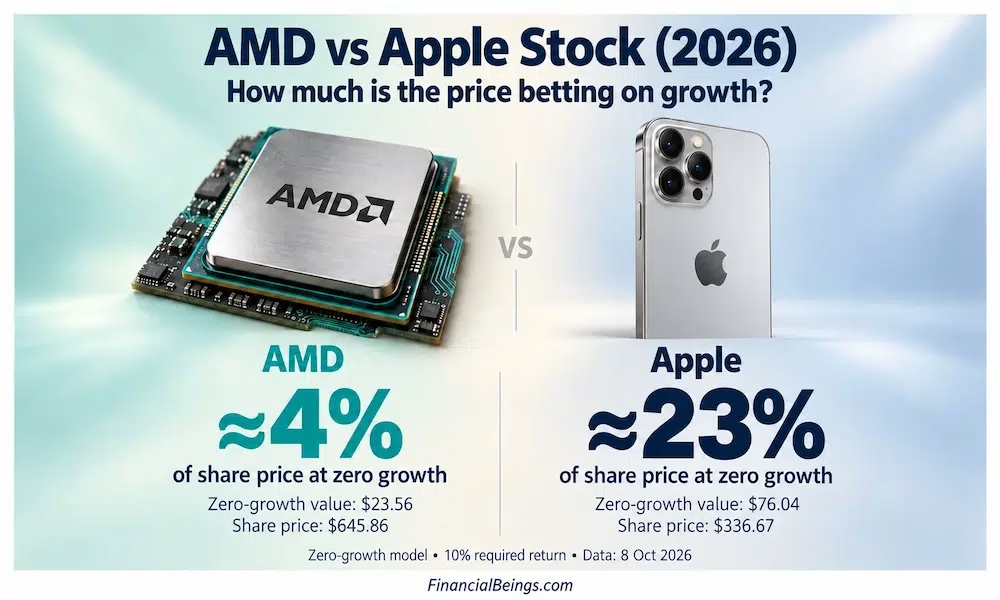
Quick answer: In the AMD vs Apple stock comparison, Apple is the more stable company and makes about 20 times more profit than AMD. AMD is growing approximately 3x faster, and its share price would reflect approximately 8.2% annual growth forever, as compared to Apple’s 7.8%. Choose the assumption you believe, rather than the lower P/E. (Data as of 8 Oct 2026.)
Meet Sara. She is 34 now and a physiotherapist and has $10,000 in a savings account earning virtually nothing. Her brother continues to send her SMS messages about AMD. “This year, it was tripled,” he writes. “Tripled.”
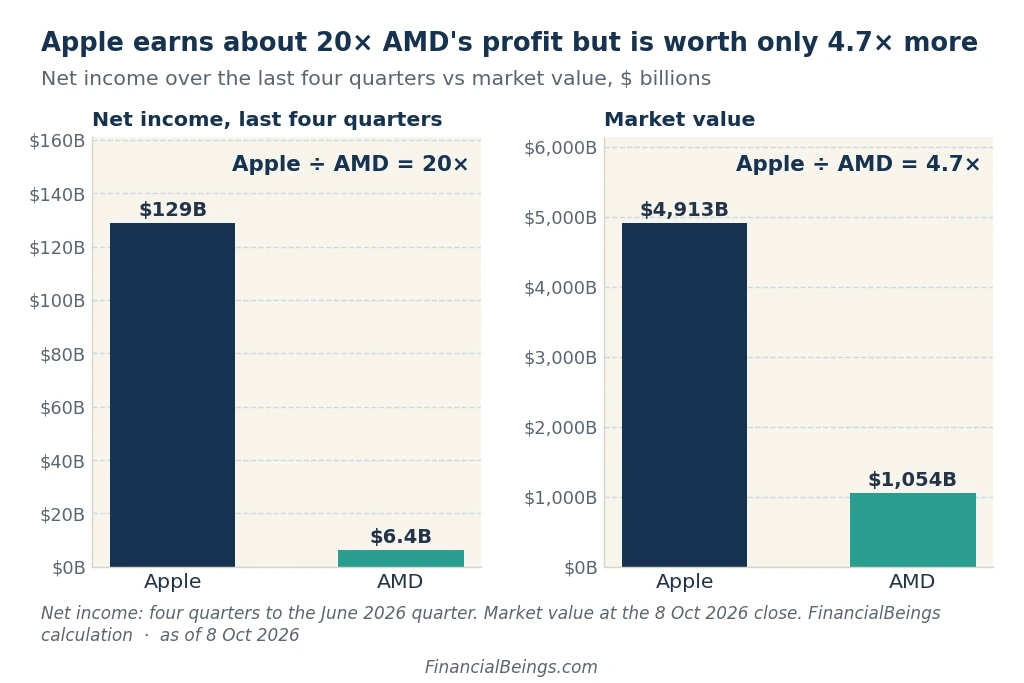
He’s right. AMD’s share price is up 201.6% in 2026. The total value of the chipmaker’s market capitalization reached $1 trillion, or $1,054 billion, on 8 October. The company that produced Sara’s pocket phone, Apple, has a value of $4,913 billion. That’s 4.7 times bigger.
That is what is bothering Sara. Apple has made a profit of $128.9 billion in the past 12 months. AMD earned $6.43 billion. Apple earns about $20 for every $1 AMD earns, yet is valued at only about $4.70 for every $1 of AMD’s value.
Thus, is AMD a good deal? Or is it the most costly on the shelves? In order to answer that, Sara must stop asking “which one is cheaper?” and start asking a better question. What assumptions about the future are made by each price?
AMD vs Apple Stock at a Glance
Let’s put AMD vs Apple Stock (2026) side by side.
| Metric | Apple | AMD |
| Share price (8 Oct 2026) | $336.67 | $645.86 |
| Market value | $4,913B | $1,054B |
| Revenue, June 2026 quarter | $109.4B | $11.54B |
| Revenue growth vs a year ago | +16.4% | +50.1% |
| Net income, last four quarters | $128.9B | $6.43B |
| Unlevered P/E | 38.6× | 193.4× |
| Unlevered P/B | 37.4× | 17.9× |
| Price change, 2026 to date | +23.8% | +201.6% |
| Price change, last 12 months | +30.5% | +174.2% |
Two terms require a brief explanation. Unlevered P/E is the cost of the entire business, including debt, but excluding cash, for every dollar of after-tax operating profit. Each dollar of Apple profit will cost approximately $39. Each dollar of AMD profit will cost appx. $193.
Unlevered P/B is the same concept, but in terms of the assets of the company that are used to operate its business. AMD’s 17.9× looks cheaper than Apple’s 37.4×. AMD has $41.8 billion in operating assets that consist of the company’s goodwill and intangibles, mostly from its purchase of the chip designer Xilinx. Not factories; that’s accounting value. Without it, AMD trades at about 72× its operating assets. Our earlier AMD stock analysis looks at the company’s balance sheet in more detail.
Which Company Is Growing Faster?
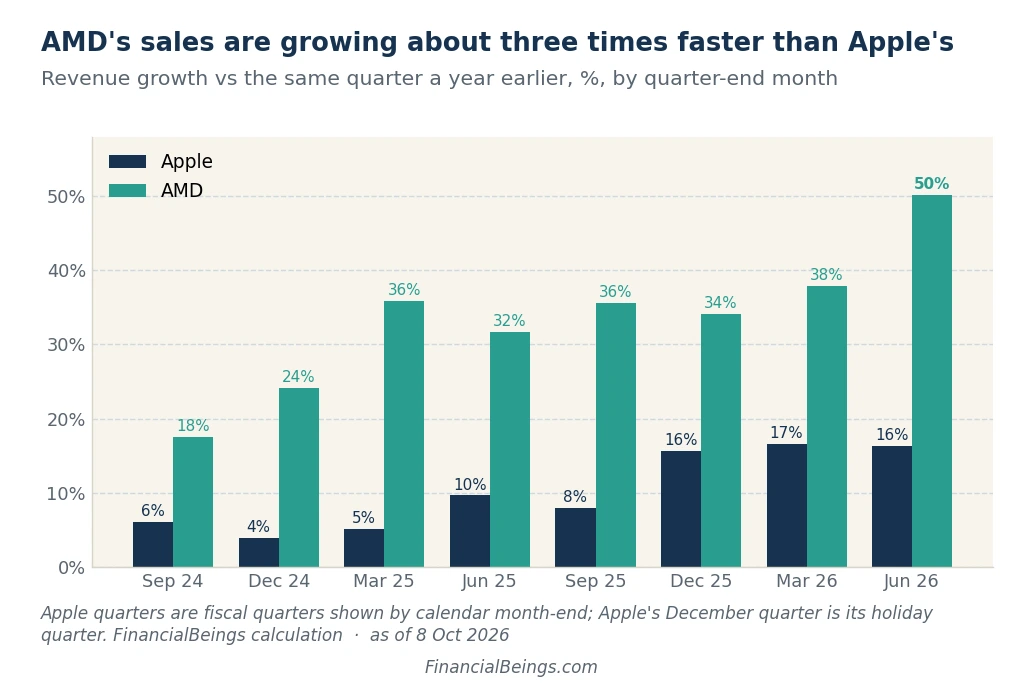
On growth, AMD vs Apple Stock (2026) isn’t close. It’s why Sara’s brother is excited.
| Quarter ending | Jun 2025 | Sep 2025 | Dec 2025 | Mar 2026 | Jun 2026 |
| Apple growth vs year ago | +9.6% | +7.9% | +15.7% | +16.6% | +16.4% |
| AMD growth vs year ago | +31.7% | +35.6% | +34.1% | +37.8% | +50.1% |
Apple’s revenue rose by 14.2% in the past four quarters. AMD’s grew 39.5%. That is about three times as fast, and it seems to be accelerating. For a closer look at how AMD’s growth compares with its biggest AI-chip rival, see our Nvidia vs AMD stock analysis.
There’s a catch, however. Size matters. Apple’s quarterly sales are approximately 10 times greater than AMD’s, at $109.4 billion compared to $11.5 billion. Consider a bakery that’s on a corner and a supermarket. The bakery can see sales doubled with the one new café contract. The supermarket is hardly aware. Thus, an additional dollar contributes ten times more to the growth rate of AMD.
By the way, the 50.1% is clean. The one-off charge was a negative that made AMD’s margin look weak a year ago, which flatters the margin comparison. It has no impact on revenue growth.
Which Business Earns More on Its Operating Assets?
It’s thrilling when things are growing quickly. Sara does, however, have a question that she needs answered. How much does each company get back when it invests one dollar?
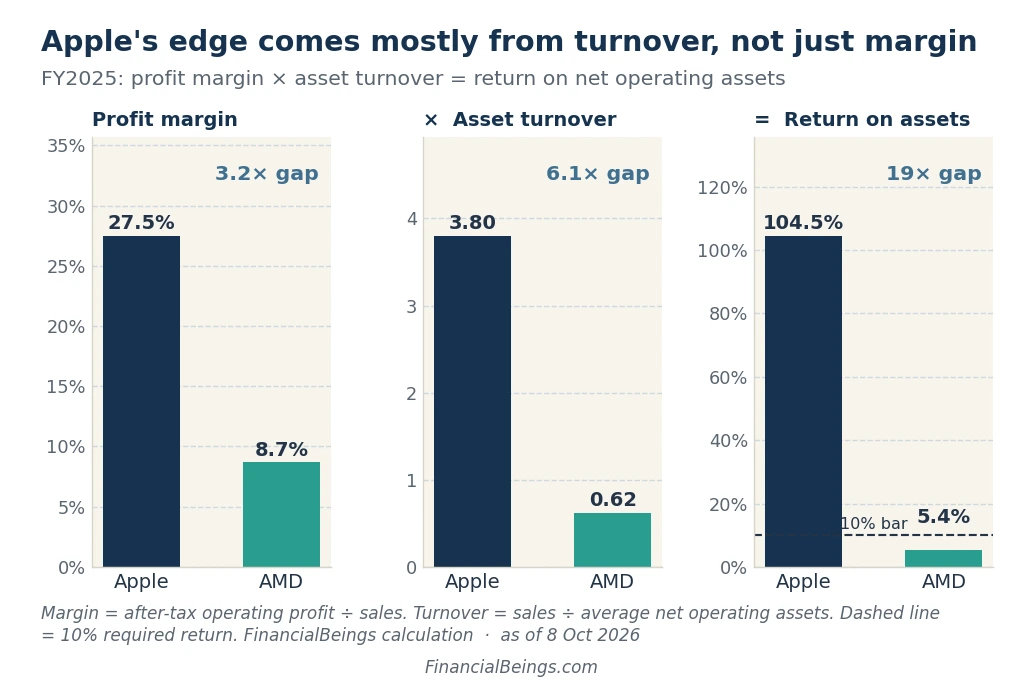
Three ideas, all very simple, give the answer to that. Profit margin is the number of cents made in operating profit per dollar of sales. The asset turnover ratio is the number of dollars of sales generated by each dollar of operating assets. Multiply them together, and you will find the return on operating assets.
| FY2025 | Profit margin | × Asset turnover | = Return on operating assets |
| Apple | 27.5% | 3.80 | 104.5% |
| AMD | 8.7% | 0.62 | 5.4% |
| Gap (Apple ÷ AMD) | 3.2× | 6.1× | 19× |
Read the last column carefully. Apple earns more than 100% a year on its operating assets. AMD earns 5.4%.
Most of the difference is due to turnover, not margin. At the end of 2025, the operating assets of AMD totaled $56.5 billion, of which $41.8 billion were goodwill and intangibles, primarily associated with Xilinx. Those assets exist on the books but are not chips. Take them out and AMD earns approximately 21% on the remainder. That’s good but not great.
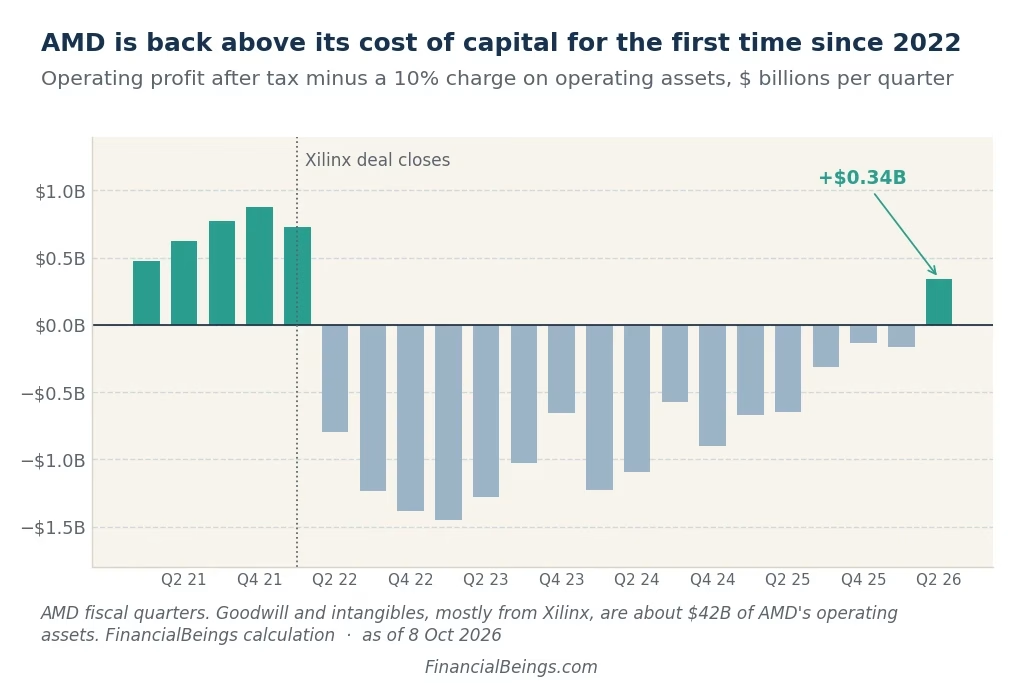
Now the bar. Investors want to get their money’s worth. The rate will be 10% per year for both companies. Profit above the cost of capital is the operating profit after tax minus a 10% charge on the assets that generated the profit. Positive means “the business is performing better than what investors need.”
| Profit above the cost of capital ($B) | Jun 2025 | Sep 2025 | Dec 2025 | Mar 2026 | Jun 2026 |
| AMD | −0.65 | −0.32 | −0.14 | −0.16 | +0.34 |
Last four quarters, Apple earned $116.4 billion on top of that. The net result: AMD was still slightly negative. But look at June 2026. For the first time since the Xilinx deal closed in early 2022, AMD crossed the line, recording a 12.5% annualized return on operating assets for the quarter. This is the crux of this story. We tracked the same turnaround in our AMD vs Qualcomm stock comparison.
What Is Each Share Price Assuming?
It’s the core of AMD vs. Apple (2026). A share price is a prediction. It can be read backwards to determine the amount of growth that the bet requires.
The price of Apple assumes that its profit over the cost of capital grows about 7.8% per year, indefinitely. AMD’s price assumes 8.2%. But growth isn’t all that’s required for AMD.
| At a 10% required return | Apple | AMD |
| Long-run growth the price assumes | 7.8% | 8.2% |
| Its own range since 2017 | 3.8%–7.8% | 7.9%–9.9% (2017–22) |
| Value per share with zero growth | $76.04 | $23.56 |
| Share of price that pays for growth | 77% | 96% |
This is the most growth Apple’s price has ever asked for. It’s at the highest end of its range at 7.8%. Our Apple stock forecast for 2030 shows how Apple’s value changes with long-term growth. AMD’s 8.2% is slightly below its 2017–2022 average of 8.9%. For years, investors have had high hopes in AMD.
Here’s the surprise that hit Sara. When a business earns less than its cost of capital, it is worth less the faster it grows, not more. Similar to “Lemonade Stand” but with a little lemonade being lost with each sip. It costs more for each additional cup that you pour. On AMD’s 2025 returns, each share is worth $0.94 at 6% growth, and less than nothing at higher growth rates.
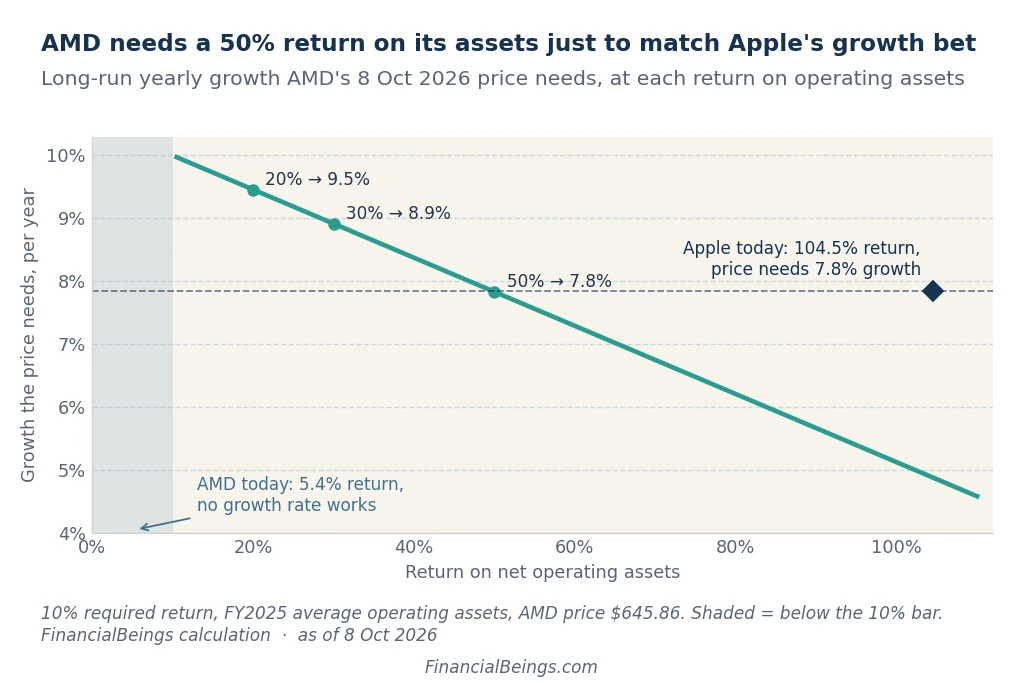
It is therefore really an investment in AMD’s return growth that’s being made through its price. How far?
| If AMD’s return on operating assets settles at… | …the price needs this growth every year |
| 5.4% (2025 level) | No growth rate works |
| 20% | 9.5% |
| 30% | 8.9% |
| 40% | 8.4% |
| 50% | 7.8% |
| Apple today, at 104.5% | 7.8% |
For AMD’s price to ask no more of it than Apple’s price asks of Apple, AMD must earn about 50% on its operating assets. That’s about nine times its 2025 level.
What Would Have to Be True for Each Price?
It’s easy to say and difficult to get right, and Apple’s price asks for exactly that: “Stay this good forever.” Apple’s price needs today’s profitability to persist and grow by 7.8% annually. If Apple grows just 5%, it would require a return more than 2x what it is getting now, a 41% margin, and a 5.6 turnover, all at once.
The role for AMD is to squeeze as much sales as possible from the asset which it purchased. To need no more growth than Apple’s price assumes, AMD would need a margin of about 26% and turnover three times the current level. It is not “margin” alone that will take you there. Even with the solid quarter in June 2026, with a margin of around 15% and turnover of 0.83, it requires 9.9% growth every year to warrant the price.
Dividends and Share Repurchases: Which Returns More Cash?
When a company repurchases its shares, the remaining shareholders will own a larger percentage of the company. If it issues more shares, each share gets smaller. This thinning is known as dilution.
| Shares outstanding (billions) | FY2016 | FY2022 | FY2025 | Change since FY2016 |
| Apple | 21.02 | 15.84 | 14.70 | −30.1% |
| AMD | 0.935 | 1.612 | 1.630 | +74.3% |
The share count has dropped by approximately 7% in three years for Apple. AMD jumped in 2022 as it paid for Xilinx with stock, which diluted existing shareholders by approximately one-third. See each company’s latest filings for dividend amounts and current yields.
Key Risks for Each Stock
AMD: 96% of the price is for growth yet to come. The business costs about 193 times its operating profit. The share count is up 74% since 2016. A stock that triples in a year can drop precipitously, too. AMD has also filed paperwork that highlights competition, export regulations, and supply restrictions. For how AMD stacks up against another AI-chip competitor, see our AMD vs Broadcom comparison.
Apple: The price assumes the most growth in Apple’s history, and 77% of that price goes toward paying for its future. Revenue is expanding at 14.2%, which is far below AMD’s growth rate. The issues of China and App Store regulation remain under debate.
Which Stock Fits Which Investor?
Sara is not in need of a tip. She has to decide which story she will believe.
It boils down to two types of bets when it comes to AMD vs Apple Stock (2026). AMD is a bet that it can raise its return on operating assets from around 6% to 30–50%, and then keep growing at 8–9% annually. For the first true proof that it has gone across the line, it was June 2026.
In return for paying for a record 7.8% growth forever, Apple investors get a business that already earns more than 100% on its operating assets and shrinks its share count every year. If you are weighing Apple on its own, read our take on whether Apple stock is worth buying in 2026.
Neither is safe. Both are demanding. The lower P/E is not the answer on its own.
FAQ
Is AMD a better investment than Apple stock right now?
It is subject to the assumptions you believe. Apple’s price needs today’s returns to last and its profit above the cost of capital to grow 7.8% a year. AMD has growth needs of 8.2% and needs returns several times what it earns today.
Is AMD still a good stock to own after passing $1 trillion?
At $1,054 billion, the price needs AMD’s returns to rise several times over, not just its sales.
How much would $10,000 have grown over five years?
From 8 Oct 2021 to 8 Oct 2026, about $23,560 in Apple and $61,475 in AMD. This is the price return, before dividends.
Does AMD pay a dividend?
Review the latest filings by AMD. Our data indicates that its share count is increasing, not decreasing.
Sources and Methodology
Valuation data is Financial Beings data derived from SEC filings. We divide each company into its operating business and its cash and debt, and calculate the profit above the 10% required return that the operating business makes, and solve for the long-run growth rate that today’s share price implies. Data as of 8 Oct 2026.