

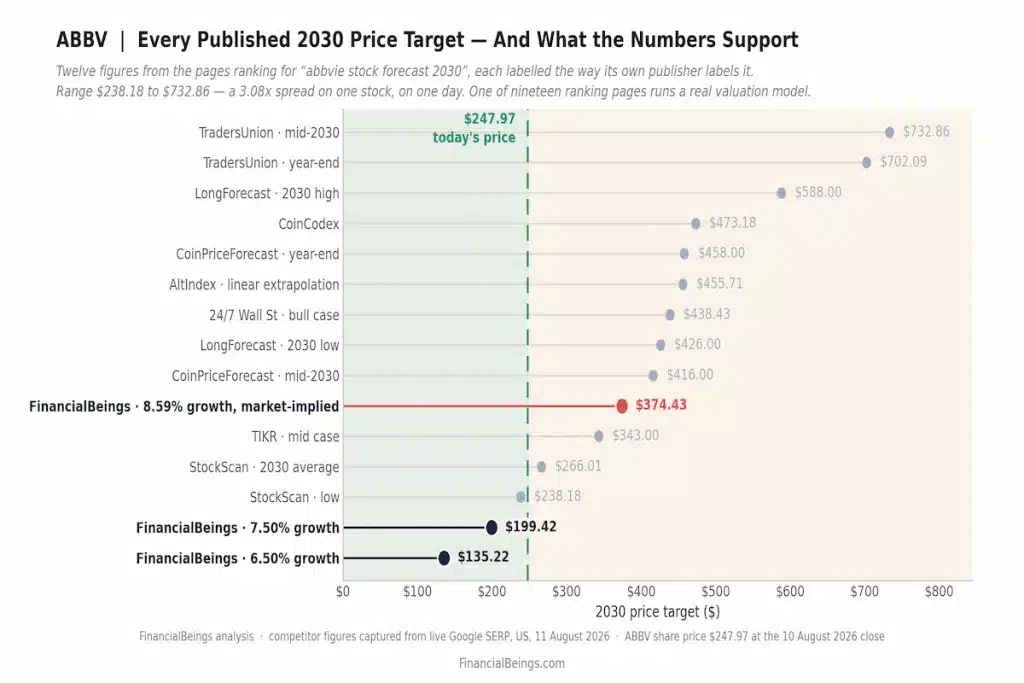
When you go to Google and search for “AbbVie stock forecast 2030”, you will come across something strange: One website forecasts that the AbbVie stock price will be close to $733. Another estimates it at almost $238. Same company, same day; the spread is too wide to be reasonable both times.
This difference isn’t within the margin of error. If much of what is found on the internet isn’t actual analysis, it’s a line that’s been continued along, or an analyst view averaged with a dozen others, and presented in the guise of a forecast. When it comes to numbers, it’s best to understand what they are based on and what must be true for them to be reliable. The subsequent sections break that down into its constituent parts, not just based on the headline price target, but in AbbVie’s own numbers.
What Is AbbVie’s Stock Price Forecast for 2030?
The truth of the matter is that it depends almost exclusively on one thing: the rate of growth of the business. No one is right or wrong here; there is a range, and where you fall in the range is determined by your growth assumption.
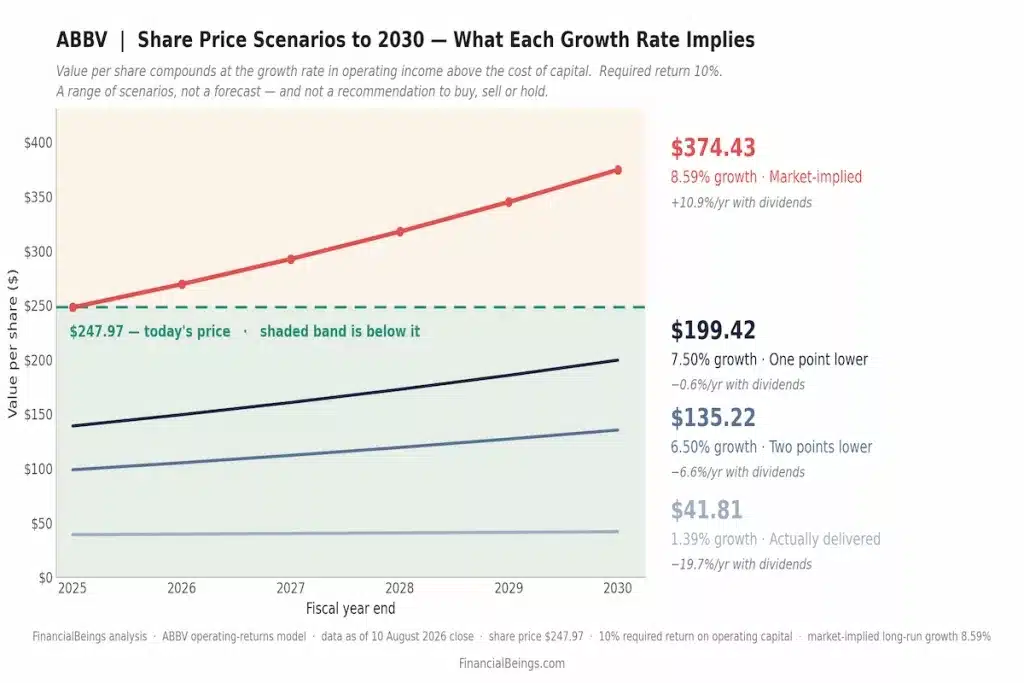
On August 10, 2026, AbbVie shares traded at $247.97. The market is pricing an annual growth rate of 8.59%, and if it continues to go up at that rate, it should be valued around $374 by 2030, plus the dividends earned. Reduce that growth rate by one percentage point, to 7.5%, and it becomes just about $199. Move it down two points, to 6.5%, and it’s approximately $135. If that growth is measured by the company’s actual results over the past few years, the figure is much less.
The range from a solid gain to a real loss, based on a single assumption, is the center of any legitimate AbbVie stock prediction. The forecasts didn’t differ that much about the future, anyway. It’s about the rate at which they are each going to grow without anyone knowing about it.
Why Do Price Targets Range From $238 to $733?
Go to twelve different sources to look for the AbbVie stock forecast, and you’ll get twelve different numbers, which differ by a factor of three from the lowest to the highest. A part of that spread is due to the timing and the methodology. This is mostly something simpler; few of these numbers are based on an actual valuation model.
Only a minority of the sources quoted in such rankings relate the target price to the fundamentals of the company (its profit, capital, growth). The rest interpolate a graph, use the average of other people’s estimates, or quote some number that hasn’t been updated in, say, months!
None of this implies a model-based estimate is a necessarily correct estimate. It is impossible to predict what 2030 will be like. However, one should ask before taking any price target as it is set, what is the assumption that’s working behind it?
If a number is not apparent, it’s more a guess than a forecast.
What Is AbbVie Actually Worth Today?
When determining a business’s value, analysts generally consider the profits it earns above the costs of running it. That “cost” is not just the expenses associated with it, such as rent, wages, and materials; it also includes a required return on the capital put at risk by the investors. This is the “cost of capital“, as economists say, the minimum return that an investment must generate to make it worthwhile to take the risk of investing.
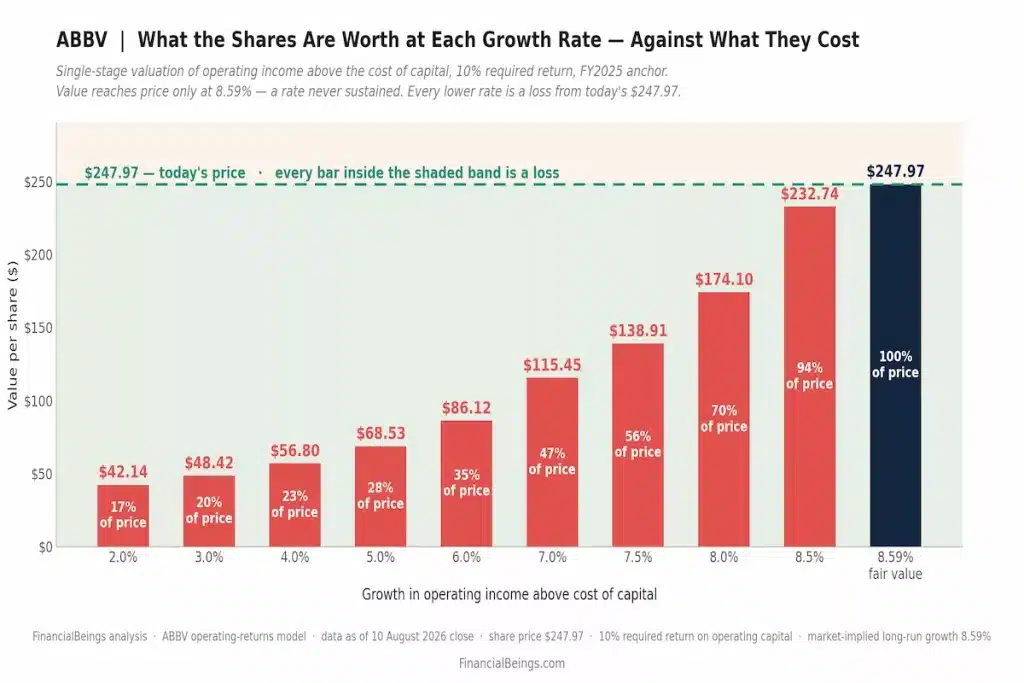
If the cost of capital has a typical value for a company of AbbVie’s size (10%), then the share price would only reach today’s level of $247.97 if the earnings above the cost of capital increase at an 8.59% rate every year, forever. The spread is sharp at more moderate growth; in the case of 5% growth, shares would be worth about $69, which represents a little less than 28% of today’s value. If the growth rate is only 8% for a stock, the fair value is approximately $174, which is still lower than the current price of the stock.
There’s something that seldom gets included in these forecasts. For earnings above the cost of capital to keep increasing at 8.59%, the operating asset base would in general have to grow at that same rate over the long run. Rather, the asset base has decreased by almost 35% from 2021 to 2026.
Much of the company has improved its profitability over the past few years by running its business more efficiently on a smaller asset base. This can be good for a couple of years. But holding it up as the foundation for a decade of growth is another matter, and it’s the largest of the many conflicts that lie beneath the price tag.
How Has AbbVie’s Return on Capital Actually Performed?
To its credit, AbbVie has overcome that hurdle time and time again. It has maintained a return on net operating assets that is above that 10% cost of capital since 2021, and at >22% in 2024.
When you examine that return in detail, you’ll see that it comes from two sources: the profit margin (the portion of each dollar of sales that is profit) and asset turnover (the efficiency of the company in generating sales on its assets). AbbVie’s profit margin has actually decreased since 2021 from just over 28% to about 20%.
Asset turnover has been the reason for the consistent returns as it has increased over the same time frame. AbbVie’s gains, in other words, have less to do with higher profits on each sale, and more to do with selling more drugs for every dollar invested. It’s an actual accomplishment, but a very limited one. To see how this return-on-capital profile compares against another diversified healthcare giant, check out our AbbVie vs Johnson & Johnson stock comparison.
What Growth Rate Is the Market Actually Pricing In?
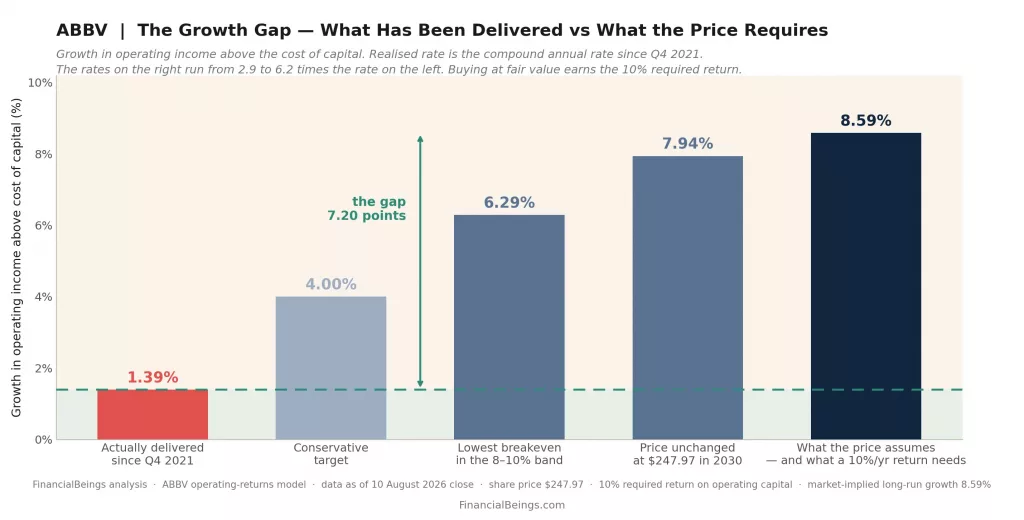
This is the number that has been central to any AbbVie stock forecast since the end of 2021: The company’s profit above its cost of capital has been growing at an annual rate of approximately 1.39%. Today’s stock price assumes 8.59% — more than six times that rate.
If you want to use a benchmark, one at the low end of the conservative growth analysts would probably target 4%. Even if the lowest growth rate would be considered necessary, which would justify the price for today, it is still around 6.3%, and only if the cost of capital is relaxed from 10% to 8%. The rate the price actually assumes is 8.59%.
The valuation doesn’t seem to value steady, moderate growth. It is at a price point to make a significant acceleration, which hasn’t manifested itself in the results yet. Curious how AbbVie’s growth assumptions compare to its closest peers? Our Lilly vs AbbVie vs Amgen breakdown puts all three side by side.
Why Aren’t the P/E Ratio and Dividend Numbers Telling the Full Story?
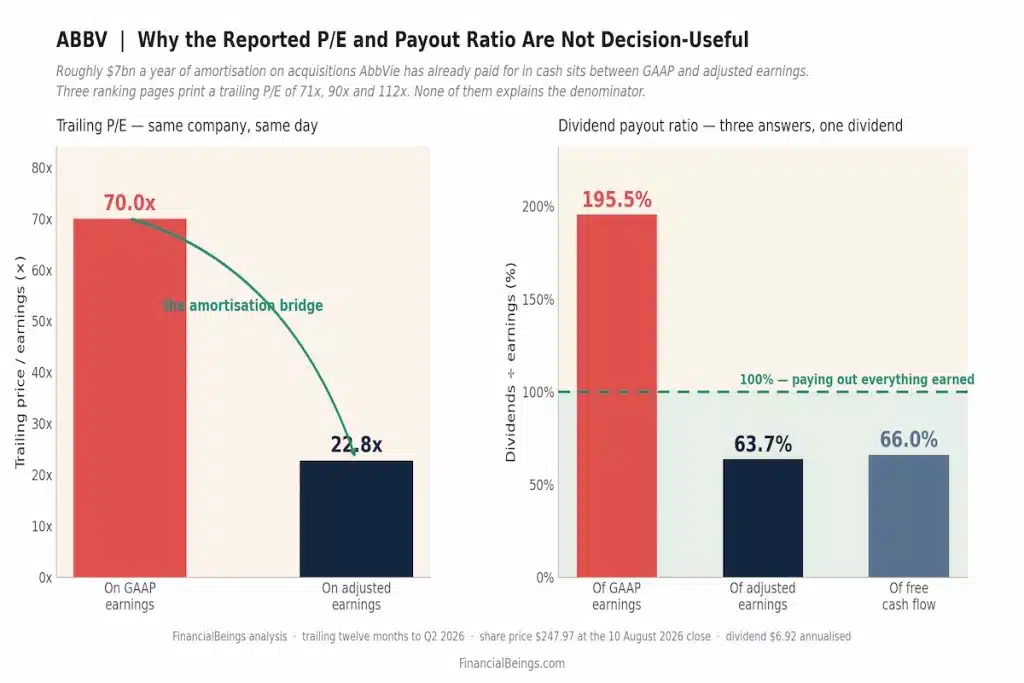
One of the more common ways to determine whether or not a stock is expensive or not is by a price-to-earnings ratio, or P/E, which is the share price divided by profit per share. AbbVie is cited as having anywhere from 70 to 112, all for the same company on the same day. For a side-by-side look at how AbbVie’s valuation multiples stack up against its closest pharma rival, see our AbbVie vs Eli Lilly stock comparison.
The problem is, what counts as “earnings”? Amortization, an accounting expense that allocates the cost of past acquisitions over several years, really slashes into AbbVie’s reported profit despite the cash having been used many years ago. Now that the non-cash charge is excluded, AbbVie’s P/E ratio is closer to, though still not cheap, 22.8, compared to 70 or 112.
The same sort of distortion is evident in the dividend payout ratio. However, on reported, unadjusted profits, AbbVie seems to be paying out approximately 195% of its profit as a dividend, which is typically considered to be a red flag, as a company simply cannot pay out more than its profits.
If viewed as a ratio of adjusted earnings or free cash flow, it’s a far more reasonable number, at 64–66%. It is also important to note explicitly: At the growth rate the price assumes, the dividend paid is approximately twice what that growth leaves available. If dividend income is a core part of your strategy, our roundup of best dividend stocks to buy includes AbbVie alongside other reliable payers.
What About Patent Cliffs and Pricing Pressure?
While no stock prediction can be complete without considering patent expiration, the expiration of that key patent may be one of the most important factors in AbbVie’s stock forecast. AbbVie’s previous blockbuster drug Humira, which was formerly protected by patent, is slowly giving way to its lower-priced biosimilar rivals. For now, newer medications like Skyrizi and Rinvoq have been able to compensate for that drop.
More recently, U.S. Medicare price negotiations have begun slowly lowering prices on an increasing number of selected drugs. This is no hypothetical headwind, but a real one – and something to keep an eye on as more drugs are put on the negotiation table in the coming years. To see how AbbVie’s return profile stacks up against other major healthcare players, check out our roundup of the best large healthcare companies.
What Does the Path to 2030 Actually Look Like?
Based on its 2024 results, AbbVie has guided revenue growth at a high-single-digit rate through 2029. Notably, the company has not provided a guideline towards 2030; a good reminder that even management doesn’t claim visibility that far. Any 2030 discussion, anywhere, is dependent on assumptions; it is not a guarantee.
Three Scenarios, Laid Out Plainly
To summarize, combining all the pieces, there are three scenarios to consider:
With that current price growth in the stock (8.59%), shares would be valued around $374 by 2030, and total returns (including AbbVie stock dividend) would be around 11% annually, which is a respectable return.
Where growth is one point lower (7.5%) then the share price falls, and with dividends taken into account, there is a slight net drop.
Growth of two points less (6.5%) is definitely negative even if the dividends are taken into consideration.
The question across all of the different versions of this AbbVie stock forecast is the same: whether growth comes in below the rate already reflected in the price, and whether the market will continue to pay the price they set today. That’s an important point to keep in mind, but not one for concern; it’s an evaluation of the assumptions behind any forecast based on its headline number instead.
Numbers on this page are subject to change as they are updated with new information and guidance as they become available, as of August 10, 2026.
Frequently Asked Questions
What is AbbVie’s stock price forecast for 2030?
It is growth-dependent. The shares would be worth about $374 by 2030, based on the market’s estimate of 8.59% annual increases. With slower growth of 6.5%, the number is approximately $135.
Is AbbVie stock overvalued right now?
The shares are at fair value at today’s price only if the company can grow profit above its cost of capital at 8.59% per annum, which it hasn’t been able to achieve in recent years. If growth comes in below that rate, the shares are overvalued at today’s price.
What growth rate does AbbVie’s stock price assume?
The price implies an 8.59% annual increase in operating profit over the cost of capital, while the actual operating profit growth since the end of 2021 is around 1.39% per annum.
How does AbbVie’s dividend payout compare to its earnings?
The earnings payout ratio is approximately 195% based on the official earnings. It falls to the 64–66% that is considered to be a more sustainable level when considering adjusted earnings and free cash flow.
What is AbbVie’s return on capital?
Since 2021, RNOA has been above the 10% cost of capital, with 2024 seeing a double-digit increase above the cost of capital, but primarily driven by efficiency gains and not by increased profit margins.
Will Medicare price negotiations affect AbbVie’s 2030 outlook?
Yes. A real, ongoing consideration in AbbVie’s longer-term growth prospects is the U.S. Medicare price negotiation, which will gradually decrease the prices of selected AbbVie drugs.