
Suppose that your friend, Sara, has been watching Amazon for some time. She’s not a trader. She has just a little bit of cash and a gut sense that “Amazon’s not going away.” One evening, she logs in to her brokerage app, and the price is $248.63. But is it too much?
The question is: how is an Amazon stock forecast 2030 supposed to answer that, beyond a gut feeling? And the math tells a tale most people are never told: much of what Sara would be paying for is not the Amazon of today.
Quick Answer: Amazon Stock Forecast 2030 & 2040
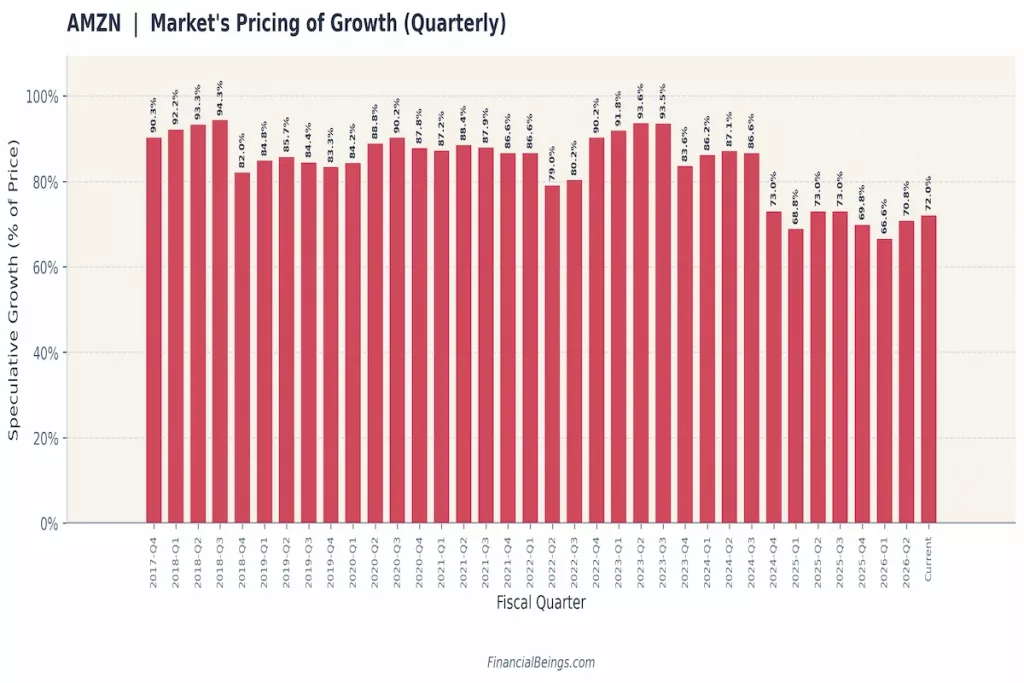
The short version goes like this. Our model puts Amazon around $387 by 2030 and $1,045 by 2040 in the base case. However, most forecasts leave out a crucial aspect of the purchase: about 72% of the price is a wager on yet-to-be-achieved growth.
This isn’t a criticism; it’s just a description of how the price is built. But it changes the way you read all the big numbers thrown around about Amazon’s future.
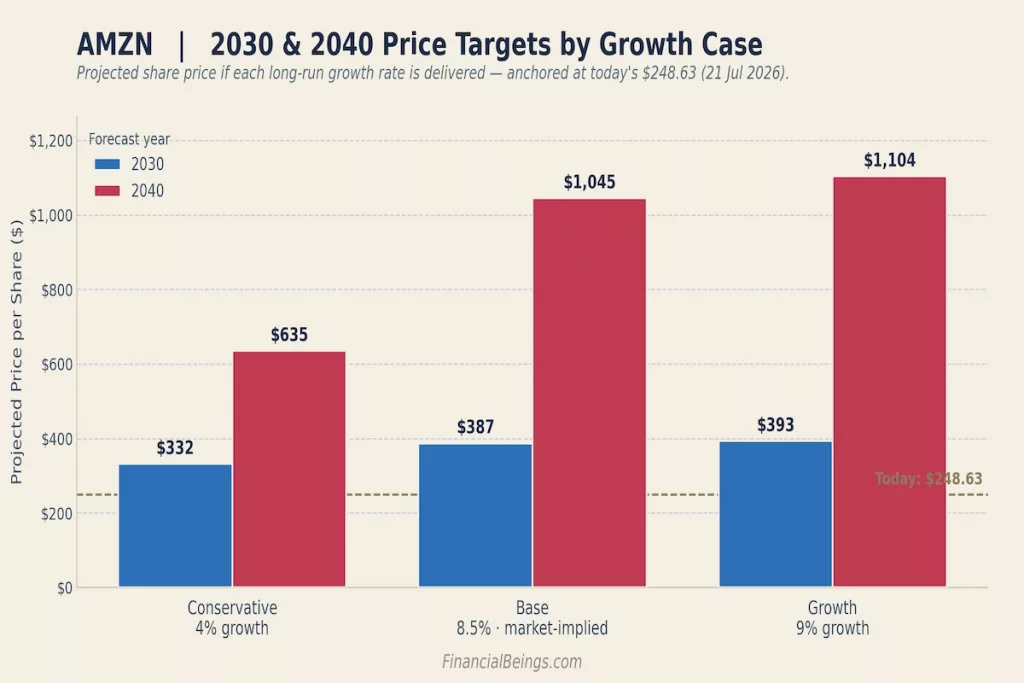
The table below illustrates what you would be getting each year if you purchased today under three different growth paths: slow, average and strong.
| Scenario | If long-run growth is… | Return/yr | 2030 Target | 2040 Target |
| Conservative | 4% (economy-like) | 6.7% | ~$332 | ~$635 |
| Base | 8.5% (what the market expects) | 10.4% | ~$387 | ~$1,045 |
| Growth | 9% | 10.9% | ~$393 | ~$1,104 |
Anchored at $248.63, the closing price on 21 Jul 2026. These are not wild guesses; they reflect the return you would receive if you bought the stock today and one of the growth scenarios played out.
Take a moment to observe that the change from “Base” to “Growth” is not very large. The transition from “Conservative” to “Base” is quite dramatic. The rest of this article is the story of that gap.
What the Price Already Assumes
Let’s go back to Sara and her $248.63. What is the origin of that number?
Strip away the buzzwords and the headlines, and a stock price is simply the value of the company as it stands today plus the value people believe it will create in the future.
Consider purchasing a bakery. Part of the price covers the ovens, the recipes and the customers already coming through the door. The other part pays for the bakery you hope it becomes — three more locations and a loyal following it hasn’t built yet.
The ‘already there’ part of Amazon is surprisingly small. Of that $248.63 share price, only about $69.62 is covered by the business as it exists today: the company’s book value (around $38.31 — essentially what would be left if you sold all of its assets and paid off all of its debts) plus the profit it is already making over its costs (around $31.31).
That leaves about $179 — almost three-quarters of the price — being paid for what hasn’t happened yet.
Read backwards, the price tells you something specific: it only makes sense if Amazon keeps growing its excess profit at approximately 8.5% annually, essentially forever. The overall economy grows at a long-term average of about 4%. So the market isn’t just betting on Amazon keeping up with the economy; it’s betting on Amazon running twice as fast as the economy for years to come.
Here’s the lesson to ponder: you are not buying Amazon’s past; you are pre-paying for a specific, demanding future.
Year-by-Year Targets, Explained
But where did the numbers $387 and $1,045 come from? Not from looking at a stock chart and drawing a line up. They come from compounding — growth building on top of itself, like interest on interest — applied consistently in each scenario out to 2030 and then out to 2040.
The Base case, which puts the price at $1,045 by 2040, is not our independent forecast. It is just the market’s current view, taken to its logical conclusion. If the 8.5% growth you are paying for today actually occurs year after year, you’ll make approximately a 10.4% return on your money annually.
That sounds decent. But it’s not a bargain; it’s the market getting exactly what it paid for. There’s no buffer — no “margin of safety,” as investors say: the discount that keeps you safe if things go a little wrong. At today’s price, there isn’t one.
Only when Amazon grows at a greater rate than the baked-in growth can you beat that 10.4%.
The honest read on any Amazon stock price prediction — is the same: a great business at a demanding price. Not a red flag, and not a green light either; just a fact to know before you decide.
The Return You’re Really Buying
Let’s break that anticipated return into its constituent parts, as this is where it gets interesting.
Of the roughly 10.4% you would expect in the base case, only about 3.5 percentage points come from profit the business already makes — the bakery that is open and selling bread today. The remainder, most of the return, is only realized if the growth narrative unfolds.
The majority of the value (72%) in the price is a growth bet, and the majority of the return is on that growth bet. Not a retail company, not a cloud-computing company, not an advertising company — none of those is what you’re buying at this price. You’re buying growth. Growth by its nature is unpredictable; it can come early, late, or simply not at all.
Let’s see how the returns you would make evolve with the various growth paths:
| If long-run growth proves to be… | The return you’re buying today |
| 4% (economy) | ~6.7% |
| 6% | ~8.4% |
| 8.5% (what’s priced in) | ~10.4% |
| 9% | ~10.9% |
Notice how flat the curve is at the top — from 8.5% to 9% growth, there is hardly any difference in return. Now look at how steep it gets at the low end. The real danger in an Amazon stock forecast is that the downside is much larger than the upside.
The Growth Case, Stated Fairly
None of this means Amazon is resting on its laurels. Far from it — the business has genuinely inflected.
If we calculate the “excess” operating income over what a normal, unremarkable business would make on the same assets, the past three years have seen a 9x increase, from about $0.6 billion per quarter to about $5.6 billion per quarter. That is no rounding error. This is a profit engine that has shifted into a new gear.
There’s a genuine moat here, too — one that is difficult for competitors to match. One measure: the value of Amazon’s earning power (its profits, capitalized the way a bond is) is about $340 billion, compared with the roughly $36 billion it would take a competitor to build Amazon’s warehouses, servers and other assets from scratch. That is almost a 10-fold gap between the value of the business and the cost of rebuilding it. That gap is the moat.
This is not a “cheap and broken” story, where a company sells cheaply because something is amiss. It is just the reverse: “expensive and improving.” The debate about Amazon isn’t about the quality of the business — that is almost universally recognized. It’s all a matter of price: what you are being asked to pay for something that is already good.
Why Published Forecasts Disagree So Much
If you’ve done some research on an Amazon stock forecast 2030 or a 2040 prediction before, you may have noticed something unsettling: the figures are all over the place. The projected 2040 prices from various analysts and firms range from around $538 to $2,500 — almost a 5x difference between the lowest and the highest.
Why such a mess? Nearly every one of those forecasts begins with a guess about a growth rate — pick a number that feels reasonable, then extrapolate it. Different guesses, vastly different results.
This piece does the opposite. Instead of guessing at growth, it reads the growth rate already reflected in today’s $248.63 price and shows the return each growth outcome would pay. That is why the figures here are anchored to something tangible while so many others scatter across the map. It’s the difference between forecasting the weather and reading the thermometer.
Will Amazon Hit $500 / $1,000 / $2,000?
This is usually the question people actually came here for. Based on the base-case path, the 8.5% growth scenario, starting from today’s price:
- $500 – around 2033
- $1,000 – around 2040, though it’s worth repeating: this is just the market’s already-priced-in path. Hitting $1,000 in this scenario means you earned your ordinary ~10% a year, not some windfall. It’s the destination the market already expects, not a surprise upside.
- $2,000 – not until the mid-to-late 2040s, even in this scenario.
If growth instead settles closer to the economy’s slower, more ordinary 4% pace, every one of these milestones lands several years later than the dates above.
Amazon’s Real Risk: Valuation, Not Solvency
The top concern with Amazon at the moment isn’t the company going “under.” Its balance sheet is solid: net debt (what it owes minus the cash it holds) is around $47 billion, or less than 2% of the company’s total value. It’s not a solvency risk; it’s a valuation risk. The company isn’t in jeopardy — the question is the price you pay for it. We cover this distinction in more detail in our complete Amazon stock analysis.
That’s the air pocket to be aware of: if growth slows back to the roughly 4% that is normal for the economy, rather than the 8.5% expected by the market, your return would be about 6.7% a year, and the fair value of the stock today would be about $90. That’s not a small gap from $248.63. That’s the cost of a re-rating — the market suddenly deciding it was wrong about the future and adjusting prices accordingly.
There’s a second aspect to watch besides headline profits. Amazon’s profit recovery in recent years has largely been margin-led, even as the capital required to operate the business has kept rising. In 2018, Amazon needed approximately 10 cents of assets for every $1 in sales. It now needs approximately 46 cents. The profits are increasing, but so is the asset base holding them up.
Today’s price already reflects a hefty expectation of a further “ramp” in profits. If that ramp falters, the math breaks with it.
The primary growth drivers to keep an eye on are AWS (Amazon’s cloud computing arm), advertising and AI (artificial intelligence). The biggest risks are regulation, competition, heavy AI spending and Amazon’s historically thin retail profit margins. See our picks for best AI stocks to buy now if you want to explore this trend beyond Amazon.
Frequently Asked Questions on Amazon Price Forecast (FAQs)
What will Amazon stock be worth in 2030?
Our base case is about $387, assuming the market’s currently implied ~8.5% growth holds. The slower, economy-like growth path points to about $332, while the stronger path points to about $393.
What about 2040?
In the base case, approximately $1,045. The conservative case points to about $635, while the stronger growth case points to about $1,104.
Is Amazon a good investment right now?
A great business at a demanding price. The expected return of about 10.4% only materializes if the growth arrives, since the majority of the price (72%) is a bet on the future. That’s fair compensation for the risk, but there’s no cushion at about $249.
Will Amazon reach $1,000?
Around 2040 on the base-case path. But that is simply the market’s priced-in expectation playing out — you’d be earning your ordinary return, not a windfall.
How high can it go?
In the stronger growth scenario, about $1,104 by 2040. Going meaningfully higher would need Amazon to beat the already-aggressive growth baked into today’s price.
What’s the biggest risk?
That growth slows towards the economy’s normal ~4% rate. If this occurs, the return drops to approximately 6.7% annually and fair value today would be around $90 — the price would have to reset for the reward to justify the risk.