
Not financial advice. All figures are point-in-time. Verify with primary sources (company IR, SEC EDGAR) before making investment decisions.
| TL; DR – Quick Verdict Tesla (TSLA): Growth/AI play. $1.49T market cap. No dividend. 370x trailing P/E. 54% US EV share. Net margin 3.95% TTM. Equity ratio 84.2%. 10-yr return ~2,659%. Ford (F): Income/value play. ~$56B market cap. ~4.3% dividend yield ($0.60/yr). Forward P/E 7.66x. EV losses ~$4-4.5B guided 2026. ROE swung to -22.7% in 2025. Tesla appeals to growth investors; Ford appeals to income investors who are seeking yield. Neither is always the best option; it depends on your goal. |
Tesla vs Ford Stock at a Glance (2026 Snapshot)
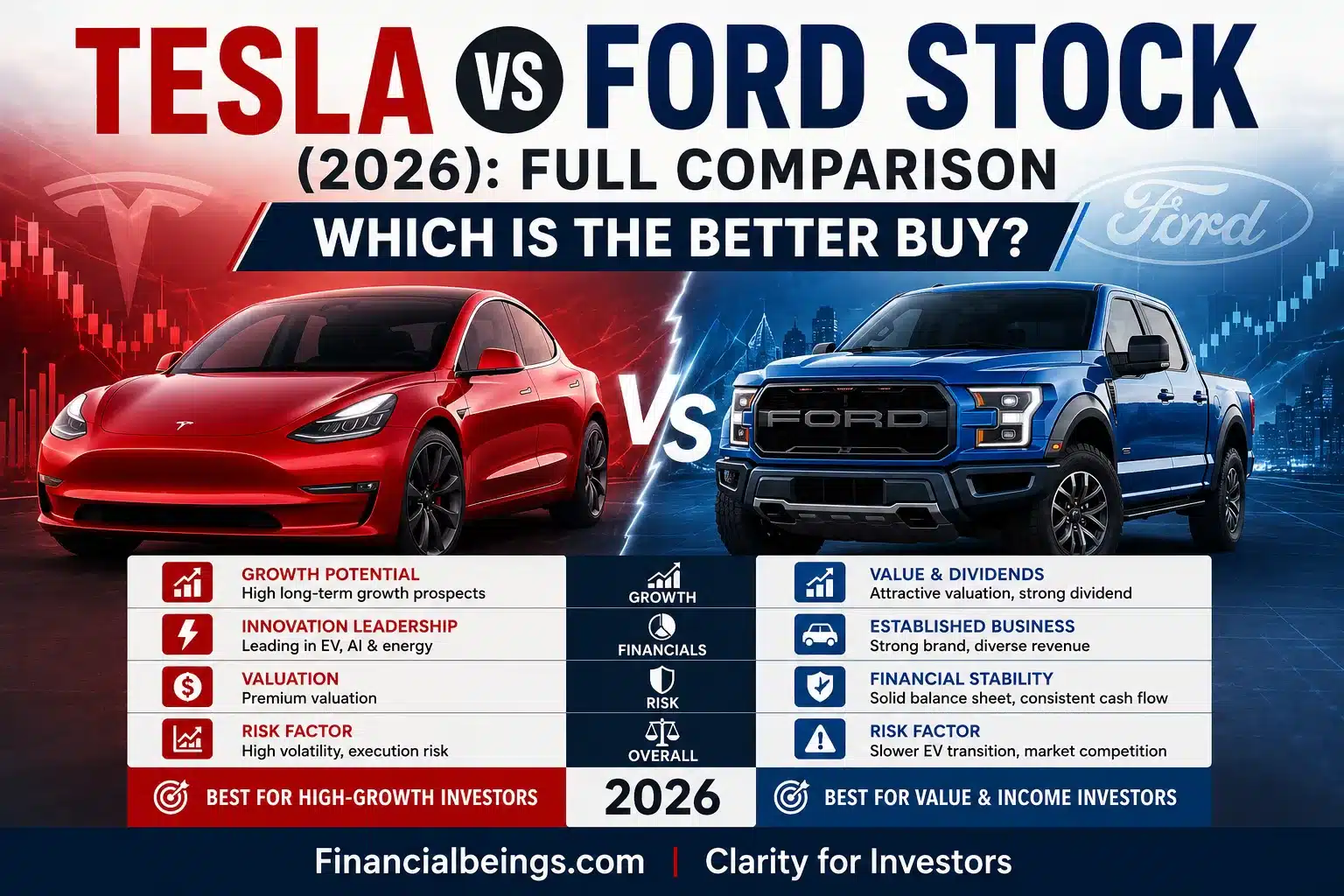
Tesla is a growth and AI play, trading at a huge premium, while Ford is a value and income play with ~4.3% dividend yield, but no tech optionality like Tesla.
Tesla’s market cap is about 27 times that of Ford’s, despite Ford having a revenue of nearly twice that of Tesla. This is because expectations and AI optionality are a factor, rather than current earnings.
| Metric | Tesla (TSLA) | Ford (F) |
| Share Price (21 Jun 2026) | $400.49 | $ 14.06 |
| Market Cap | ~$1.49–1.50T | ~$56B |
| 52-Week High | $498.83 | $14.95 (22 May 2026) |
| P/E (Trailing) | 370.8× | N/A (neg. earnings) |
| Forward P/E | 160.2× | 7.66× |
| PEG Ratio | 5.72 | 8.48 |
| P/B Ratio | 18.29× | 1.50× |
| EV / EBITDA | 122.3× | 32.2× |
| Dividend / Yield | $0 (none) | $0.60 / ~4.3% |
| Q1-2026 Revenue (YoY) | $22.4B (+16%) | $43.3B (+6%) |
| TTM Revenue | $97.9B | $189.9B |
| Net Margin (TTM) | 3.95% | -3.22% |
| Gross Margin (Q1-26) | 21.08% | 18.36% |
| Operating Margin (TTM) | 5.41% | -3.77% |
| Return on Equity (TTM) | 4.55% | -16.29% |
| Free Cash Flow (TTM) | $7.0B | $9.5B |
| US EV Market Share (Q1-26) | 54.2% | ~3-4% |
| Relative Volatility | ~10.5% | ~7.1% |
| Analyst Price Target | ~$416-420 | ~$13.85-14.09 |
| 10-Yr Total Return | ~2,659% (~39%/yr) | ~4.6-7%/yr |
Stock Price & Market Cap: Why Tesla Is Worth ~27x Ford
Tesla’s ~$1.49T market cap, versus Ford’s ~$56B, is driven by autonomous driving, AI robotics, and optionality, not current profits.
If you’re considering buying Tesla, the stock price of $400.49 is a bit high, while the stock price of $14.06 at Ford is a bit low. The per share price is of no use without any context: the total market capitalization. This section summarises the three structural causes of the valuation gap in the table below.
| Factor | Tesla (TSLA) | Ford (F) |
| Share Price (21 Jun 2026) | $400.49 | $14.06 |
| Market Cap | ~$1.49-1.50T | ~$56B |
| Market Cap Multiple | ~27x Ford | Baseline |
| 52-Week High | $498.83 | $14.95 (22 May 2026) |
| Revenue (TTM) | $97.9B | $189.9B (2x Tesla) |
| Reason 1: Margins | Higher operating margin | Lower/cyclical margin |
| Reason 2: AI pipeline | Robotaxi, Optimus, FSD | No autonomous program |
| Reason 3: Optionality | Technology premium | Cyclical auto multiple |
Valuation Comparison: Is Tesla Overvalued?
Tesla’s 370.8x trailing P/E and 160.2x forward P/E compare with Ford’s 7.66x forward P/E. Yet on a PEG basis, adjusting for growth, Ford (8.48) is actually more expensive than Tesla (5.72).
Conventional wisdom ends with the PEG ratio. Ford’s expected EPS growth is ~1% compared to Tesla’s ~28%. A low P/E divided by zero growth is a high PEG, but Ford is not the cheaper stock on a growth-adjusted basis. Many investors wonder why Ford stock remains so cheap despite its low valuation. For a deeper analysis, check: Why ford stock is so cheap. This is a counterintuitive piece of information that most analyses have not considered.
| Valuation Metric | Tesla (TSLA) | Ford (F) |
| Trailing P/E | 370.8x | N/A (neg. TTM earnings) |
| Forward P/E | 160.2x | 7.66x |
| PEG Ratio | 5.72 (lower = cheaper) | 8.48 (higher!) |
| P/B Ratio | 18.29x | 1.50x |
| EV / EBITDA | 122.3x | 32.2x |
| Implied EPS Growth Rate | ~28%/yr | ~1%/yr |
| What does the multiple imply | AI/autonomy optionality | Cyclical value – no growth |
PEG = P/E divided by earnings growth rate. A lower PEG indicates better value for growth. Despite Ford’s dramatically lower P/E, its PEG of 8.48x exceeds Tesla’s 5.72x because Ford’s implied EPS growth is only ~1%.
Dividend & Income: Ford’s ~4.3% Yield vs Tesla’s $0
The annual $0.60/share dividend is covered by the free cash flow, representing ~4.3% dividend yield. For more high-yield dividend stocks, check our latest list: Best dividend stocks to buy in 2026. Tesla has never paid a dividend and instead uses all of the capital to invest in R&D, AI, and autonomy.
| Dividend Metric | Tesla (TSLA) | Ford (F) |
| Annual Dividend | $0 (never paid) | $0.60/share |
| Dividend Yield | 0% | ~4.3% (Jun 2026) |
| Payout Ratio (TTM) | 0% | N/A (neg. net income) |
| Dividends / TTM FCF | 0% | ~34.29% |
| Q1-26 Dividends / FCF | 0% | 57.26% |
| Dividend history | No dividend ever | Suspended in 2020 |
| Capital use instead | R&D $1.95B/quarter | Ford Pro expansion |
Ford’s TTM dividends are ~34.29% of TTM free cash flow, which is within a healthy range. But in 2020, Ford suspended its dividend due to COVID; income investors should use the yield conditionally.
Performance & Returns: 10-Year History and ROE Trend
Over 10 years Tesla returned ~2,659% (~39%/yr); Ford returned ~4.6-7%/yr. The trend in the 10-year ROE below measures the quality difference and Ford’s perilous cyclicality.For a detailed forecast of where Tesla stock could go by 2030 driven by AI, Robotaxi, Optimus, and energy growth, read our full analysis: Tesla stock forecast 2030.
Tesla’s ROE went into positive territory in 2020 (3.2%), peaking at 28.1% in 2022, after which the margin pressures began to take a toll. Ford’s ROE is clearly cyclical, and the swings in the margin are quite large nearly 60 percentage points from peak to trough over four years.
| ROE % | 2020 | 2021 | 2022 | 2023 | 2024 | 2025 |
| Tesla | 3.2% | 18.3% | 28.1% | 23.9% | 9.7% | 4.6% |
| Ford | -4.1% | 36.8% | -5.0% | 10.1% | 13.1% | -22.7% |
Profitability Deep-Dive: DuPont Decomposition & Credit Quality
DuPont breaks ROE into margin x turnover x leverage. The same is true of both companies; asset turnover is nearly identical (0.68x vs 0.67x), with the difference being margin quality and debt amplification.
The operational quality is high, with low leverage (1.69x), which is the origin of Tesla’s 4.55% ROE. Ford’s -16.29% ROE is a manageable margin loss, which is exacerbated 7.53x by financial leverage. This is the aspect of its business that is least noticed, but has been the most significant advantage for Tesla: its equity ratio stands at 84.2%, compared to Ford’s 19.0%.
| DuPont Metric (TTM) | Tesla (TSLA) | Ford (F) |
| Net Margin (Return on Sales) | 3.95% | -3.22% |
| x Asset Turnover | 0.68x | 0.67x |
| x Financial Leverage (Equity Mult.) | 1.69x | 7.53x |
| = Return on Equity (ROE) | 4.55% | -16.29% |
| Return on Assets (ROA) | 2.69% | -2.16% |
| Return on Total Capital (ROTC) | 5.74% | -4.14% |
| Return on Capital (ROC) | 3.84% | -1.88% |
| Equity Ratio | 84.2% | 19.0% |
| Gross Margin | 19.07% | 2.14%* |
| Operating Margin | 5.41% | -3.77% |
| Trailing P/E | 370.8x | N/A (neg. earnings) |
| Forward P/E | 160.2x | 7.66x |
| PEG Ratio | 5.72 | 8.48 |
| P/B Ratio | 18.29x | 1.50x |
| EV/EBITDA | 122.3x | 32.2x |
| EBITDA ($mm) | $12,067 | $6,020 |
| FCFE / FCFF ($mm) | $8,443 / -$3,457 | $10,159 / $2,076 |
Ford’s gross margin reads 2.14% in the DuPont TTM model due to the 2025-Q4 write-down. Q1-26 clean gross margin is 18.36%. EBITDA and FCFE/FCFF differ across models due to TTM window differences.
Quarterly Credit Ratios
The table below provides FinancialBeings’ CALCULATED RATIOS based on the internal credit analysis models, as of 21 June 2026.
| Ratio | TSLA Q1-26 | TSLA TTM | F Q1-26 | F TTM |
| Gross Margin % | 21.08 | — | 18.36 | — |
| Operating Margin % | 4.20 | — | 5.38 | — |
| Net Margin % | 2.13 | — | 5.89 | — |
| Return on Equity % | 0.57 | 4.82 | 6.80 | -18.89 |
| Return on Total Capital % | 0.90 | 6.52 | n/a | n/a |
| Assets / Liabilities x | 2.44 | — | 1.15 | — |
| Net Tangible Assets / Liab. x | 1.43 | — | 0.15 | — |
| EBIT Coverage x | 9.13 | — | 9.32 | — |
| EBITDA Coverage x | 23.70 | — | 14.70 | — |
| Total Debt / Capital % | 9.62 | — | n/a | n/a |
| Total Debt / EBITDA x | 4.14 | 2.98 | n/a | n/a |
| Total Debt / Op. Cash Flow x | 2.29 | 2.09 | n/a | n/a |
| Dividends / FCF % | 0 | 0 | 57.26 | 34.29 |
Financials & Growth: Revenue, Margins, FCF & Q1-2026 Earnings
Over time, Tesla’s clean margins are significantly higher, though Tesla’s revenue is lower (+16% YoY vs +6% YoY in Q1-26), and Ford’s revenue is almost double its rival’s amount of $189.9B.
The losses are clearly attributable to the net loss of a single quarter (Q4-2025: ~$10.7B Model e impairment) for Ford. Ex that charge, the three trailing quarters produced ~+$5.0B in net income, a testament to the underlying cash-generating business operations. On a clean quarter basis, the margins of both companies are much closer in the Q1-26 timeframe.
| Financial Metric | Tesla (TSLA) | Ford (F) |
| Q1-2026 Revenue | $22.4B | $43.3B |
| Q1-2026 YoY Growth | +16% | +6% |
| TTM Revenue | $97.9B | $189.9B |
| Q1-26 Gross Margin | 21.08% | 18.36% |
| Q1-26 Operating Margin | 4.20% | 5.38% |
| Q1-26 Net Margin | 2.13% | 5.89% |
| TTM Net Margin | 3.95% | -3.22% (write-down) |
| Q4-2025 Model e charge | N/A | ~$10.7B impairment |
| Q4-2025 Net Income | N/A | -$11.06B |
| 3 Qtr ex-write-down net | N/A | ~+$5.0B |
| TTM Free Cash Flow | $7.0B | $9.5B |
| FCFE (TTM) | $8.4B | $10.2B |
| FCFF (TTM) | -$3.5B | $2.1B |
| EBITDA (TTM) | $12,067M | $6,020M |
| R&D Spend | $1.95B/quarter | Not disclosed |
EV Market Share & Products (2026): Cybertruck vs F-150 Lightning
Tesla holds 54.2% of U.S. EV sales in Q1-2026. The impact of the EV tax-credit expiry and a drop in demand was particularly harsh for Ford’s EV sales, which dropped ~70% YoY. To see how Tesla compares with the global EV giant BYD, read our detailed analysis: BYD vs Tesla – which EV stock is the best buy?“
| EV & Product Metric | Tesla | Ford |
| US EV Market Share Q1-26 | 54.2% | ~3-4% |
| Q1-26 EV Units Sold (US) | ~117,300 | ~70% decline YoY |
| FY2025 EV Market Share | ~55% | ~7% |
| US EV market (% of total) | ~5.8% of all cars (Q1-26) | — |
| Key EV models | Model Y, Model 3 | F-150 Lightning, Mach-E |
| EV truck comparison | Cybertruck (outsells) | F-150 Lightning |
| EV segment status | Profitable, growing | ~$4-4.5B loss guided 2026 |
| Tax-credit expiry impact | Limited (higher-priced) | Significant (lower-priced) |
Business Strategy: Tesla’s AI Bet vs Ford’s Truck Fortress
Tesla is turning into an AI/Robotics company (FSD & Robotaxi & Optimus). Ford is focused on profitable commercial vehicles as well as Ford Pro software while limiting EV losses. For more details on how Ford is competing with other traditional automakers, read our GM vs Ford stock comparison here.
| Strategic Area | Tesla (TSLA) | Ford (F) |
| CEO | Elon Musk | Jim Farley |
| Core identity | AI/robotics/energy company | Truck + commercial fleet |
| Autonomous driving | Robotaxi (Cybercab) in Austin, Dallas & Houston | No autonomous program |
| FSD subscriptions | ~1.28M active | N/A |
| Robotics | Optimus (limited production) | N/A |
| Profit engine (2026) | Energy + auto gross profit | Ford Pro ($6.5-7.5B EBIT) |
| Financial services | Tesla financing (minor) | Ford Credit (~$2.5B) |
| EV segment | Core business, expanding | Model e ($4-4.5B loss) |
| New growth vector | Megapack energy storage | Ford Energy (vehicle-to-grid) |
Tesla FSD subscriptions (~1.28M active) generate recurring software revenue. Ford Pro EBIT guidance of $6.5-7.5B for 2026 makes it the clear profit engine of the Ford group.
Risks & Opportunities
Tesla’s biggest risk is execution on AI and autonomy dates at an overvalued price, while Ford’s is the risk of eradicating years of book value in a single quarter with losses in EVs.
| Category | Tesla (TSLA) Risks & Opportunities | Ford (F) Risks & Opportunities |
| Key Risks | Valuation (370x P/E leaves no margin for error); Autonomy timeline delays; Key-person risk (Elon Musk); Regulatory/FSD headwinds; Insider selling | Model e losses ($4-4.5B guided 2026); Violent ROE cyclicality (-22.7% in 2025); Dividend suspension risk; Tariff exposure; EV demand weakness |
| Financial Risk | High volatility (~10.5%); Triple-digit forward P/E; No dividend buffer | 7.53x financial leverage; 19% equity ratio; TTM net loss (write-down driven) |
| Opportunities | Robotaxi revenue scaling; Optimus robots (new market); Megapack energy storage; FSD subscription growth | Ford Pro software (high-margin recurring); Ford Credit stability; Ford Energy (vehicle-to-grid); ICE cash flows fund transition |
| Evidence / Data | 52-wk high $498.83; 10-yr return ~2,659%; ROE compressed to 4.55% TTM | ROE swung +36.8% (2021) to -22.7% (2025); Dividend suspended 2020; $10.7B write-down 2025 |
Tesla 52-week high $498.83; current $400.49. Ford ROE peak-to-trough swing: +36.8% (2021) to -22.7% (2025) = 59.5 percentage-point range in 4 years. Ford’s dividend was suspended in 2020 (COVID).
Analyst Price Targets & Forecasts
The Wall Street consensus is for Tesla at ~$416-420, and Ford at ~$13.85-14.09, both of which are close to current prices, suggesting low re-rating potential in the near-term. Ford is currently trading at ~$13.85-14.09, making it one of the most attractive stocks under $20.
| Analyst Metric | Tesla (TSLA) | Ford (F) |
| Current Share Price | $400.49 | $14.06 |
| Consensus Price Target | ~$416-420 | ~$13.85-14.09 |
| Implied Upside | ~4-5% | ~0% (at target) |
| Forward P/E at target | ~165x | ~7.7x |
| Bull case | Robotaxi/Optimus multi-trillion | Ford Pro re-rating |
| Bear case | AI timeline slip, P/E re-rate | EV losses, cyclical downturn |
| Analyst sentiment | Wide spread of opinion | Broadly aligned near the target |
Consensus targets are as of 21st June 2026. The quality gap that makes up the difference in the Targets is explained by the DuPont and Credit-quality layer. The premium is warranted by Tesla’s more balanced and better-margined business, limited by Ford’s cyclicality.
Which Stock Is Right for You? (Investor Profiles)
Ford is a value and income play, and Tesla is a growth stock that’s willing to accept triple-digit premiums and increased volatility. This conclusion is based on the data. If you are a value investor looking for more options like Ford, check our latest picks: The 3 best stocks to invest in right now (Value Investing).
| Investor Profile | Tesla (TSLA) | Ford (F) |
| Income Seeker | Not suitable – no dividend | Strong fit – ~4.3% yield, covered by FCF |
| Value Investor | Stretched (P/E 370x, P/B 18x) | Caution: PEG 8.48x > Tesla’s 5.72x |
| Growth Investor | Strong fit – AI/robotics optionality | Limited growth (~1% EPS growth implied) |
| Risk-Averse | High volatility (~10.5%) | Lower volatility (~7.1%) |
| Long-Term (10+ yrs) | ~2,659% total return over 10 years | ~4.6-7%/yr incl. dividends |
| Balance sheet focus | 84.2% equity ratio, 2.44x assets/liab. | 19.0% equity ratio, 1.15x assets/liab. |
Final Verdict: Tesla vs Ford Stock in 2026
Tesla (TSLA) is the structurally stronger business: net margin 3.95% vs -3.22% TTM; leverage 1.69x vs 7.53x; equity ratio 84.2% vs 19.0%; gross margin 19.07% vs 2.14% TTM; 10-yr return ~2,659%. The AI/autonomy pipeline (Robotaxi, Optimus, FSD) offers real long-term optionality, which no traditional carmaker can deliver.
Ford (F) has a higher FCFE ($10.2B TTM) and pays a dividend yield of ~4.3% compared to cash flow (34.29% of TTM FCF). It trades at a forward P/E of 7.66x, which is low. But Ford’s PEG (8.48x) exceeds Tesla’s (5.72x) on a growth-adjusted basis, and ROE swung from +36.8% (2021) to -22.7% (2025), making it a potential value trap for the unwary.
Tesla is the play for growth investors who are willing to play the long game, with its high valuation and volatility, and its optionality from AI/autonomy. Ford is an option for income investors looking for lower volatility in their daily investments in exchange for lower expectations of returns and a risk of volatility in earnings. A buy isn’t necessarily the right call on both.
Not financial advice. Always conduct your own due diligence and consult a qualified financial adviser before investing.
Frequently Asked Questions
Tesla vs Ford stock – which is better in 2026?
There is no clear superiority of either. Tesla is ahead of its peers in terms of growth, margins, AI optionality, and equity ratio (84.2%). Ford outperforms on income (~4.3% dividend yield) and on near-term free cash flow. It will depend on whether you’re more interested in growth or income. Not financial advice.
What are Tesla and Ford stock prices right now?
As of 21 June 2026, Tesla (TSLA) trades at $400.49 and Ford (F) at $14.06. Tesla’s 52-week high was $498.83; Ford’s was $14.95 (22 May 2026).
Is Tesla overvalued compared to Ford?
Tesla’s trailing P/E is 370.8x, and its forward P/E is 160.2x, a pretty big premium. But Ford’s PEG ratio (8.48x) is higher than Tesla’s (5.72x) since the PEG ratio of a stock is a function of its implied EPS growth (roughly 1% for Ford and ~28% for Tesla). On a growth-adjusted basis, Ford is not the cheaper stock.
What is the P/E ratio of Tesla vs Ford?
Tesla’s trailing P/E is 370.8x; forward P/E is 160.2x. There is no trailing P/E for Ford because of the negative earnings over the last 12 months (TTM), and the forward P/E for Ford is 7.66x. Tesla’s P/B is 18.29x vs Ford’s 1.50x.
Does Tesla or Ford pay a dividend?
Ford pays $0.60 per share annually (~4.3% yield as of June 2026), covered by ~34.29% of TTM free cash flow. Tesla has never declared a dividend and has always used all profits for reinvestment in R&D, AI, and autonomy infrastructure. Income investors prefer Ford; growth investors prefer Tesla.
What is Tesla’s vs Ford’s US EV market share in 2026?
Tesla held 54.2% of US EV sales in Q1-2026 (~117,300 units), in a market where EVs represented ~5.8% of all new cars. Ford’s EV sales decreased by ~70% in Q1-2026, resulting in an estimated share of 3-4% of the US EV market, down from ~7% for full-year 2025.
Cybertruck vs F-150 Lightning – which sells better?
The Cybertruck is outselling the F-150 Lightning in the high-end Electric-Truck market. The EV tax-credit expiry was more of a business shock for Ford as sales of its overall EV mix declined ~70% YoY in Q1-2026, impacting lower-priced car segments more. The loss of the credit didn’t impact so much Tesla’s higher-priced vehicles.
What is Tesla’s 10-year return vs Ford’s?
Over the past 10 years, Tesla delivered a total return of approximately 2,659% (around 39% annualised). Ford’s return over the same period was more modest, ranging from roughly 4.6% to 7% annually depending on the source and whether dividends were reinvested. Not financial advice.
⚠️ Important Disclaimer
This is educational content from Financial Beings, not personalised investment advice. Prices and figures are as of June 21, 2026 and will change. Always do your own research, or speak with a licensed financial adviser, before investing.
References
- U.S. Securities and Exchange Commission. (2026). Tesla Inc. (TSLA) filings & 10-Q. SEC EDGAR. Link
- U.S. Securities and Exchange Commission. (2026). Ford Motor Company (F) filings & 10-Q. SEC EDGAR. Link
- Tesla, Inc. (2026). Q1-2026 investor update. Tesla Investor Relations. Link
- Ford Motor Company. (2026). Q4-2025 earnings release & investor materials. Ford Shareholder Relations. Link
- Yahoo Finance. (2026, June 21). Tesla Inc. (TSLA) stock quote. Link
- Yahoo Finance. (2026, June 21). Ford Motor Company (F) stock quote. Link
- FinanceCharts. (2026). Tesla (TSLA) 10-year total return. Link
- FinanceCharts. (2026). Ford (F) 10-year total return. Link
- AverageAnnualReturn. (2026). Ford Motor 10-year return (dividends reinvested). Link
- Drive Tesla. (2026). Tesla holds 54% of U.S. EV market share in Q1 2026. Link
- Motley Fool. (2026, May). Ford vs Tesla: Revenue trends. Link
- 24/7 Wall St. (2026, April). Tesla’s AI bet vs Ford’s truck fortress. Link
Not financial advice. Data as of June 21, 2026.