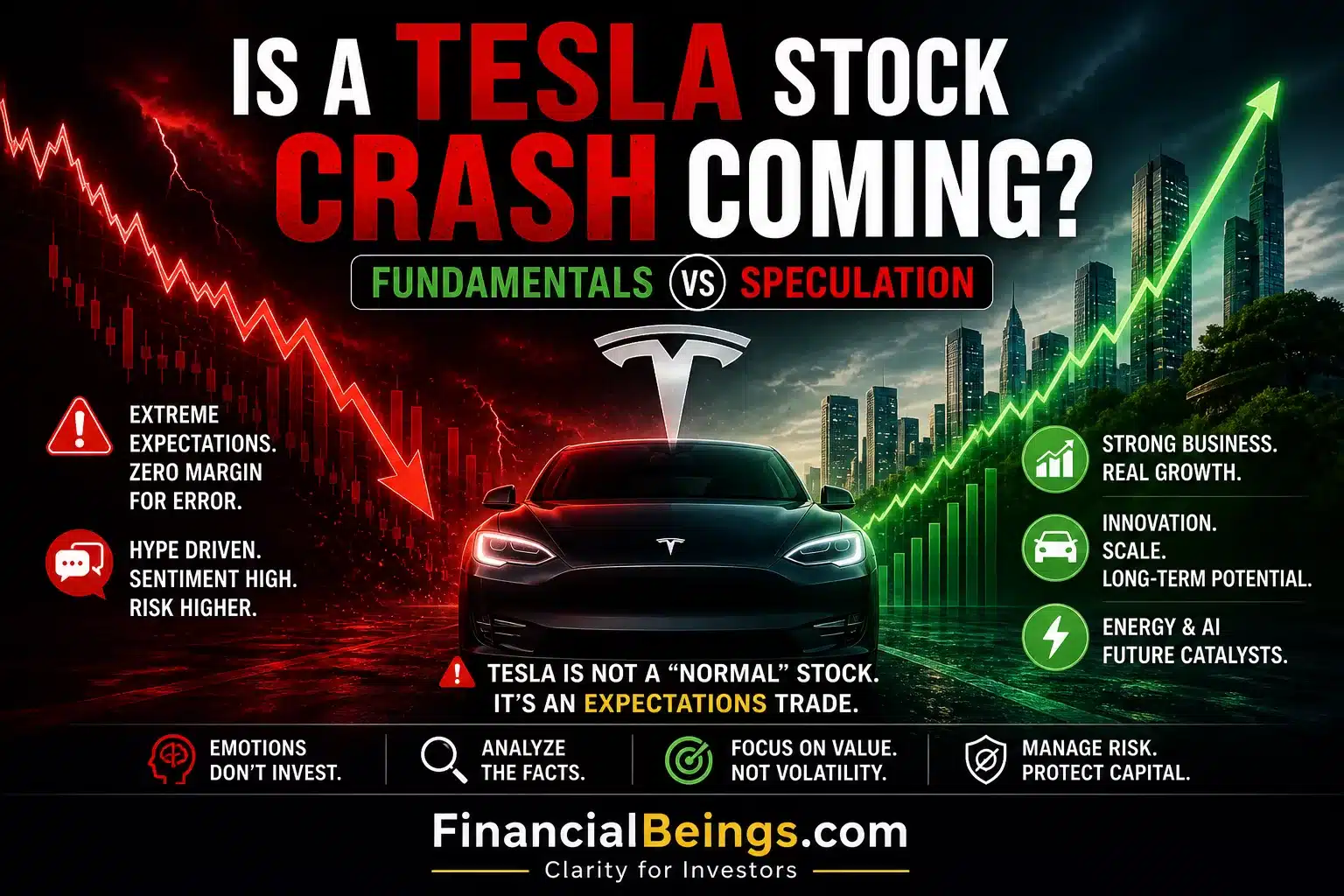
Wall Street analysts have an average price target of $406 for Tesla stock. But when I run the numbers using a strict earnings-based valuation model (Residual Operating Income), I get a very different picture: $30 to $83 per share.
Right now, Tesla is trading around $373 — with a massive $1.4 trillion market cap.
Here’s the simple truth: To justify today’s price, Tesla doesn’t just need strong growth for the next few years. It needs to grow at nearly 10% every single year… forever.
That’s extremely rare. The U.S. economy has historically grown around 2-3% annually. Even if Tesla grows at a very optimistic 5%, the model suggests the stock is worth only about $34. At a heroic 9% perpetual growth, it reaches just $83.
This article isn’t telling you to buy or sell. It’s simply showing you the cold math behind the hype.
Tesla is a fascinating company with huge ambitions — but at current prices, the market is betting on perfection for decades to come. The real question is: Are you comfortable paying that much for that level of perfection?
By the end, you will be able to answer that question yourself.
Financial Beings Valuation Lens
Is Tesla Stock Really at Risk of a Crash?
Tesla stock is not currently crashing. But concerns about a significant future decline are growing and they are not coming from panic. They are coming from the numbers.
Here is the tension. Tesla has a strong balance sheet. It possesses cash of up to $44.1 billion. It produces actual free cash flow. The company is not going to go bankrupt in the near future. Yet at $372.80, it requires an extraordinary assumption: 9.83% perpetual growth, indefinitely, according to the Financial Beings ReOI valuation model. That is about three times as much as the long-run growth rate of the US economy.
| Growth (%) | Model Value ($B) | Model Price/Share | Model Value % |
|---|
Model Value % > 100% = The model value exceeds the current market cap under the stated assumptions. Model Value % < 100% = The current market cap is above the model value under the stated assumptions. Model Value % = 100% = The model value matches the current market cap at the assumed growth rate.
At 2% growth, TSLA’s model value reaches a Model Value % of 8.0% relative to current market cap. At 5% growth, the model reaches a Model Value % of 9.2%, and even at 9% growth the model reaches only 22.2% of current market cap.
The breakeven growth rate is approximately 9.8%. That is the long-term growth assumption where the model value lines up with a company already valued at nearly $1.40T, showing what the market appears to require from Tesla’s vehicle, autonomy, robotics, and energy platform ambitions.
Note: Under the 10% hurdle rate scenario set, TSLA reaches only 22.2% Model Value at 9% growth. The sensitivity uses an ~16.5% sustainable RNOA basis, and the current market cap is not crossed anywhere inside the tested range.
That gap is where the real danger hides.
- Only 2.58% of Tesla’s $1.4 trillion market value is backed by what the business owns and earns today. The other 97.42% is a forward bet.
- Revenue fell to $94.8 billion in 2025. Tesla has been a public company since 2010. In all those years, through recessions, and a global pandemic – revenue had never gone backwards. Not once. Until 2025.
- The profitability picture is even harder to look at directly. In 2022, Tesla’s Return on Net Operating Assets sat at 57.6%. That is an extraordinary number.
- By 2025, that same figure had fallen to 6.9%. Three consecutive years of decline – from 57.6% down to 6.9%. The direction of travel is impossible to ignore.
- And yet. The stock trades at 345 times earnings. The average S&P 500 company trades around 25 times. Tesla’s EV/EBITDA ratio sits at 110x. The S&P 500 median is approximately 14x. Tesla is not just expensive by market standards. It exists in a different category of pricing entirely.
Why Do Investors Talk About a Tesla Stock Crash?
Nobody talks about a crash when everything is fine. The conversation starts when something feels wrong, even if nobody can name it exactly.
High Valuation Concerns
Here is what feels wrong with Tesla. The stock trades at 345 times earnings. That means investors are paying $345 for every $1 Tesla earns today.
Apple, considered expensive by most, trades at 32 times. The gap is not small. It is staggering. And it gets harder to justify when you see what is happening inside the business at the same time.
Gross margins have compressed to 19.07%. Net margin sits at just 3.95%. The efficiency of the business is shrinking, while the price tag keeps demanding more. That contradiction is where the crash conversation begins.
Market Expectations vs Reality
The market expects 9.83% perpetual growth from Tesla. Forever. But in 2025 revenue went backwards for the first time in company history. Expectations and reality are moving in opposite directions. That gap does not stay open indefinitely.
Volatility and Sentiment
Tesla’s stock swings twice as hard as the broader market. One bad delivery number. One FSD delay. One tweet. The price reacts violently – because when expectations are this stretched, disappointment hits harder than anywhere else.
Tesla Fundamentals Explained
Before forming any opinion on Tesla, you need to see the business clearly. Not through a bull’s eyes. Just the numbers, exactly as they are.
Revenue and Earnings Performance
Tesla generated $94.8 billion in revenue in 2025. That sounds enormous. In 2024, Tesla made $97.7 billion. Revenue went backwards. For the first time in Tesla’s entire history as a public company, the top line shrank.
Delivery Growth and Demand Trends
Tesla delivered approximately 1.79 million vehicles in 2024 – slightly below the 1.81 million delivered in 2023. A company that once grew deliveries by 50% per year is now experiencing flat to negative volume. Competition from BYD in China, Hyundai in the US, and European manufacturers is no longer a future concern. It is a present reality.
To stimulate demand, Tesla cut prices aggressively across multiple markets. More buyers showed up. But they came at a lower price – and that trade-off shows up directly in the margins.
Profit Margins and Pricing Strategy
Gross margin compressed to 19.07% – the lowest in Tesla’s profitable era. RNOA, which measures how efficiently Tesla converts its assets into profit, fell from 57.6% in 2022 to just 6.9% in 2025. Three years. Three consecutive declines.
The business is not broken. Cash flow remains strong at $22.3 billion. The balance sheet holds $44.1 billion in cash. Tesla is financially resilient. But efficiency is declining.
Speculation Around Tesla Stock – What’s Driving It?
Most stocks get priced on what they earn. Tesla gets priced on what people believe it will become. That distinction matters more than almost anything else when trying to understand why the price sits where it does.
AI and Robotaxi Expectations
Close your eyes and imagine this. You are sitting in the back of a car. No driver. No steering wheel. The car drops you off at home, then drives itself to the next passenger. Then the next. All day. All night. Earning money while you sleep.
That is the Robotaxi dream. And Tesla’s stock carries a significant portion of that dream in its price right now.
Future Growth Narrative
Optimus – Tesla’s humanoid robot could genuinely reshape manufacturing. Energy storage through Megapack is growing quietly and steadily. These are not fantasy products. They are real bets on real markets.
Valuation and Market Hype
EV/EBITDA of 110x. FCF yield of just 0.50%. These numbers do not describe a car company. They describe a belief system.
Fundamentals vs Speculation: What’s Really Driving Tesla Stock?
Tesla has two personalities. One is grounded in spreadsheets and quarterly reports. The other lives in imagination and possibility. Most days, both are present at the same time. The hard part is knowing which one is moving the price on any given day.
When Fundamentals Drive Stock
Earnings day arrives. Tesla reports delivery numbers. Margins hold steady or improve. Free cash flow comes in strongly. On these days, the stock moves because the business earned it. Investors point to real numbers. The rally feels justified.
This is Tesla at its most rational and its most investable.
- Strong delivery beats signal real consumer demand holding up against competition
- Positive free cash flow of $22.3 billion confirms the operational engine still runs
- Any margin recovery from the current 19.07% gross margin signals the pricing strategy is stabilizing
- RNOA improvement from the 2025 low of 6.9% would mean the core business is regaining its earning power
When Speculation Takes Over
Then comes the other Tesla. Elon posts something. A Robotaxi timeline gets announced. An Optimus robot demo goes viral. The stock jumps 12% in a day, with nothing in actual business changing at all.
This is Tesla at its most dangerous for investors who are not paying attention.
- FSD announcement moves the stock on promises, not delivered revenue
- Optimus demos generate excitement with zero near-term earnings impact
- Political headlines around Musk swing sentiment violently in both directions
- Competitor news triggers fear-based selling with no real market share analysis behind it
Right now, speculation is doing most of the heavy lifting. The fundamentals are declining. The price is not. That gap does not close quietly.
What Could Trigger a Tesla Stock Crash in the Future?
Every stock has a breaking point. Not a moment of weakness, a moment where the gap between price and reality finally becomes too wide to ignore. For Tesla, several specific triggers could force that reckoning.
Slowing EV demand
Global EV adoption is not growing as fast as the models assumed. If consumers pull back — due to high interest rates, charging anxiety, or economic pressure — Tesla’s volume story collapses. A company priced for 9.83% perpetual growth cannot afford slowing demand.
Intensifying competition
BYD already outsells Tesla in China. In the ride-hailing and autonomous mobility space, Uber remains a dominant global player aggressively developing self-driving technology. Meanwhile, Hyundai, GM, and European manufacturers are also closing the gap everywhere else. Every percentage point of market share lost is a percentage point the growth narrative loses with it.
Margin pressure
Gross margin already sits at 19.07%, the lowest in Tesla’s profitable era. One more round of forced price cuts and the economics of the business start to look very different from the story the stock price is telling.
FSD failure or delay
Full Self-Driving is not a feature. At this valuation, it is a requirement. If it misses another major milestone, a significant portion of the speculative premium has nowhere to hide.
RNOA staying depressed
If the collapse from 57.6% in 2022 to 6.9% in 2025 is structural – not cyclical – the entire valuation framework built on Tesla’s earning power breaks down permanently.
Regulatory risk
Safety investigations, recall mandates, or new autonomous vehicle legislation in key markets could damage both revenue and the trust that keeps the brand premium alive.
These risks are not just theoretical. They are already being discussed in detail in recent market analysis, including whether Tesla’s stock could continue to drop in 2025.
What Could Prevent a Tesla Stock Crash?
The Following Catalysts Could Prevent a Crash.
FSD and AI commercialization
A genuine, regulatory-approved Full Self-Driving deployment unlocks Robotaxi revenue overnight. That single catalyst could rewrite the entire valuation conversation in Tesla’s favor.
Optimus robot revenue
Even modest commercial adoption in manufacturing creates a brand new billion-dollar revenue stream with no direct competitor on scale. One factory contract changes the narrative.
Earnings recovery
A return toward the 14–17% net margins of 2022, driven by cost discipline and software revenue growth, would dramatically close the gap between price and fundamental value.
Market expansion
A lower-priced vehicle targeting India and Southeast Asia could reignite volume growth without forcing another round of margin-destroying price cuts in existing markets.
The prevention requires execution, not promises.
Is Tesla Stock Overvalued or Fairly Priced?
The Financial Beings ReOI model gives a clear and uncomfortable answer. At $372.80, Tesla is overvalued in every modelled scenario – from conservative 2% growth all the way to near-heroic 9% growth.
| Growth Scenario | Model Value/Share | Market Cap Implied | Coverage Ratio |
| 2% (Conservative) | $29.65 | $111B | 7.95% |
| 4% (Moderate) | $34.20* | $128B | 9.17% |
| 5% (Base Case) | $34.20 | $128B | 9.17% |
| 7% (High Growth) | $57.09 | $214B | 15.31% |
| 9% (Peak Growth) | $82.71 | $310B | 22.19% |
| Market Implied | $372.80 | $1,399B | 9.83% growth required |
The table tells a stark story. Even at 9% perpetual growth – a scenario that would require Tesla to outgrow the US economy by a factor of three, forever – the model values Tesla at $82.71. At the time of this analysis, the stock traded at $372.80.
Does that mean Tesla is definitely going to crash? No. It means the current price is not justified by any conventional earnings-based valuation. What justifies it is belief, belief in FSD, Optimus, Robotaxi, and energy storage becoming transformative at a scale no model can currently validate.
Should Investors Trust Fundamentals or Market Sentiment?
Two investors are looking at the same Tesla stock. Same price. Same day. One sees danger. The other sees opportunity. Both are using real information. So, who is right?
The answer depends entirely on one question: how long are you willing to wait?
Short-term traders follow sentiment. And with Tesla, sentiment moves fast and hits hard. One earnings surprise. One FSD headline. One Elon tweet. The stock swings 10 to 15% before lunch. If you are trading around events and momentum, ignoring sentiment is not discipline. It is just expensive.
Long-term investors follow fundamentals. And right now, the fundamentals are sending a complicated message. The balance sheet is genuinely strong, $44.1 billion in cash, minimal debt, no solvency risk. That is the reassuring part. But RNOA has fallen from 57.6% to 6.9% in three years. Revenue declined in 2025 for the first time ever. Margins are compressing while stocks still trade at 345 times earnings.
The truth is this. Sentiment tells you where the stock is going tomorrow. Fundamentals tell you whether it deserves to be there at all.
Right now, those two answers are very far apart.
If you’re trying to understand how Tesla behaves around earnings and whether to buy or stay cautious, you can read a detailed breakdown of Tesla stock volatility after Q3 earnings.
What Should Investors Do Right Now?
This is not financial advice. But here is a clear-eyed framework for navigating Tesla in 2026:
- Avoid panic decisions: Tesla has been ‘about to crash’ for a decade. Panic selling on headlines has cost many investors dearly. Do not make emotional decisions based on short-term price moves
- Focus on fundamentals: Watch RNOA, gross margin, and delivery numbers, not just stock price.
- Monitor earnings closely: The 2025 revenue decline was a warning. If 2026 shows another decline, the bull case becomes significantly harder to defend.
- Watch FSD progress: Regulatory approval milestones for Full Self-Driving are the single most important catalyst, positive or negative, for Tesla’s long-term valuation.
- Size your position honestly: If you own Tesla, make sure the size reflects the risk. A stock trading at 345x earnings with declining revenue requires a position size that matches your risk tolerance.
Final Verdict: Risk or Overreaction?
Here is the honest answer. It is both.
The risk is real. The Financial Beings ReOI model values Tesla between $29.65 and $82.71 per share across every tested scenario. At the time of this analysis, the stock traded at $372.80. Revenue declined in 2025. Margins are compressing. RNOA has fallen from 57.6% to 6.9% in three years. These are not opinions. They are facts and they deserve to be taken seriously.
But overreaction is also real. Tesla has one of the strongest balance sheets in the S&P 500. $44.1 billion in cash. Genuine free cash flow. And a portfolio of future bets: FSD, Optimus, Robotaxi, energy storage that could individually reshape entire industries.
The Tesla stock crash conversation is not irrational panic. It is a legitimate question raised by a very real valuation gap.
FAQs About Tesla Stock Crash
Is Tesla stock crashing right now?
No. Tesla is not currently crashing. At the time of this analysis, the stock traded at $372.80 with a $1.4 trillion market cap. It is volatile – it always has been. But volatility is not a crash. A crash requires sustained fundamental deterioration or a collapse in investor confidence. Neither has happened yet.
Can Tesla stock crash in the future?
It is a real risk, not a certainty. The Financial Beings ReOI model values Tesla at $29 to $83 per share across all growth scenarios. At the time of this analysis, the stock traded at $372.80. If the speculative premium unwinds, due to FSD delays, earnings miss, or slowing growth – a significant repricing is mathematically plausible.
Why is Tesla stock so volatile?
Tesla moves on sentiment as much as fundamentals. It has a high Beta, a passionate retail investor base, and a CEO whose public statements move markets. Add a P/E of 345x, where any change in growth expectations has an amplified effect on price and you get a stock that swings violently in both directions.
What drives Tesla stock more – fundamentals or hype?
Right now, speculation drives more of the price than fundamentals. Only 2.58% of Tesla’s market value is backed by current assets. The remaining 97.42% is expectation: FSD, Optimus, Robotaxi, and energy storage. Fundamentals matter at earnings time. Speculation matters almost every other day.
Sources & References – Tesla Stock Analysis
- Tesla SEC Filings: Form 10-K 2025 & Form 10-Q Q1 2026 SEC EDGAR – Tesla Inc. Filings
- TSLA Real-Time Data: Stock Price, Market Cap, P/E Ratio, EPS Yahoo Finance – TSLA
- Official Delivery Data: Tesla Q1 2026 Vehicle Production & Deliveries Tesla Investor Relations
- Analyst Consensus: Revenue & EPS Estimates for TSLA Yahoo Finance
- EV Market Research: Global EV Outlook 2026 – Tesla Market Share Data IEA.org Report
- Financial News: Reuters Coverage on Tesla Demand & Price Cuts Reuters – TSLA News
- Insider Trading Data: Elon Musk & Executive TSLA Transactions OpenInsider – TSLA
- Macro Economic Data: US Interest Rates & Inflation Impact on Growth Stocks FRED – Federal Reserve Data
Data Accessed: May 5, 2026 | Last Updated: May 5, 2026