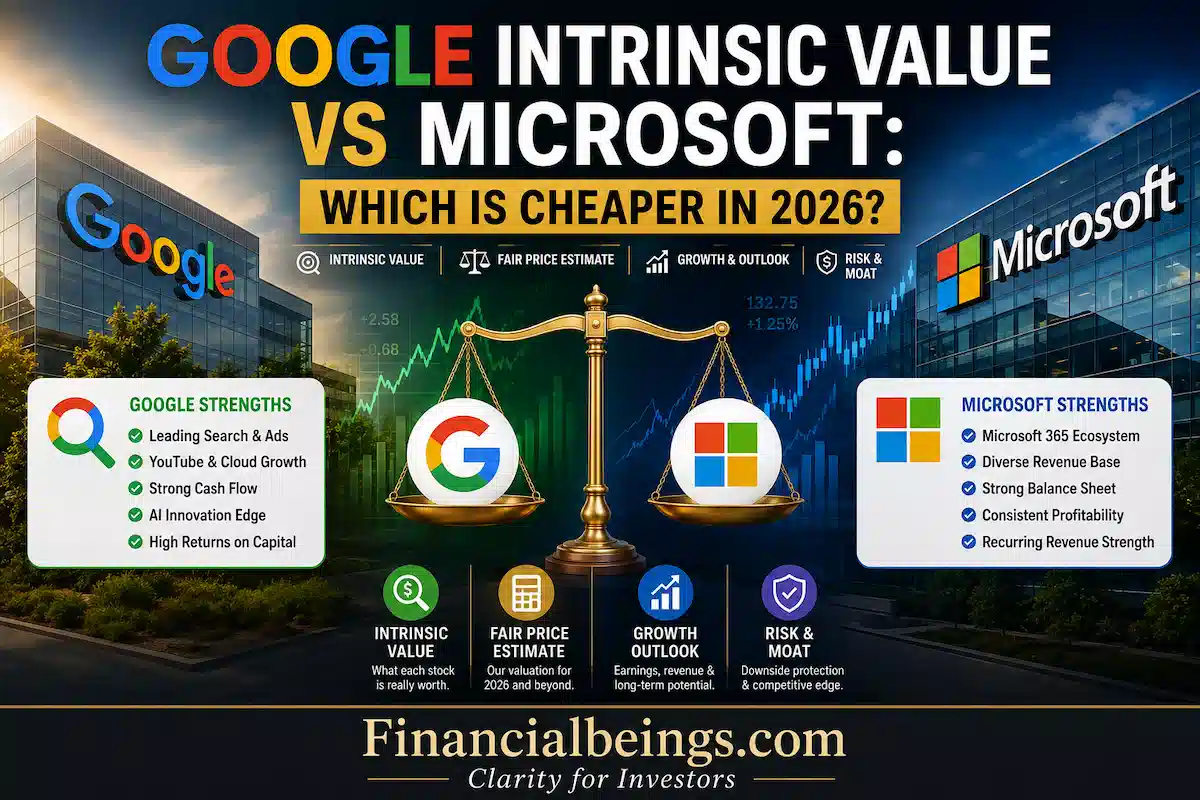
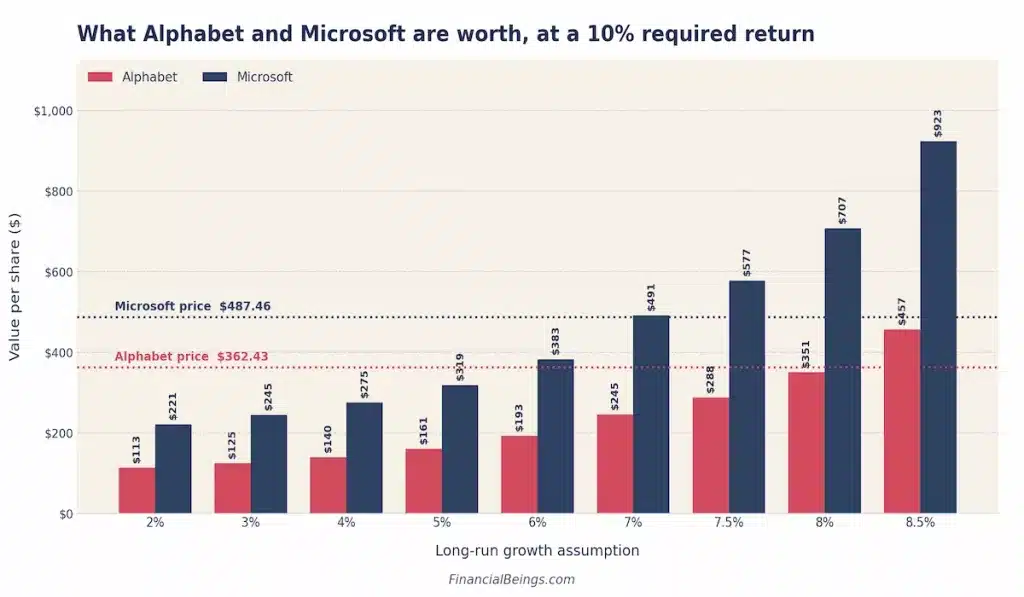
Google intrinsic value in 2026 starts with Alphabet’s operating business, the one that runs Search, YouTube and Cloud rather than the side bets, which is worth around $161 a share if profits grow at a reasonable 5% a year, forever; or around $245 a share if profits grow at a slightly more generous 7% a year, forever. The market currently prices it at $362.43.
Using the same model, Microsoft works out at about $319 a share at 5% growth, and $491 at 7%. The market prices it at $487.46.
Both prices assume a lot of future growth that has not happened yet. Microsoft’s assumes considerably less.
The gap between those two prices is what this article addresses. Not whether either company is a good business — they are. A more useful question: what does each company’s current share price require its business to deliver? Not a gut feeling, but a number built from what Alphabet actually earns today and a disciplined estimate of what it might earn tomorrow.
What Is Google Intrinsic Value Right Now?
Intrinsic value is simply an elegant way of asking: if you owned this business rather than the stock, what would it be worth, measured by the cash it generates?
To do this you also need a required return: the minimum annual compensation an investor should expect for putting money into a venture that carries risk rather than somewhere safer. We used 10% throughout, for both companies — no exceptions, and no swapping in a friendlier number when the answer looked bad.
Run Alphabet through that model today and the honest answer is: it depends on what your expectations are for its profits continuing to grow. If Alphabet’s growth rate is a conservative 5%, its operating business is worth around $161 per share. Raise that growth forecast to 7% and the figure rises to about $245. The market, however, is trading at $362.43, and that reflects even more growth. See how it stacks up against another AI leader in Nvidia vs Google stocks.
Alphabet’s market value is currently about $4.4 trillion. It is the price tag for a business with real profits, real cash flow, and a real question mark over how long its growth can keep justifying that price.
Why Do Estimates Range From $116 to $979?
This is where most people get confused, so we will take it slowly.
Ask ten different analysts about the value of Alphabet and you’ll get ten different answers, and they may cover a wide range. Run the model at a slow 2% long-run growth rate and Alphabet’s operating business is worth approximately $113 a share. Set the assumption at an aggressive 8.5% and it is worth $457. Push the assumption further still and you can reach numbers as far apart as $116 and $979, depending on how far you are willing to stretch it.
That’s not analysts being sloppy. That is the way the calculation works. A company’s value is a wager on its future, and the future is the one thing nobody knows. A few percentage points in the growth number make a big difference over the years, and result in very different price tags.
This is also the reason that a number without a growth assumption attached is nearly worthless as a single “fair value” headline number. The correct way to read a valuation is not “Alphabet is worth $200.” It is “Alphabet is worth $200 if it grows profits at this rate, forever.” Strip out that second half of the sentence and you are not analysing, you are speculating and calling it fact.
What Did the $99 Billion Gain Do?
This is the kind of thing that catches a reader out if they simply read Alphabet’s latest earnings announcement.
Alphabet reported a $99 billion gain in profit in one recent quarter. Sounds incredible. Most of that came not from advertising or cloud services, but from an unrealised gain on shares Alphabet owns in other companies. “Unrealised” means the value has risen on paper, but no one has turned it into cash. This is similar to the way that your home can appreciate in value, but you can’t spend the gain until you turn it into cash.
These gains and losses reflect the stock market’s good days and bad days; a gain does not mean the business is doing well, and a loss does not mean it is doing badly, so any serious valuation must exclude them. For Alphabet, the model strips $107 billion of such items out of forward analyst estimates before it can use them.
In the case of Microsoft, the equivalent adjustment is zero. No stripping to be done, no second-guessing. That is not a technicality; it is a large difference in how much of the reported figure you can take at face value.
What Does the Operating Business Actually Earn?
Now to the operating business itself. What does it actually earn?
The measure here is return on operating assets: the profit a company generates for every dollar invested in the business (office space, servers, data centres, equipment and the like). A higher number means the company uses its assets more efficiently.
| Alphabet | Microsoft | |
| Revenue | $402.8bn | $331.8bn |
| Profit margin | 25.7% | 38.3% |
| Asset turnover | 1.55× | 1.07× |
| Return on operating assets | 39.8% | 41.1% |
| Operating income above the cost of capital | $77.6bn | $96.2bn |
| Capital spending | $91.4bn | $115.9bn |
So how does each company get there?
Both are strong businesses, but they get there in different ways. Microsoft commands a higher share of every dollar in sales as profit: 38.3 cents versus 25.7 cents for Alphabet. Alphabet is faster at using its assets, generating $1.55 of sales for every dollar invested in the company, compared with $1.07 at Microsoft.
Here is the part Alphabet investors should worry about a little more than they do. Microsoft has been through the same thing, harder and earlier. Its asset efficiency fell from 3.19 times in 2021 to 1.07 times today, and its return on operating assets dropped from 117% in 2021 to less than 40% currently — which raises the question: is MSFT stock a buy right now? Over the last two quarters, though, that number has stopped falling. It has levelled out and even ticked up a little.
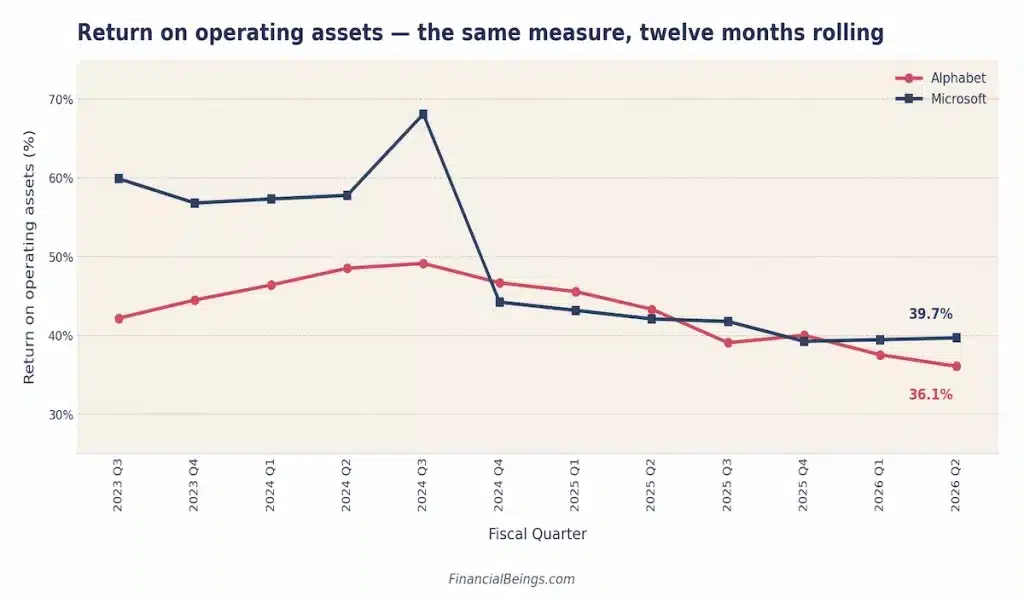
Alphabet’s has not. It has slid from 40.0% at the end of 2025 to 36.1% by mid-2026. Both companies are spending heavily on AI infrastructure, and both are taking a hit. Microsoft looks like it’s coming out the other side. Alphabet doesn’t, yet.
Google vs. Microsoft — Which Is Cheaper?
Microsoft — and it is not close. This is the comparison nobody else runs: two very different kinds of business put through the same model, on the same day, demanding the same return. We did that.
This is the clearest way to see it. Assume profit grows 7% a year, indefinitely, and Microsoft’s share price is fully justified — it is at “fair value”, in this language. Alphabet only reaches that point at about 8.1% growth. An extra 1.1 percentage points of growth a year may seem like nothing much. Over an indefinite horizon, it is not. That is the distinction between a believable story and an implausible one.
At every growth rate we tested, Microsoft is worth a larger share of what it costs — and pays roughly 1.4 percentage points more a year to an investor at today’s price.
The surprising thing about the two companies is their almost equal returns on the capital they use: Alphabet 36.1%, Microsoft 39.7%. They simply get there in different ways, as above: Alphabet via faster turnover, Microsoft via fatter margins. Same destination, different roads — and the market pays a meaningfully higher price for Alphabet’s.
There’s a blunter way to test this, too: ask what revenue each company actually needs next year to justify what you are paying for it today.
| Alphabet, 2026 | Microsoft, 2027 | |
| Revenue the price requires | $553bn | $365bn |
| What analysts expect | $490–520bn | $380–403bn |
| Verdict | Above range — not achievable | Below range — comfortably achievable |
Alphabet’s price needs more revenue next year than Wall Street’s own analysts think it will deliver. Microsoft’s price needs less than analysts expect. That’s about as clean a difference as this kind of analysis ever produces.
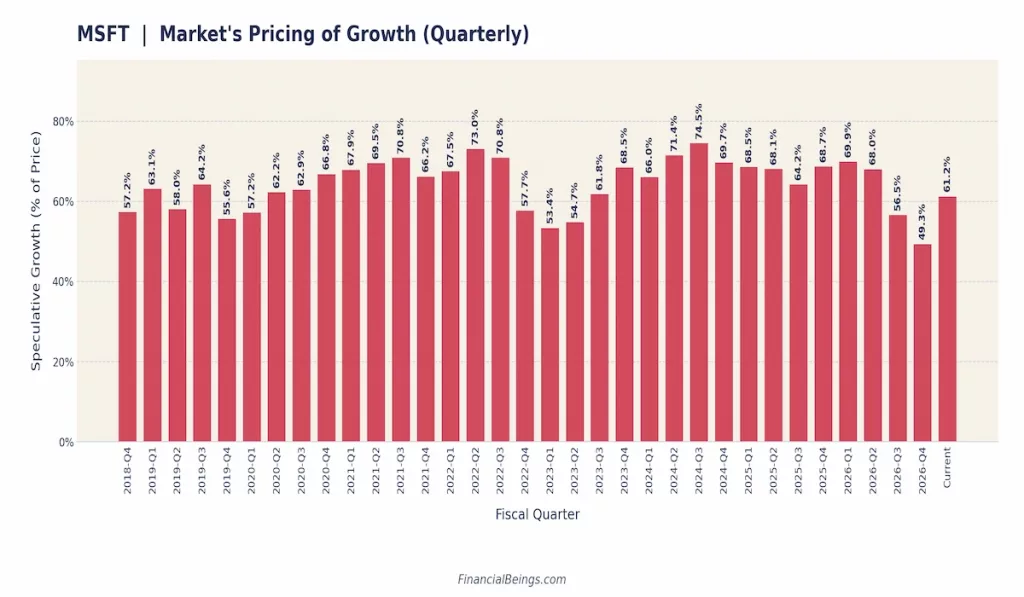
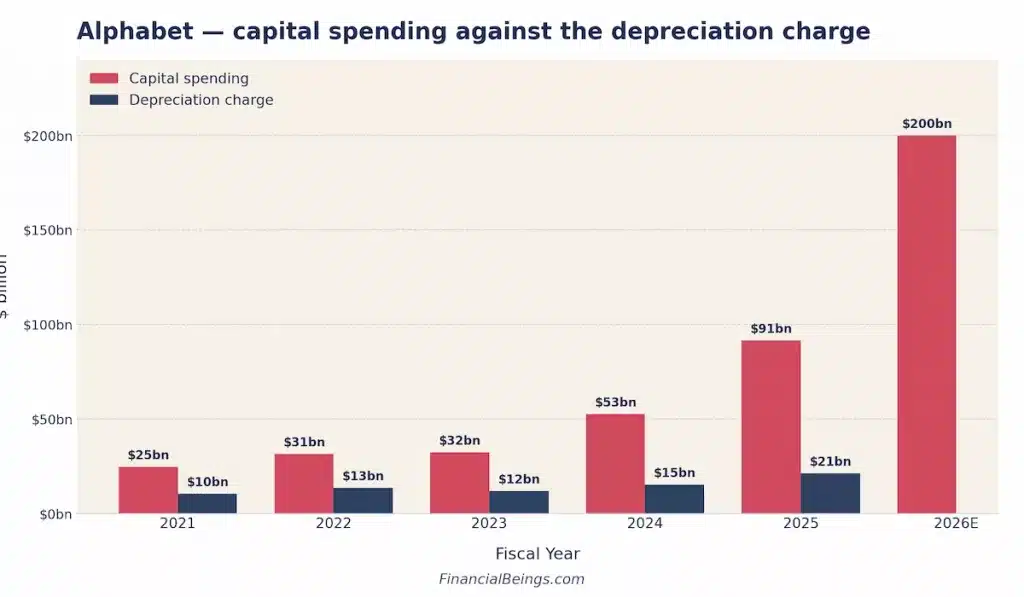
None of this is to say that Microsoft is cheap in any absolute sense; there are some cracks in its own story. It has seen return on operating assets drop from a creditable 117% in 2021 to 39.7% now. Last year it took a $34.3 billion depreciation charge and spent $115.9 billion on capital, so it is investing far faster than its existing assets are wearing out. It also carries a financing cost despite holding more cash than debt — a small, odd blemish on an otherwise tidy balance sheet, which passes six of our seven safety checks.
The same AI-driven spending is reshaping both companies. Microsoft is simply further into that cycle, and priced more forgivingly for it.
In dollars: Microsoft’s operating business is worth about $319 per share on a reasonable 5% growth assumption and about $491 per share on a more optimistic 7% assumption — against a current share price of $487.46. On the same two assumptions, Alphabet is worth $161 and $245, against a price of $362.43. For a broader look at how Microsoft stacks up against another tech giant, see our Apple or Microsoft Stock 2026 comparison.
What Growth Is Priced Into Each Stock?
Every share price tells a story about the future, whatever the company itself says. Here is what each of these prices is saying.
The current price of Alphabet assumes operating income above the cost of capital will grow at around 8.07% a year, indefinitely. Microsoft’s assumes roughly 6.97%. That one-point difference sounds small. Over an indefinite horizon, on a business earning a slightly lower return on its capital, it is not.
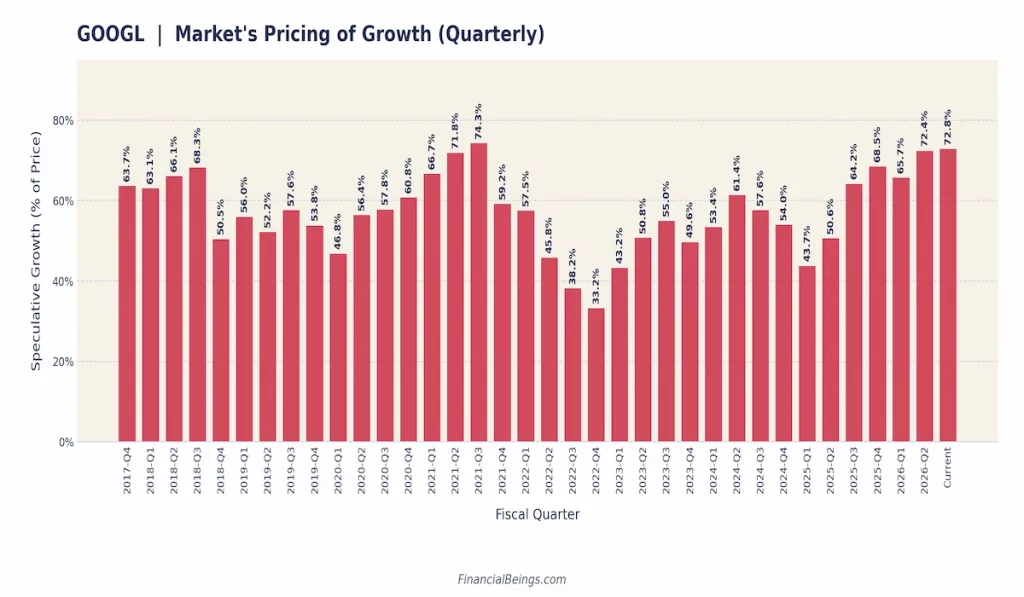
You can also see where each dollar of expected return is coming from. Of Alphabet’s forecast annual return, just 2.64 percentage points come from profit Alphabet already earns today; the remaining 7.07 points — 73% of the total — depend on growth that has not been delivered yet. Microsoft’s split is more even: 3.41 points from current profit and 6.16 from future growth, or 64% resting on growth. Full breakdown: MSFT 2026–2030 return analysis.
Assume no growth at all, and Alphabet is worth $98.53 per share, which is 27% of its market price. Microsoft’s no-growth value is $189.03, which is 39% of its price.
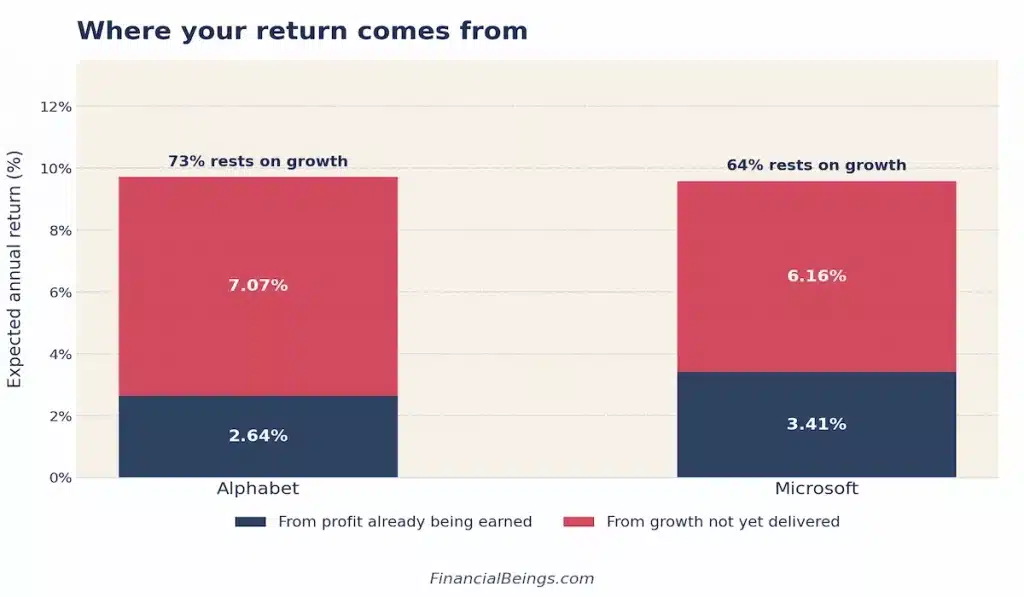
Microsoft’s price, in other words, is backed by a bigger cushion of profit that already exists, rather than profit that has to show up on schedule.
So Is Google Overvalued in 2026?
Here is the real answer, with no slogan attached.
If the second half of Alphabet’s 2026 financial year is going to justify its current valuation, the company needs operating margins near 31.5% — a real stretch today, and a bet that leaves no room for advertising growth, competition or AI spending to go wrong. It is the kind of bet Berkshire Hathaway’s position in similar large-cap technology names effectively makes: that execution stays close to perfect for years.
Microsoft, of course, needs no such stretch. Its price already sits below what analysts expect it to earn, which gives it more room for the world to disappoint before the numbers turn ugly.
The conclusion is not dramatic, just clearer than it was a page ago. Both are very good businesses. But one is priced for a future that must run virtually flawlessly. The other has a little more space for manoeuvre.
How We Did This
Even though the two companies’ financial years end on different dates, we measure both over the same trailing twelve months, ending 30 June 2026, so the comparison is like for like. All value figures assume the same 10% required return for both companies, with no exceptions. All dollar amounts move with the market and should be read as a snapshot taken at the close on 5 August 2026, not a fixed number.
Frequently Asked Questions
Is Microsoft cheaper than Google?
Yes, based on this model. Microsoft reaches its market price at about 7% long-run growth, while Alphabet needs about 8.1%. Under the same assumptions, Microsoft offers about 1.4 percentage points more return a year at today’s prices.
Is Microsoft undervalued in 2026?
Not quite. At $487.46, it is worth about $319 on a 5% growth assumption and $491 at 7% — close to fair value, and clearly better value than Alphabet on the same assumptions.
Which is the better AI investment, Google or Microsoft?
Both are spending heavily on AI infrastructure, and both have seen a sharp drop in return on operating assets. Microsoft’s has stabilised in recent quarters. Alphabet’s has not.
Why does the required return matter so much?
Because it is the benchmark every other number is measured against. Change it, and every number in this article changes — which is why we picked one figure, 10%, for both companies, and state it openly rather than moving it to suit the answer.
Does a lower “growth requirement” mean Microsoft is a safer investment?
It means that Microsoft’s current price needs less to be justified. That’s a comment on its price, not a promise on what either company will do.
Could these numbers change soon?
Yes, constantly. Both prices fluctuate daily and each of the percentages in this article will change daily as well. This is not a permanent verdict, but a snapshot taken on 5 August 2026.
References
- Alphabet Q2 2026 Results, Form 8-K Exhibit 99.1 (22 July 2026)
- Alphabet Q4 and FY2025 Results, Form 8-K Exhibit 99.1 (4 February 2026)
- Microsoft FY26 Q4 Results, Form 8-K Exhibit 99.1 (29 July 2026)
- Alphabet Investor Relations
- Microsoft Investor Relations
- Competitor estimates surveyed: ValueInvesting.io, GuruFocus, Simply Wall St, Alpha Spread, MiniValuator, StockUnlock, StockOracle, ValueSense.io