

AI stocks are companies that have been helped by technologies such as machine learning, automation, and cloud computing. The importance in 2026 is due to AI gaining momentum in all industries, and these stocks are among the most appealing long-term investments.
The most promising AI stocks 2026 will be those that have high financial growth, an increase in profitability, and cash flow generation. Apple, Amazon, NVIDIA, Microsoft, and others have consistently grown in revenue, margin, and free cash flow, which makes them significant in artificial intelligence investing in the future.
So, in this guide, we will walk you through the best AI stocks to buy in 2026, helping you identify high-growth opportunities, evaluate financial strength, and make smarter long-term investment decisions.
How We Selected the Best AI Stocks
We determined the most suitable AI stocks for 2026 based on revenue growth, profitability, cash flow strength, and each company’s contribution to artificial intelligence.
- First, Companies such as Amazon, Microsoft, and Alphabet are experiencing upward trends, indicative of growing demand for AI-based services, including cloud and automation. This will make sure that real business activity supports growth.
- Second, market leadership and participation in the AI area are significant. The chosen companies are major players in AI chips, cloud platforms, and data-driven systems.
- Companies whose margins are improving and those that have high free cash flow, like Apple and Broadcom, are signs of financial strength. Lastly, future potential was based on upward growth patterns, which would keep these stocks as strong long-term AI investment opportunities.
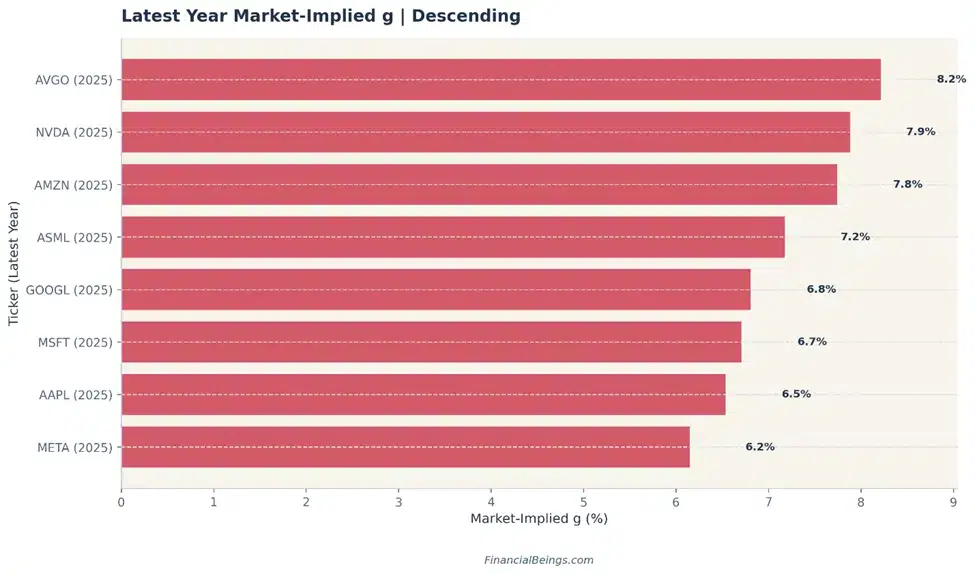
Figure 1: Market-Implied Growth Rates (g) for Leading AI Stocks (2025)
Broadcom (8.2%), NVIDIA (7.9%), and Amazon (7.8%) have the greatest expected growth, indicating high future potential among AI stocks.
Top AI Stocks to Buy in 2026
In this section, we focus on the most important companies leading the artificial intelligence revolution in 2026. These are businesses driving growth through AI chips, cloud computing, automation, and enterprise software. The goal is to help readers understand which companies are benefiting the most from real AI adoption, not just market hype.
You will also learn how each stock performs in terms of revenue growth, profitability, cash flow strength, and long-term potential. From established tech giants to infrastructure leaders, this section highlights where serious institutional money is flowing in the AI sector.
Apple Inc. (AAPL)
Apple is a leading American multinational technology company its headquartered in Cupertino & California. It is globally famous for designing, manufacturing & marketing premium consumer electronics – software & online services, especially the iPhone, Mac & iPad.
The company has built a strong ecosystem that gives it a significant long-term advantage in personalized on-device artificial intelligence. However, its heavy reliance on iPhone sales remains a key risk compared to cloud-focused competitors.
Key Financial Snapshot:
- Revenue (FY2022): $394.33 billion
- Revenue (FY2025): $416.16 billion
- Net Profit Margin: 26.92%
- Free Cash Flow: $98.77 billion
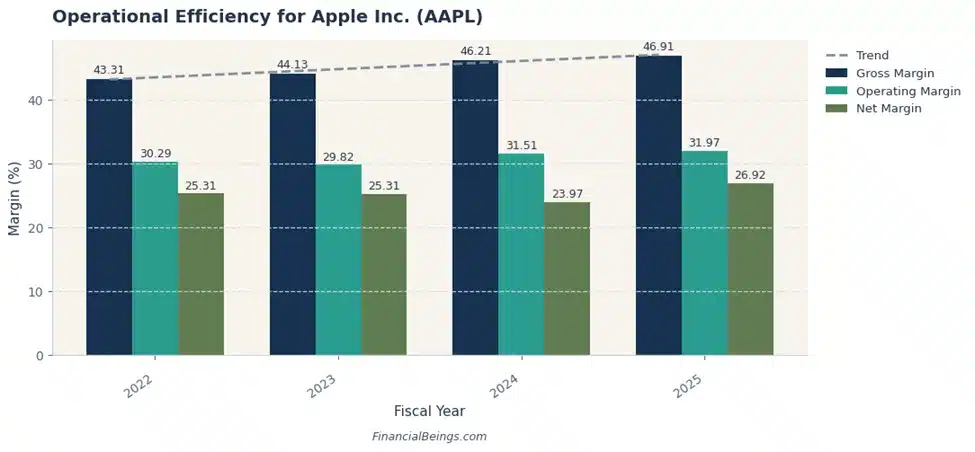
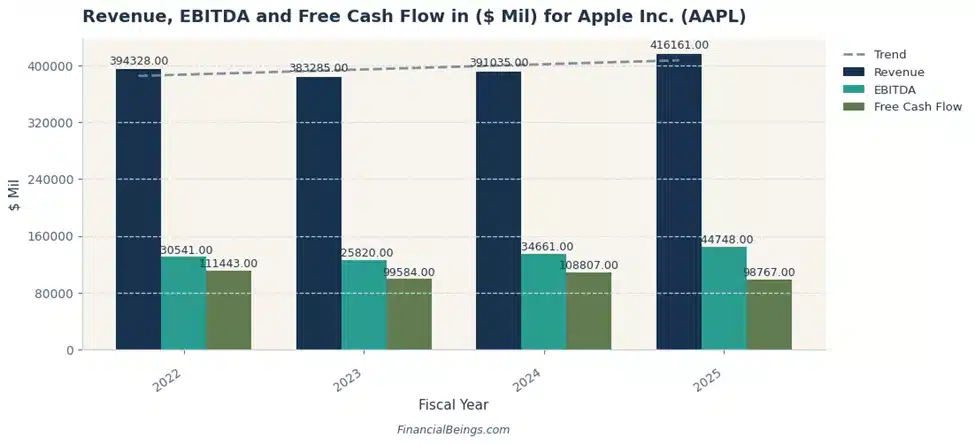
Figure 2: Apple Inc. (AAPL) Financial Performance and Operational Efficiency (2022–2025)
Amazon.com Inc. (AMZN)
Amazon is the biggest online retailer and a significant tech firm in the world that was established by Jeff Bezos in 1994 as an online bookstore.
The main offerings are Amazon Marketplace, Amazon Prime, and Amazon Web Services (AWS), with AI working in the recommendation systems, warehouse automation, and cloud-based machine learning. One of the risks is the relatively low net margins in comparison with the peers, which can be influenced by the high operational costs and reinvestment policies.
Financial Highlights:
- Revenue: $716.9 billion
- EBITDA: $165.3 billion
- Free Cash Flow: $7.7 billion
- Net Margin: 10.83%
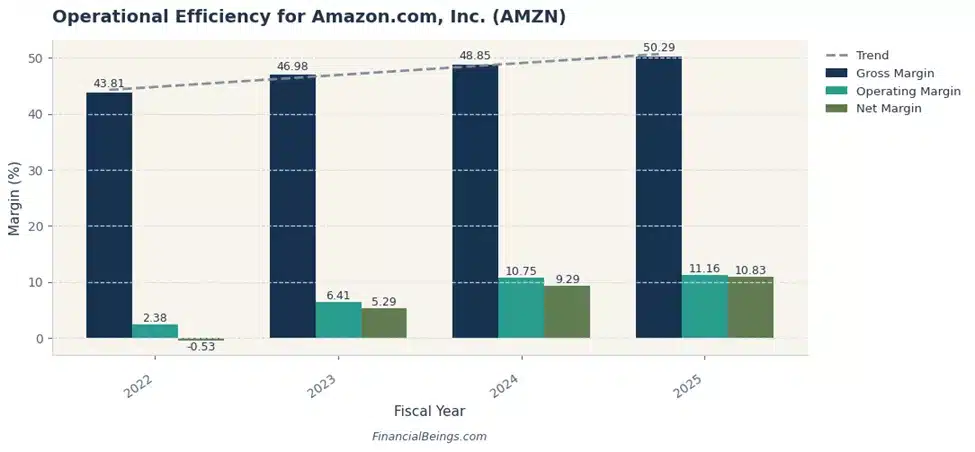
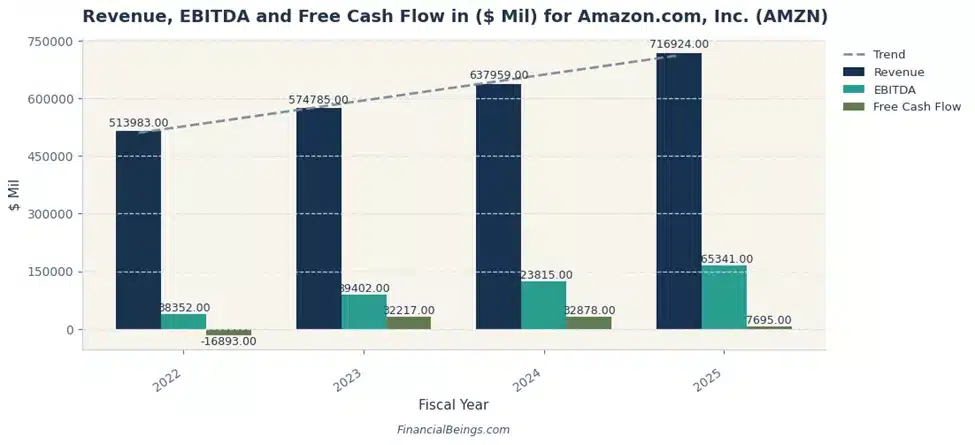
Figure 3: Amazon (AMZN) Revenue Growth and Margin Improvement (2022–2025)
NVIDIA Corporation (NVDA)
NVIDIA is an American technology company that started as a producer of graphics processing units (GPUs) to be used in gaming, but today drives the core of modern AI, data centres, and autonomous systems.
Its GPUs play a crucial role in training AI models, which makes it a fundamental infrastructure provider in the AI community. The primary risk is that the company relies heavily on AI demand cycles, and a decrease in the growth of the industry will affect the performance.
Key Financial Metrics:
- Revenue: $215.9 billion
- EBITDA: $144.6 billion
- Free Cash Flow: $96.7 billion
- Net Margin: 55.60%
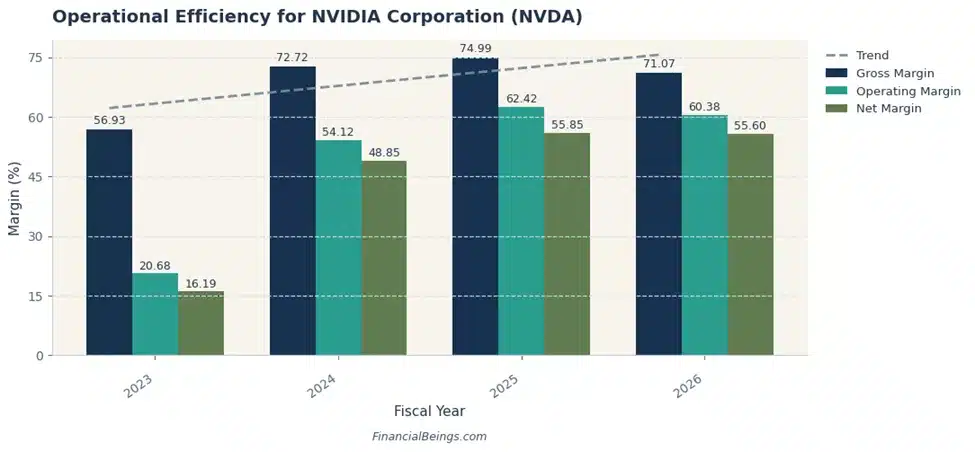
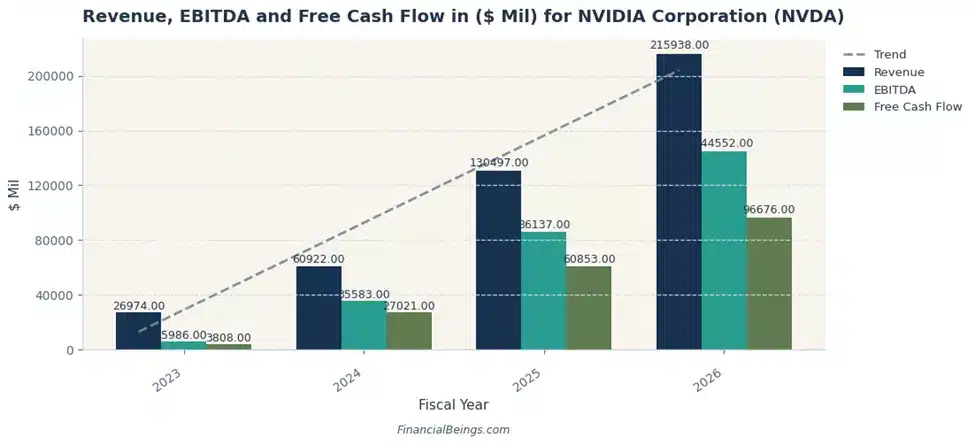
Figure 4: NVIDIA (NVDA) AI-Driven Growth and Margin Expansion (2023–2026)
Microsoft Corporation (MSFT)
Microsoft Corporation is a top American multinational technology corporation that was established in 1975 by Bill Gates and Paul Allen its headquartered in Redmond, Washington, it is the biggest software seller in the world that provides products such as Windows, Microsoft 365, Azure cloud service, Xbox, and artificial intelligence development. The most significant risk is the rise in the intensity of competition in cloud and AI services, which can strain the margins long-term.
Financial Performance:
- Revenue: $281.7 billion
- EBITDA: $160.2 billion
- Free Cash Flow: $71.6 billion
- Net Margin: 36.15%
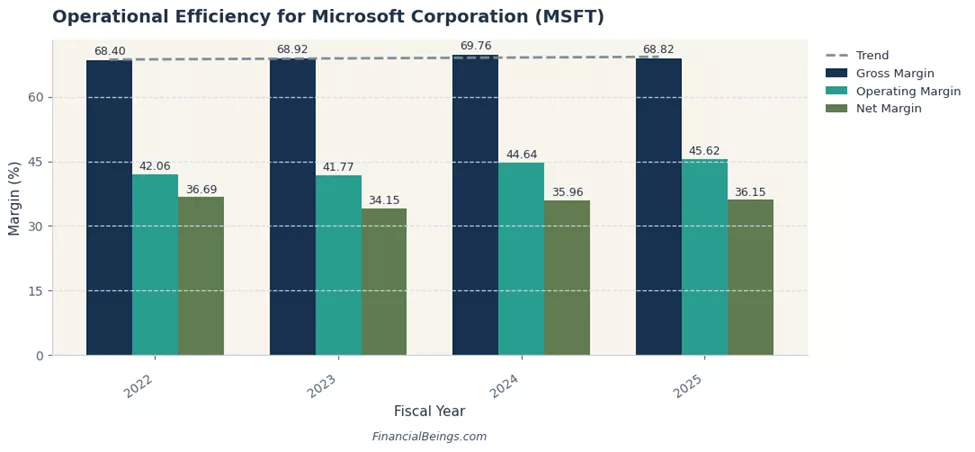
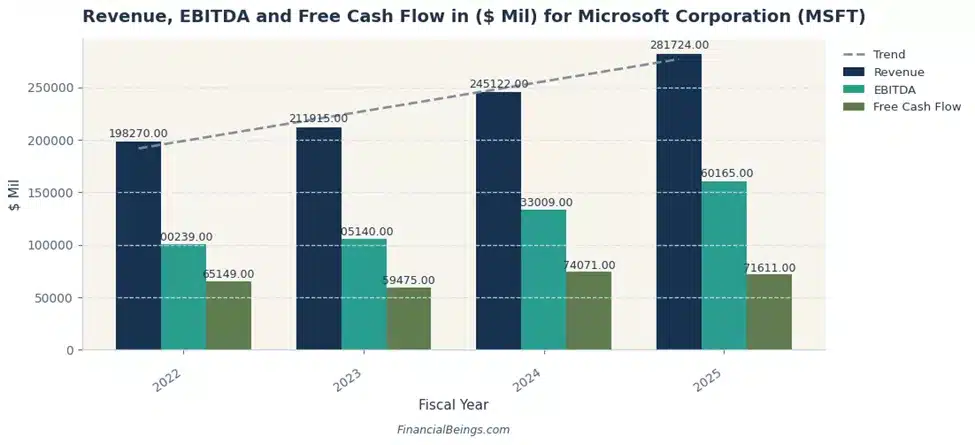
Figure 5: Microsoft (MSFT) Financial Growth and Profitability Trends (2022–2025)
Alphabet Inc. (GOOGL)
Alphabet Inc. is a multinational holding corporation that was established in 2015 as the mother company of Google, YouTube, Android, and other subsidiaries, including Waymo and Verily.
It was developed to enhance operational focus, which enables Google to focus on the core internet services as it ventures into AI and advanced technologies. One major risk is that it is highly dependent on advertising revenues, which can be influenced by market conditions and regulatory constraints.
Key Financial Indicators:
- Revenue: $402.8 billion
- EBITDA: $180.7 billion
- Free Cash Flow: $73.3 billion
- Net Margin: 32.81%
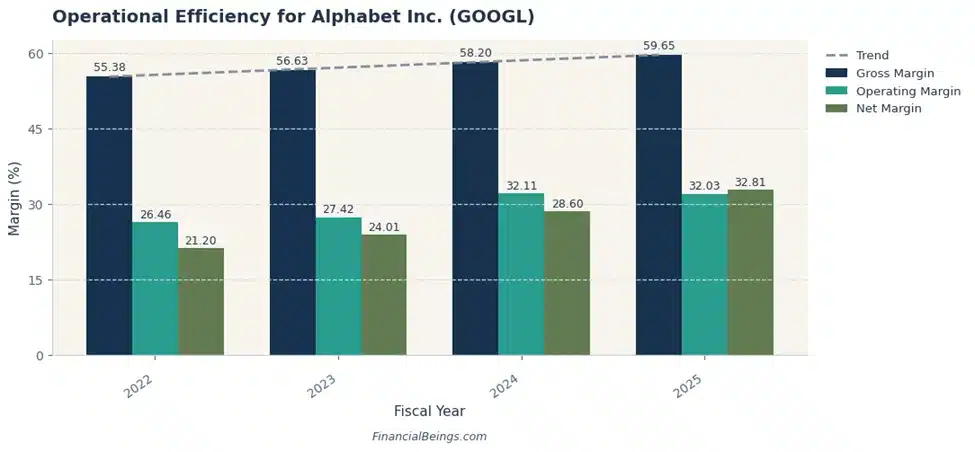
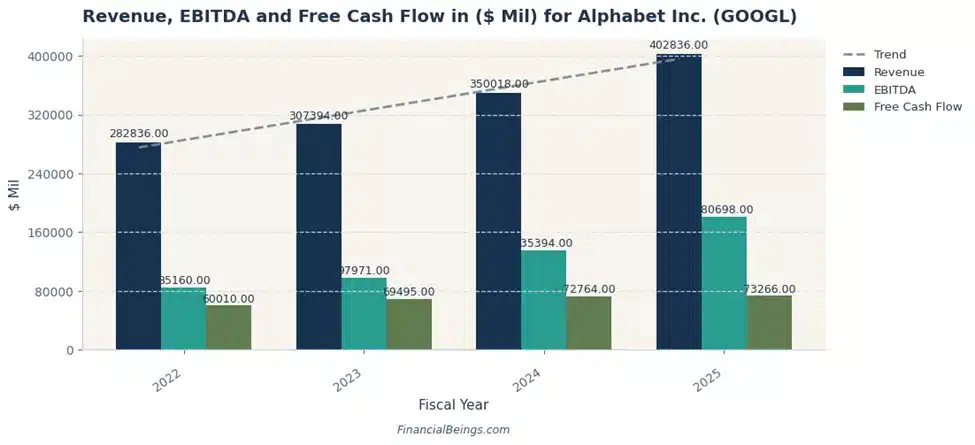
Figure 6: Alphabet (GOOGL) Revenue, Cash Flow, and Margin Trends (2022–2025)
Broadcom Inc. (AVGO)
Broadcom Inc. is a technological powerhouse with its headquarters in Palo Alto, California, that designs and supplies a variety of semiconductor and software products.
It provides data centres, networking, wireless, and storage markets, the technology of which constitutes a fundamental backbone of digital infrastructure. Its dependence on the large enterprise clients and acquisitions is a major risk, as it could influence the stability of an issue in the integration.
Financial Highlights:
- Revenue: $63.9 billion
- EBITDA: $34.7 billion
- Free Cash Flow: $26.9 billion
- Net Margin: 36.20%
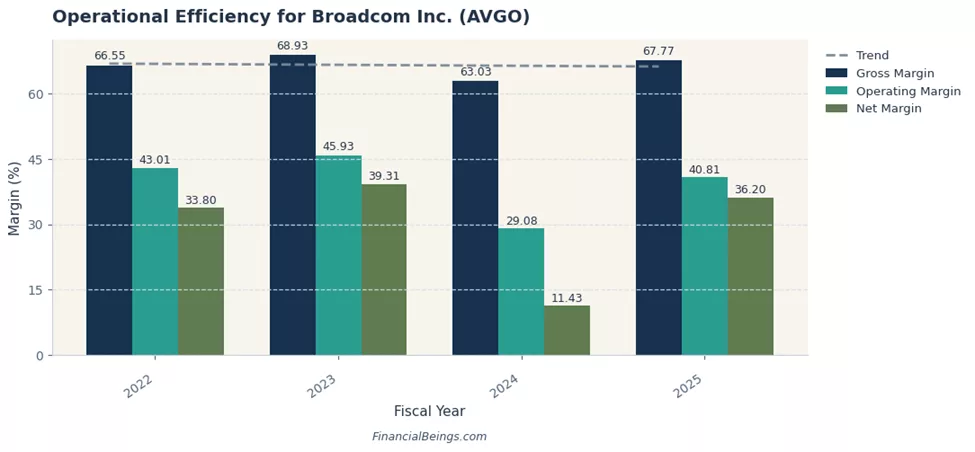
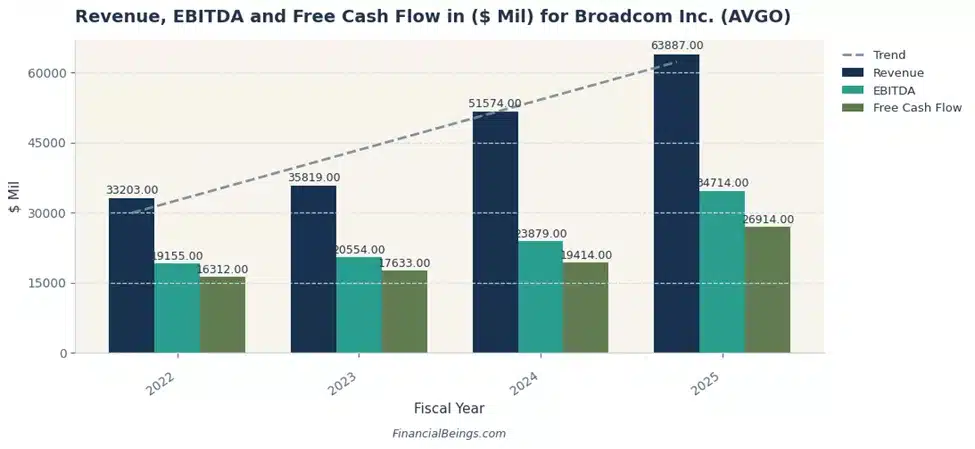
Figure 7: Broadcom (AVGO) Profitability and Cash Flow Performance (2022–2025)
Meta Platforms Inc. (META)
Meta is leading the top AI companies because it applies artificial intelligence to maximise social media networks, advertising systems, and content suggestions. Meta (previously Facebook, Inc.) is a multinational technology firm founded by Mark Zuckerberg and runs operating platforms, including Facebook, Instagram, WhatsApp, and Threads.
The company has since been working on building into the metaverse and further developing AI technologies within its digital ecosystem since rebranding in 2021. The biggest risk is that it relies on advertising income, which is unstable and has the potential to change due to market dynamics.
Key Financial Snapshot:
- Revenue: $201.0 billion
- EBITDA: $105.7 billion
- Free Cash Flow: $46.1 billion
- Net Margin: 30.08%
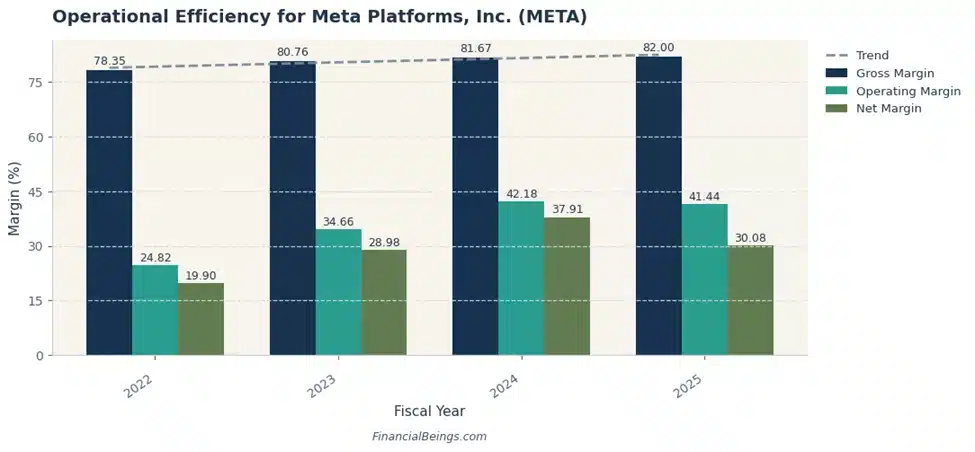
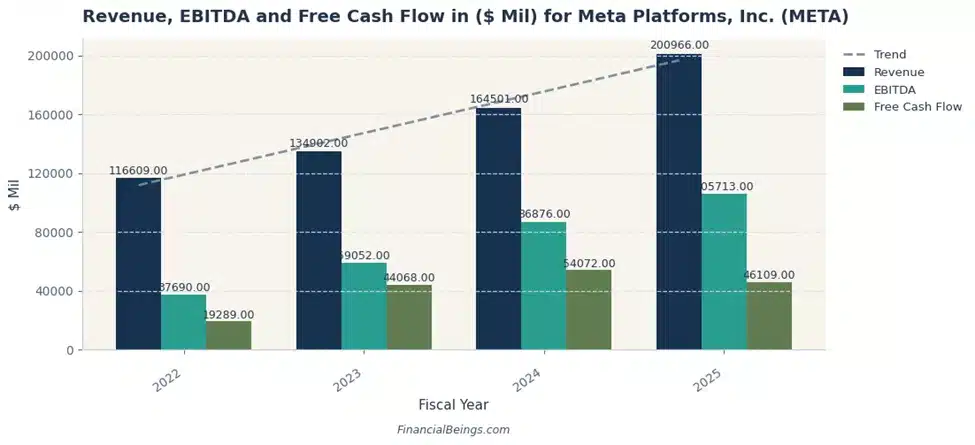
Figure 8: Meta (META) Efficiency Improvements and Margin Expansion (2022–2025)
ASML Holding N.V. (ASML)
ASML is leading AI company because it offers superior semiconductor equipment that is utilised to produce AI chips. ASML Holding N. V. is a Dutch multinational corporation headquartered in Veldhoven, Netherlands and the largest manufacturer of photolithography systems in the world.
It is the sole company that manufactures extreme ultraviolet (EUV) lithography equipment, which is needed to make sophisticated microchips used in artificial intelligence. Risk is the political uncertainty and reliance on supply chains, which can impact operations and international demand.
Key Financial Highlights:
- Revenue: $32.7 billion
- EBITDA: $12.6 billion
- Free Cash Flow: $11.0 billion
- Net Margin: 29.42%
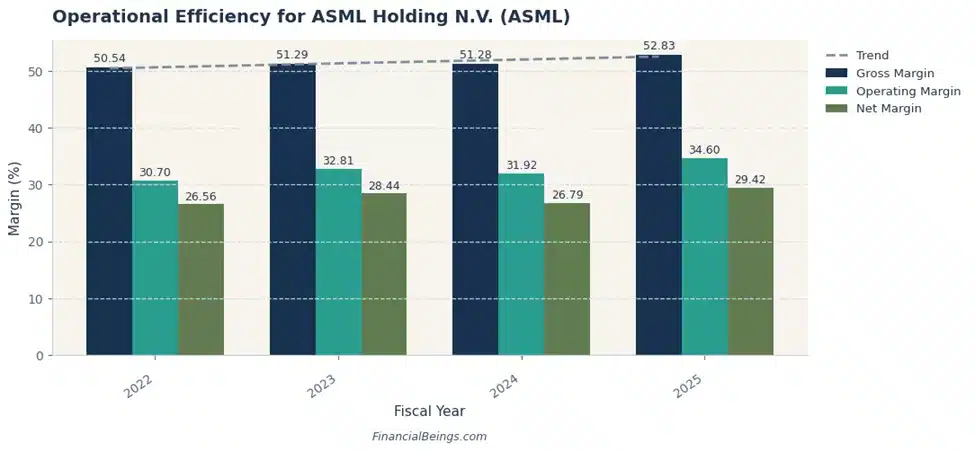
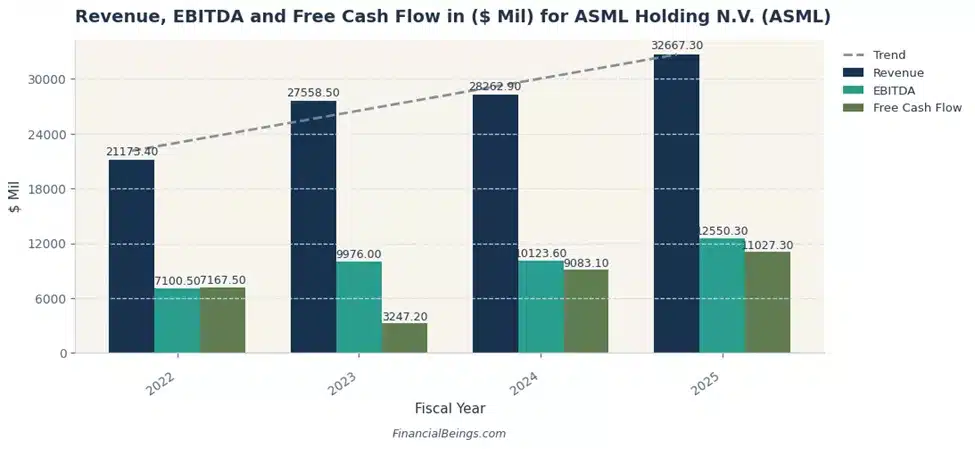
Figure 9: ASML Financial Performance and Semiconductor Market Strength (2022–2025)
Financial Comparison of Top AI Stocks
| Company | Revenue ($M) | EBITDA ($M) | Free Cash Flow ($M) | Net Margin (%) |
| Apple | 416,161 | 144,748 | 98,767 | 26.92 |
| Amazon | 716,924 | 165,341 | 7,695 | 10.83 |
| NVIDIA | 215,938 | 144,552 | 96,676 | 55.60 |
| Microsoft | 281,724 | 160,165 | 71,611 | 36.15 |
| Alphabet | 402,836 | 180,698 | 73,266 | 32.81 |
| Broadcom | 63,887 | 34,714 | 26,914 | 36.20 |
| Meta | 200,966 | 105,713 | 46,109 | 30.08 |
| ASML | 32,667 | 12,550 | 11,027 | 29.42 |
Best AI Stocks for Beginners
Beginners should consider AI stocks that have shown steady revenue growth, high cash flow, the lowest market-implied growth, and high profitability, as these minimise risk and provide exposure to artificial intelligence.
Good starting points would be companies such as Apple, Microsoft, and Alphabet, since they demonstrate a stable financial performance. In 2025, Apple generated 98,767M in free cash flow, and Microsoft and Alphabet generated 71,611M and 73,264M, respectively. These strong cash flows are a good sign of financial stability, and they are valuable to beginners who require lower-risk investments. Moreover, these companies are spread over various segments such as cloud computing and digital platforms, making them less risky.
To achieve balanced growth, Amazon and Broadcom are also worth considering for beginners. Amazon has high revenue growth, whereas Broadcom has high profitability, with a net margin of 36.20%. These stocks offer a good balance of growth and stability, making them an ideal starting point for AI investing.
Risks of Investing in AI Stocks in 2026
AI stocks 2026 come with risks such as high valuation, market buzz and rising competition that investors should consider before investing.
Overvaluation
The growth in revenue and margins of many AI stocks is strong, which may result in high expectations. For example, companies such as NVIDIA and Broadcom are experiencing high profitability and growth rates, which can lead to higher prices in comparison with their financial performance. In case the growth decreases, stock prices can re-adjust.
Market Hype
AI is one of the most discussed sectors, and speculative investors can be drawn to it. This hype has the potential of creating short-term changes in price despite the strong company fundamentals. There is a risk of investors purchasing according to trends, not actual financial information.
Competition
The AI sector is extremely competitive, with such companies as Microsoft, Alphabet, Amazon, and Meta investing significant funds. With the escalation in competition, it could decrease profit margins and reduce the growth of certain companies over time.
AI Investment Strategy for 2026
A smart AI investment plan in 2026 is based on long-term development, diversification of good firms and entering at the right time, not at the hype of the market.
Long-Term vs Short-Term
Long-term investing is more appropriate for AI stocks, as most companies continue to increase their technologies and sources of revenue. The revenue and cash flow of companies such as Microsoft, Alphabet, and Amazon are steadily increasing, which is why it is possible to occupy these positions in the long run. Market sentiment and news can make prices volatile, and thus, short-term trading can be risky. Compounding growth and bettering margins are advantageous to long-term investors.
Diversification
Investors are advised to diversify their investments across different types of AI companies. For instance, a combination of platforms, such as Apple and Alphabet, with infrastructure players, such as NVIDIA, ASML, and Broadcom, is less risky. Every company is in a different section of the AI ecosystem, like cloud computing, chips, or digital services, which is helpful to balance the performance.
When to Buy
An ideal investment would be when companies perform well financially, but the market expectations are not so high. Stocks that have predictable cash flows, such as Apple and Microsoft, may be a safer place to enter; more growth companies may be added over time to capture the upward growth.
Common Mistakes to Avoid When Buying AI Stocks
Hyping, lack of research, and Panic selling are some of the common mistakes that investors should avoid because they contribute to poor investment decisions in AI stocks.
Following Hype
AI stock is purchased by many investors just because it is trending. A growth of companies such as NVIDIA or Amazon can make it interesting to purchase, but it is possible to lose money in case of overestimating financial performance.
No Research
The risk of overlooking data is a major mistake. Among the most important indicators that should be paid attention to by investors are revenue growth, margins, and cash flow. The financial strength of companies such as Apple and Microsoft are stable, and this is significant in making informed decisions.
Panic Selling
There may be short-run volatility in AI stocks. When the market declines, selling at a low point may lead to losses, particularly when the long-term growth is good. It is important to track financial performance to prevent investors from making emotional decisions.
Frequently Asked Questions (FAQs)
Are AI stocks risky for beginners in 2026?
Yes, AI stocks can be volatile, especially short-term. However, investing in large, established companies like Microsoft or Apple can reduce risk for beginners.
What is the minimum amount needed to invest in AI stocks?
There is no fixed amount. You can start with small investments through fractional shares, depending on your broker, and gradually increase your portfolio over time.
Which sector benefits the most from AI growth?
The biggest beneficiaries of AI growth are cloud computing, semiconductor chips, and enterprise software industries.
Do AI stocks pay dividends?
Some AI-related companies like Apple and Microsoft pay dividends, while others focused on growth, like NVIDIA, typically reinvest profits instead of paying high dividends.
Can AI stocks crash in the future?
Yes, like any sector, AI stocks can face corrections due to overvaluation, market cycles, or slower-than-expected growth.
Is it better to invest in AI ETFs or individual stocks?
AI ETFs are generally safer and more diversified, while individual stocks offer higher growth potential but come with more risk.