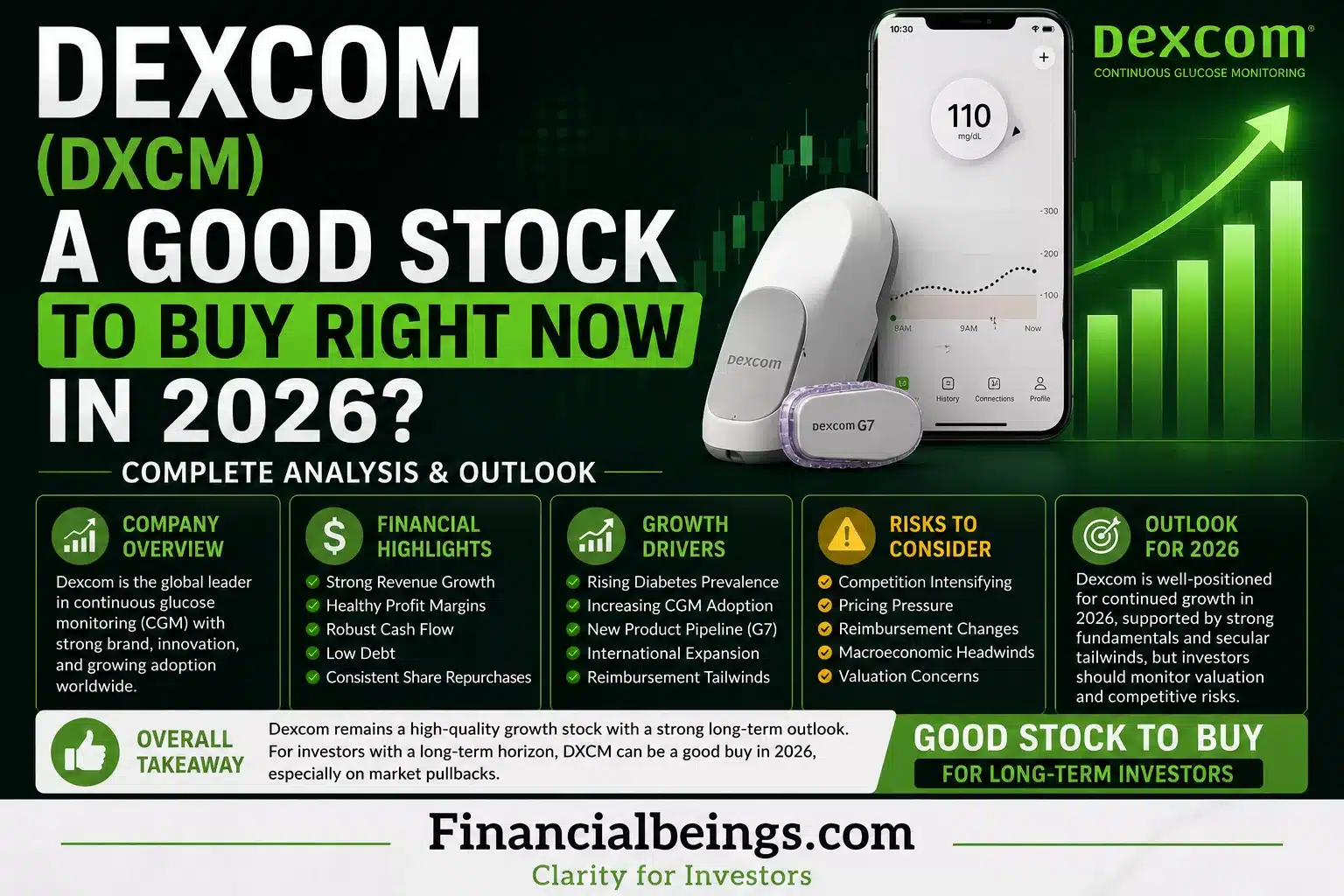
The company nearly tripled its revenue, but Dexcom (NASDAQ: DXCM) is trading around $66.95 as of May 2026, approximately unchanged over the past five years. This disconnect between impressive business growth and flat stock performance has left many investors asking: Is Dexcom (DXCM) a good stock to buy right now?
So, at FinancialBeings, we looked at the deep residual-income (ReOI) valuation at a 10% hurdle rate which we did to answer that question with real numbers and not just headlines.
Dexcom is a high-quality growth company fairly priced at current levels. The market is looking for about 5.17% year-over-year profit growth. If it does grow faster than that it appears that it has the ability to do that then the stock is cheap. If the growth is disappointing, it’s not. Best suited for patient investors who can hold for 5+ years.
Price: $66.95 | Market Cap: ~$25.8B | FY2025 Revenue: $4.66B (+16%) | Rating: Hold / Accumulate sub-$60
What is Dexcom? Company Overview
Dexcom is a company that provides Continuous Glucose Monitors (CGMs) a small wearable sensor that tracks blood sugar levels continuously instead of having to prick a finger every few hours. This technology is life changing for a diabetic patient.
The market is large, and it’s growing. There are more than 500 million people who have diabetes worldwide, and the transition from an old, glucose meter-based approach to a new, CGM-based approach is in its early days, particularly for people with Type 2 diabetes.
Main Products
- Their flagship CGM, G7, is popular for its accuracy and comfort and is worn for 10 days. Main source of revenue for Type 1 and Type 2 diabetes patients.
- Stelo is an OTC CGM that debuted in 2024 for non-insulin Type 2s. This is the big new growth avenue.
- New product expansion to greater patient population and international markets. Dexcom Flex is coming soon to new patient groups and new markets.
The key factor behind Dexcom’s financial success is its business model: sensors are worn every 10 days, generating recurring revenue. This razor-and-blade model has a Return on Net Operating Assets (RNOA) of 44 percent, which is one of the highest efficiency numbers known to few medtech firms.
Takeaway: Dexcom is a pure play leader in the CGM space that has a recurring revenue model and a vast and largely unpenetrated market across the globe. Revenue scaled from $1.93B (2020) to $4.66B (2025), 2.4× in five years.
Current Financial Performance (2023–2026)
The financial story of Dexcom is one of solid revenue growth, a short period when it was losing money in 2023-2024 & a significant turnaround in 2025. Business is back on track.
| Metric | 2023 | 2024 | 2025 | 2026E (Fwd) |
| Revenue ($B) | $3.62 | $4.03 | $4.66 | ~$5.2 |
| Revenue Growth | +24% | +11% | +16% | ~+12% |
| Net Income ($B) | $0.54 | $0.58 | $0.84 | — |
| Diluted EPS ($) | $1.40 | $1.50 | $2.14 | $2.59E |
| ROE (%) | 26.2% | 27.4% | 30.5% | 33.7% |
| RNOA (%) | 34.8% | 30.4% | 44.2% | — |
Net income increased by 45% to $0.84B in 2025; RNOA returned to 44% and the company has excess cash to operate the business. The forward P/E sits at ~26× on 2026 EPS of $2.59, and ~22× on 2027 EPS of $3.05.
The stock is up by just about 4% over the last five years, despite revenue growing nearly threefold. The stock has essentially remained flat over the past five years, trading around $67 per share today, up from $60 in early 2020. That de-rating is the basis for the long-term bull case; the business has reached a more reasonable valuation.
Analyst Ratings & Price Targets
Companies continue to have a positive outlook on Dexcom overall. The “Moderate Buy” with the average 12-month price target in the vicinity of $82 representing a +23% upside from current levels.
| Rating Summary | Low Target | Average Target | High Target |
| Consensus: Moderate Buy | ~$55 | ~$82 | ~$110 |
| Implied Upside (from $66.95) | — | ~+23% | — |
| Our ReOI Model (6% growth) | — | ~$80 | — |
Interestingly, our internal ReOI valuation at a 10% hurdle rate comes out to a very similar bull case number: ~$80 per share for 6% durable growth. The ~$82 is a fairly steady and believable read, as it represents an ~6.2% increase.
Bull Case: Why Dexcom Stock Can Go Up
The bull case for Dexcom is a convexity story: If the 5.17% growth projected by the market doesn’t materialize, the value extends disproportionately higher with each point of growth.
- 6% growth → fair value ~$80 (+20% from today)
- 7% growth → fair value ~$105 (+57%)
- 8% growth → fair value ~$154 (+130%)
There are several real catalysts for the bull case, besides the numbers:
- Stelo OTC launch opens up a huge market for Type 2 which is estimated to be 4 times the market served by Dexcom historically served in Type 1. This is the No. 1 growth driver.
- Dexcom is now being introduced in Europe and Germany is one of the countries where it is a primary early market. Approval to settle new markets opens up step-function revenue growth through insurance reimbursements.
- Dexcom net cash balance sheet is ample to support a ~$1B repurchase program. Share buyback decreases the number of shares and increases earnings per share, and it indicates management confidence.
- At 44% RNOA, for every dollar that Dexcom invests in new CGM opportunities, it returns well in excess of the cost of capital, and the compounding nature of the mathematics is in shareholders’ favour.
Bull case is very real, but convex. Dexcom needs to continue growing revenues by more than 5%. International expansion and a funded buyback are there with Stelo. But you are not paid to wait, you’re paid to be right on growth.
Bear Case & Risks – Why Dexcom Could Disappoint
There are no riskless investments. Based on our analysis, here are some important reasons why Dexcom may underperform:
- Abbott’s FreeStyle Libre is Dexcom’s primary competitor, with the #1 global share of CGM devices. The main worry of the bear case is margin pressure due to this competition. Abbott’s scale and lower price drive Dexcom to be priced higher.
- If GDP growth is 4%, Dexcom is valued at only ~$56, which is 16% less than the current price. Current stock price is only warranted with a revenue ‘floor’ of ~$5.2B in 2026. Possible, but not certain.
- In our model, approximately 48% of the margin/asset-turnover scenarios are ‘Above Range- Not Feasible’. The advantage is that Dexcom has premium margins combined with high capital efficiency. The more the margins are compressed, the more difficult it will be to do the math.
- RNOA fell from 81% in 2022 to 30% in 2024 before recovering to 44% in 2025. The series of residual income has fluctuated a bit in the four quarters. The market has already anticipated more than Dexcom has provided over the past six years (2019-2024).
- Changes to the CGM reimbursement rules (both on the insurer and government side) will have a direct effect on demand. GLP-1 weight loss medications are also being closely monitored as an alternative to be used to lower the need for CGM if they manage blood sugar well.
Financial Beings Valuation Lens
Valuation – Is Dexcom Stock Cheap or Expensive?
FinancialBeings‘ approach is the reverse-DCF residual-income (ReOI) method using a 10% hurdle rate. Rather than throwing out a guess at a price target, we ask, what rate of growth is necessary to warrant the price? The answer: 5.17% operating profit growth for the foreseeable future.
In the table below, you can see what Dexcom is worth at each growth rate from 2% to 7%, as calculated by our ReOI model. The row that is highlighted indicates where the price is today:
If you want to understand how growth stocks are evaluated and what growth expectations mean for valuation, read our guide on What are growth stocks & how to find the growth rate of a stock.
| Growth (%) | Model Value ($B) | Model Price/Share | Model Value % |
|---|
Model Value % > 100% = The model value exceeds the current market cap under the stated assumptions. Model Value % < 100% = The current market cap is above the model value under the stated assumptions. Model Value % = 100% = The model value matches the current market cap at the assumed growth rate.
At 2% growth, DXCM’s model value reaches a Model Value % of 61.5% relative to current market cap. At 5% growth, the model reaches a Model Value % of 92.4%, and at 7% growth the model reaches 147.3% of current market cap.
The breakeven growth rate is approximately 5.4%. That is the long-term growth assumption where the model value lines up with a company currently valued at about $27.6B, showing what the market appears to require from DexCom’s continuous glucose monitoring (CGM) franchise, sensor pipeline, and international expansion ambitions.
Note: Under the 10% hurdle rate scenario set, DXCM crosses 100% Model Value near 5.4% growth and reaches 147.3% at 7% growth. The sensitivity uses a ~23.4% sustainable RNOA basis (5-year median), so the current market cap is crossed inside the tested range.
| Growth Assumed (r = 10%) | Fair Value / Share | Value / Price | Upside / (Downside) vs $66.95 |
| 2% (deep bear) | $43.92 | 65.6% | −34.4% |
| 3% (bear) | $49.17 | 73.4% | −26.6% |
| 4% (GDP anchor / bear) | $56.03 | 83.7% | −16.3% |
| 5% ≈ market-implied (5.17%) | $65.81 | 98.3% | −1.7% |
| 6% (bull) | $80.49 | 120.2% | +20.2% |
| 7% (strong bull) | $104.95 | 156.8% | +56.8% |
The price ladder: $43.92 (2% deep bear), $56.03 (4% GDP anchor), $65.81 (5%, market-implied), $80.49 (6% bull), $104.95 (7% strong bull). Today’s price of $66.95 consists of $36.58 (no-growth) and $30.37 (speculative premium) above GDP growth.
Dexcom isn’t really cheap or expensive. The share price is trading for a ~5.17% profit growth. On top of that, it’s a great deal. You are paying a reasonable price for a good business with a forward P/E of ~26.
Dexcom vs Abbott Comparison
Currently, the two biggest CGM companies in the world are Dexcom and Abbott (ABT = FreeStyle Libre). These are some comparisons that you can make with them as an investment:
| Metric | Dexcom (DXCM) | Abbott (ABT) | Edge | Notes |
| Focus | Pure-play CGM | Diversified medtech | DXCM | Dexcom = all-in on CGM |
| Fwd P/E | ~26× | ~22× | ABT | ABT cheaper, lower growth |
| Revenue Growth | ~12–16% | ~5–7% | DXCM | Dexcom growing faster |
| RNOA | 44% | ~12–15% | DXCM | Capital efficiency edge |
| Balance Sheet | Net cash | Moderate debt | DXCM | Lower financial risk |
| CGM Market Share | #1 (USA) | #1 globally | Tied | Abbott leads globally |
A question of preference for the investor remains whether he chooses one or the other. Abbott is more diversified (outside of CGM, diagnostics and medical devices), and has a lower valuation multiple. Dexcom is a pure play on growth in CGM with much higher capital efficiency and quicker revenue growth at a premium multiple.
Dexcom (DXCM) – Full Pros & Cons Summary
| Bull Case (Reasons to Buy) | Bear Case (Reasons to Wait) |
| 44% RNOA — elite capital efficiency | RNOA down from 81% (2022) peak |
| Revenue 2.4× in 5 years ($1.93B → $4.66B) | ~48% of margin scenarios ‘Above Range’ |
| Net-cash balance sheet; $1B buyback funded | Uneven quarterly earnings; ReOI choppy |
| +20% upside at 6% growth; +57% at 7% | Bear case: −16% at 4% (GDP-anchor) growth |
| Stelo OTC + international expansion (Germany) | Abbott FreeStyle Libre pressure on margins |
| Type 2 diabetes wave — huge addressable market | Healthcare policy / reimbursement risk |
Technical View (Short-Term Chart Levels)
Dexcom is in the middle of a good chart level for investors who are paying attention to chart levels. The following levels are significant:
- Support: ~$58–$60 tested October 2025 and April 2026. It is a fundamentally important support as it is in the 4% growth fair value (~$56).
- Resistance: ~$73 the January–February 2026 highs. Any trend above this would indicate better momentum.
- Current price ($66.95): mid-range, no strong technical trend that needs to be addressed.
Note: Technical analysis is a short-term tool. The bottom line is that our basic belief is the accumulation zone of the $58 – $60 range for longer term investors.
Investors focused on fair value and long-term value investing can also explore our breakdown of What are value stocks & how fair value investing works.
Who Should Buy Dexcom? How to Invest
Dexcom is ideal for:
- Seasoned investors who have 5+ year horizons and are convinced that CGM adoption will remain on the rise across the world.
- Investors who do not mind seeing some volatility. DXCM has ranged from ~$58 to ~$150 in its five-year history.
- Portfolios that can accommodate it as a growth satellite (5 – 10% of diversified holdings), rather than a core holding.
Our Recommended Approach:
- Now (~$67): a small position captures the upside and franchise without getting too much of an inkling about the soft valuation signal.
- The price’s margin of safety (MoS) is 4% at $56-$60, which is a great deal, according to our ReOI model.
- Make sure that you do not configure the price above ~$78: on a non-monotonic signal quality model.
- Purchase DXCM from any major brokerage firm, such as Fidelity, Charles Schwab, Interactive Brokers or Robinhood. If you’re looking to get started, search for commission-free trading and fractional shares.
Long-term investors looking for durable businesses may also like our article on The best stocks to buy and hold for big profits
Conclusion & Final Recommendation
Dexcom is a great, capital efficient business in one of the most interesting growth segments in healthcare this decade. The balance sheet is balanced, the recurring-revenue model is solid and the long-term potential of CGM is huge.
Dexcom remains one of the more interesting healthcare growth businesses today alongside several other major companies discussed in our list of Best large healthcare companies.
Quality is not always a good buy. The price of $66.95 is a fair price, and not a bargain. The ReOI model at the 10% hurdle tells us that the stock is about fairly priced at ~5.17% growth. That’s a growth rate that’s possible for Dexcom, but not guaranteed.
FinancialBeings Verdict = Hold / Starter Weight at current prices. If you’re looking for a great entry, add up on dips and get $56-$60. It’s not a quick grab.
The takeaway of Dexcom is that it’s a good quality brand that commands a reasonable price. Those patients enough to invest with conviction in the CGM growth narrative will hopefully be rewarded over 5+ years. Properly value investing around $58-$60 gives you margin of safety.
Frequently Asked Questions (FAQs)
What is the Dexcom (DXCM) stock price target for 2026?
The range of analysts’ consensus price target is around $82, which represents about 23% upside from the current ~$67. Internal ReOI model for Dexcom, which values the company at ~$80 assuming an 8% growth rate, which is pretty comparable to the Street’s valuation.
Will Dexcom stock go up?
Analysts are overwhelmingly bullish on DexCom (NASDAQ:DXCM), expecting a price increase in the stock. The consensus data indicates a rating of “Strong Buy” with an average $79 to $82 target for the 12-month period, putting the shares at around 15% to 30% over their current trade prices.
For investors researching high-upside growth opportunities, see our list of Best stocks to buy for long-term growth.
Is DXCM stock overvalued?
Dexcom is trading at about fair value given the community consensus that the price is neither cheap nor too expensive, at ~26× forward earnings. It is only undervalued when growth slows down to ~5% or less per year. A 4% growth results in a fair value of ~$56, which is a 16% decline from the current prices.
Should beginners buy Dexcom stock?
A stock to watch for medical device investors and a good long-term growth opportunity for the more advanced investor, but there are high stock-specific risks and industry volatility to be noted for the beginner investor. Beginners are best advised to invest in a small percentage (1-3% of the portfolio) and to commit to a time horizon of 5 years or more.
If you’re new to investing, our beginner guide, Stock Investment for Dummies, explains portfolio sizing, risk, and long-term investing principles.
What is the next DXCM earnings date?
Dexcom recently released its Q1 2026 earnings (EPS: $0.51). The Q2 2026 data is predicted in late July/August 2026.
Is Dexcom better than Abbott’s FreeStyle Libre?
Dexcom is the pure-play CGM play with the greatest growth and capital efficiency, as an investment. Abbott is more diversified and has a lower valuation. There is no definite “better” one, it depends on your risk-taking appetite and growth belief.
What is the bear case for DXCM?
The bear side is straightforward: if Dexcom’s profit growth slows down to the GDP level (~4%), the stock trades at ~$56, which is about 16% under the current price. Add in potential margin compression at Abbott and the risk of GLP-1 substitution and downside is the reality.
Where can I buy DXCM stock?
On your major US brokerage (Fidelity, Charles Schwab, TD Ameritrade, Interactive Brokers, or Robinhood). DXCM is a NASDAQ listed company. Most platforms don’t charge any trading fees.
📚 References
- Dexcom, Inc. (2026). Q1 2026 earnings release and investor presentation. Dexcom Investor Relations. Link
- Dexcom, Inc. (2025). Annual report 2025 (Form 10-K). U.S. Securities and Exchange Commission. Link
- MarketBeat. (2026). DXCM analyst ratings and price targets. Link
- Yahoo Finance. (2026). DexCom, Inc. (DXCM) stock price, news, quote & history. Link
- Zacks Investment Research. (2026). DXCM earnings estimates and EPS consensus. Link